
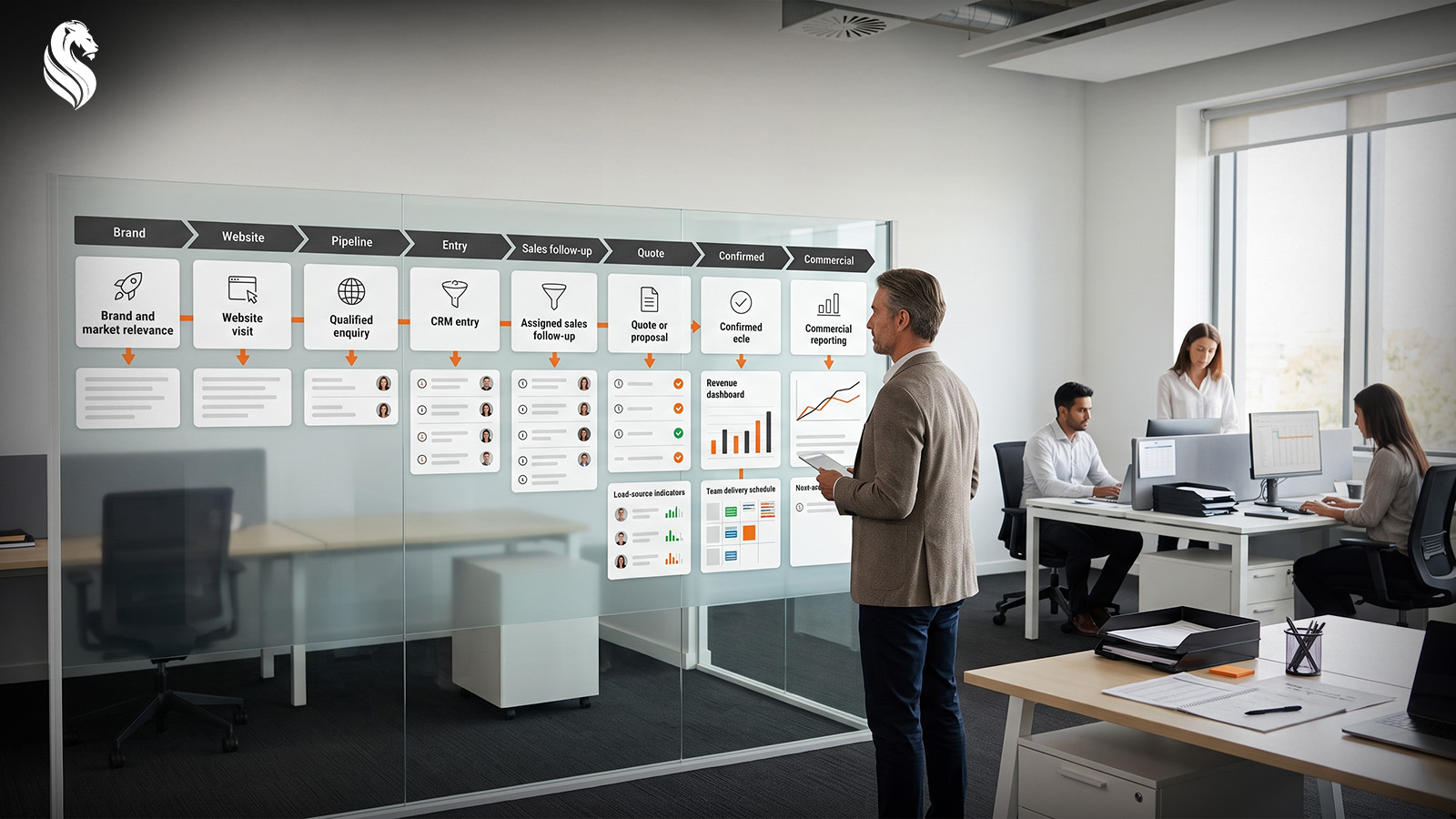
How a Connected Growth System Creates Predictable Growth
A growth system framework gives owners a clear view of how brand, website, sales, CRM and reporting work together to produce revenue. Without that connection, a business can generate attention and enquiries while still losing opportunities through weak positioning, slow follow-up, unclear sales processes and reporting that does not explain what is creating commercial value.
This is a common problem in established, owner-led businesses. The company may have a capable team, a recognised name and several marketing tools in place, yet growth still feels inconsistent and too dependent on the owner.
The individual tools may appear to be working. The website receives traffic, campaigns create leads, the CRM contains contacts, and reports show activity. Yet when these tools operate separately, the owner cannot clearly see how attention becomes an enquiry, how an enquiry becomes a sale or where commercial value is being lost.
Reviewing the foundations, connecting the customer journey and measuring the path from first impression to completed sale can help make growth more predictable. These connections improve visibility and follow-up, while results also depend on market demand, delivery capacity, and the profitability of the work won.
Why More Marketing Activity Does Not Always Create Growth

When leads slow down, or revenue becomes unpredictable, the natural response is often to increase marketing activity. The business invests in more advertising, publishes more content, changes its website or introduces another software platform.
These actions may increase visibility, but visibility alone does not guarantee commercial progress.
A campaign can generate enquiries that are poorly matched to the business. A website can attract traffic without creating enough trust. A CRM can store contacts without ensuring anyone follows up with them. A report can show clicks and impressions without showing whether the business won profitable work.
More activity cannot compensate for a disconnected system.
This is why growth problems must be diagnosed before the business attempts to scale. The first question should not be how to generate more traffic. It should be where the current journey is breaking down.
Possible problems may include:
- The market does not understand the offer.
- The website does not guide the right visitors towards action.
- Lead capture forms collect too little useful information.
- Sales follow-up is inconsistent.
- Quotes are not tracked.
- CRM records are incomplete.
- Reporting stops at marketing metrics.
- The owner cannot see where opportunities are being lost.
Increasing spend before fixing these problems usually makes the inefficiency more expensive.
What a Growth System Framework Actually Does
A growth system framework connects the main commercial parts of the business so they support one another. It creates a visible path from market positioning through to revenue, retention and future growth decisions.
The system should answer five practical questions.
- Does the brand attract the right type of customer?
- Does the website move that customer towards a useful next step?
- Does the sales process protect the opportunity after the enquiry?
- Does the CRM create consistent follow-up and accountability?
- Does reporting connect activity to commercial outcomes?
Each component has a different role, but none should operate in isolation.
The brand creates relevance and trust. The website translates that position into a customer journey. The sales process converts interest into a commercial opportunity. The CRM ensures the opportunity is managed properly. Reporting shows where the system is working and where it needs attention.
Together, these parts create a system the owner can understand, improve, and eventually scale.
Build the Foundation Before You Scale
A growth system should be built in the right sequence.
Wandering Lion uses a simple principle.
Foundation First. Build Properly. Scale Predictably.
The foundation stage reviews the brand, website, customer journey, sales process, lead capture, CRM, automation and reporting. This creates a clear diagnosis of what is slowing growth down.
The build stage improves the parts that are weak or disconnected. This may include clearer positioning, better landing pages, stronger forms, defined sales stages, automated follow-up and more useful reporting.
The scale stage increases traffic and demand through paid advertising, SEO, AEO, content, partnerships, outreach, referrals and retargeting. This happens after the system is ready to convert and measure the opportunity.
This sequence protects the business from scaling confusion.
Ads can increase the number of people entering the system, but they cannot repair unclear positioning, weak trust, poor follow-up or incomplete reporting. Ads amplify clarity. They do not create it.
Brand Positioning Creates Relevance
Brand is not limited to a logo, colour palette or visual style. In a growth system, brand positioning helps the right customer quickly understand who the business serves, what problem it solves and why it is a credible choice.
Weak positioning creates friction at every later stage.
A visitor who does not understand the offer is less likely to remain on the website. A lead who does not understand the value may focus mainly on price. A salesperson working with unclear messaging may explain the business differently in every conversation.
Clear positioning gives the website, sales team and marketing activity one commercially relevant message to carry through the customer journey.
Questions the Brand Must Answer
The brand should make several points clear.
- Who is the business best equipped to help
- What commercial problem does it solve
- What makes its approach different
- What evidence supports its claims
- What should the right customer do next
For an established trade business, stronger positioning may mean moving away from broad claims about quality and reliability. The business may instead focus on the type of projects it handles best, the problems it prevents and the experience customers receive throughout the job.
For a professional consultancy, positioning may need to communicate authority before the first conversation. The website, case studies and service language should help prospective clients understand the firm’s expertise, process and ability to manage risk.
Clear positioning reduces the amount of explanation required later. It helps the website, sales team and marketing activity work more efficiently.
The Website Guides the Customer Journey
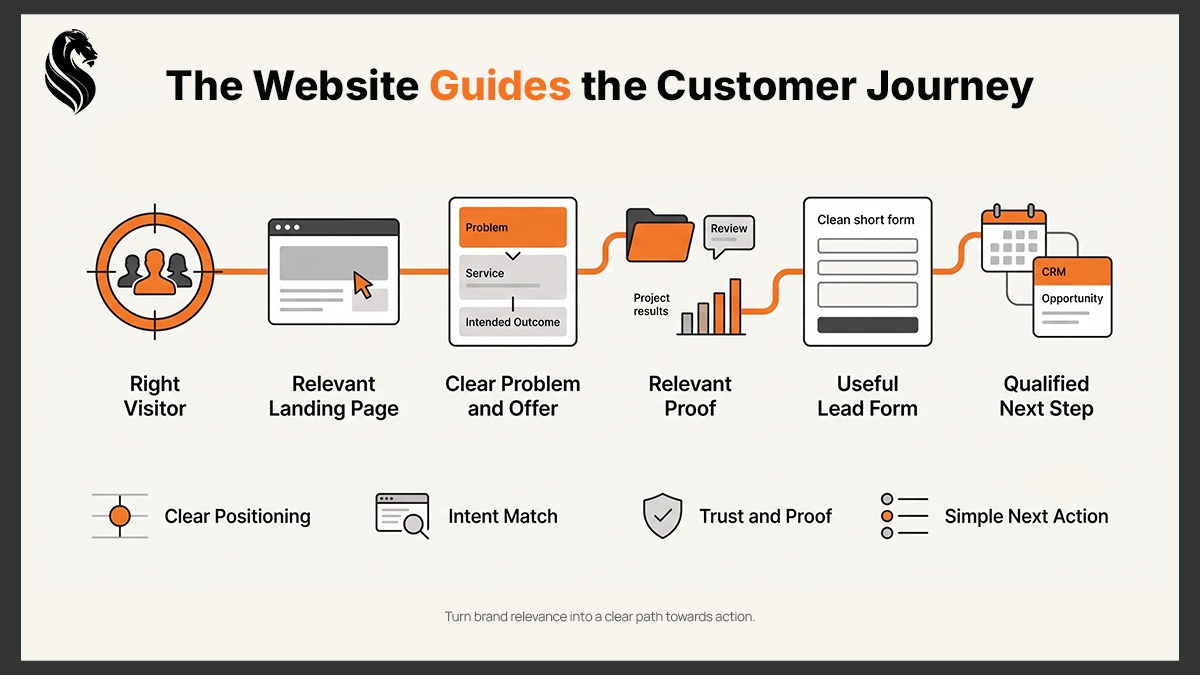
Once the brand position is clear, the website must turn that message into a practical route for the customer.
The website is where positioning becomes practical. It should help a visitor recognise their problem, understand the business’s approach, review relevant proof and take an appropriate next step.
Many websites fail because they are treated as digital brochures. They describe the company but do not guide the customer.
A strong website structure reflects how different customers think and what they need to see before making contact.
Build Pages Around Customer Intent
Different visitors may arrive with different priorities. A trade business owner may want better-fit enquiries and less administrative work. A land surveyor may need stronger authority and higher-value projects. An established B2B company may need a more predictable sales pipeline.
Sending every visitor to the same general page can weaken relevance.
Segment-specific landing pages allow the business to address:
- The customer’s industry or business type
- The commercial problem they are experiencing
- The service that fits their situation
- The proof most relevant to them
- The next step they should take
Lead capture should also support the customer journey. A useful form collects enough information to make the next conversation productive while reducing unnecessary administration for both the prospect and the internal team.
The goal is not to collect the largest possible number of leads. The goal is to create a clear and efficient path for the right opportunities.
Sales Processes Protect Conversion
Many businesses focus heavily on generating enquiries but pay less attention to what happens after the enquiry.
This is where significant commercial value can be lost.
A lead may wait too long for a response. A salesperson may make one call and never follow up. A quote may be sent without a scheduled next step. A potential customer may disappear simply because no one owns the opportunity.
In these situations, the marketing may have created a valid opportunity, but the process after the enquiry has failed to protect it.
Review the Journey From Enquiry to Sale
A connected sales process should define:
- Who receives each lead.
- How quickly the first response should happen.
- What information must be recorded.
- How many follow-up attempts should be made.
- When a quote should be sent.
- How quotes are tracked.
- When an opportunity is considered lost.
- How the reason for the loss is recorded.
Imagine a building services company generating 30 enquiries each month. Ten are unsuitable, eight are still awaiting qualification, and twelve become qualified opportunities. Of those twelve, eight receive quotes: four become customers, two decline and two are still deciding. The other four qualified opportunities are awaiting further information before a quote can be prepared.
Without a defined process, the owner may only see the total enquiry number and final sales figure.
A connected system shows what happened to every opportunity. It may reveal that qualified leads are being contacted too slowly or that quotes are not receiving a structured follow-up.
That insight gives the business a specific problem to solve.
The CRM Controls Follow-Up and Accountability
A customer relationship management system, commonly called a CRM, should be more than a database of names and email addresses. It should support and enforce the agreed process for moving leads through the sales journey.
The CRM creates a shared record of each opportunity. It shows who is responsible, what has happened, what needs to happen next and where the lead currently sits.
Without CRM discipline, valuable information often remains in inboxes, spreadsheets, mobile phones and individual team members’ memories.
What the CRM Should Make Visible
A useful CRM setup should allow the business to see:
- The source of each lead
- The customer’s main need
- The value of the opportunity
- The current sales stage
- The most recent contact
- The next required action
- The quote status
- The outcome
- The reason an opportunity was lost
Automation can reduce manual work by assigning leads, creating reminders, sending confirmation messages and prompting follow-up. However, automation should support a clear process rather than cover up a weak one.
Software does not create discipline by itself. The business still needs agreed stages, responsibilities and standards.
Reporting Shows What Produces Commercial Value
Reporting should help the owner make better decisions. It should not simply list the activities completed during the month.
Clicks, reach, impressions, and website sessions can provide useful context, but they don't explain the full commercial picture.
A connected report follows performance through the entire system.
Lead performance should show:
- Which channels generated enquiries.
- Which enquiries were properly qualified.
- Which customer types produced the strongest opportunities.
Sales performance should show:
- How quickly leads were contacted.
- How many opportunities received quotes.
- How many quotes became sales.
- Where opportunities were lost.
Commercial performance should show:
- What revenue was influenced.
- Which work was most profitable or commercially valuable.
- What should be changed next.
This turns reporting into a management tool rather than a marketing summary.
For example, one campaign may generate fewer leads than another but produce more profitable projects. Another campaign may create strong enquiry volume but attract poor-fit customers who take time away from the team.
Lead volume alone would make the second campaign appear stronger. Commercial reporting shows which campaign is actually helping the business grow.
Reporting Must Explain What Happens Next
Useful reporting should answer four questions.
What happened? The report outlines the most important activity and results.
What changed? It explains improvements, declines and meaningful patterns.
What needs attention? It identifies bottlenecks, risks and gaps in the journey.
What happens next? It recommends the next action and explains the commercial reason behind it.
This gives the owner clarity without forcing them to interpret disconnected dashboards.
How to Review Your Current Growth System
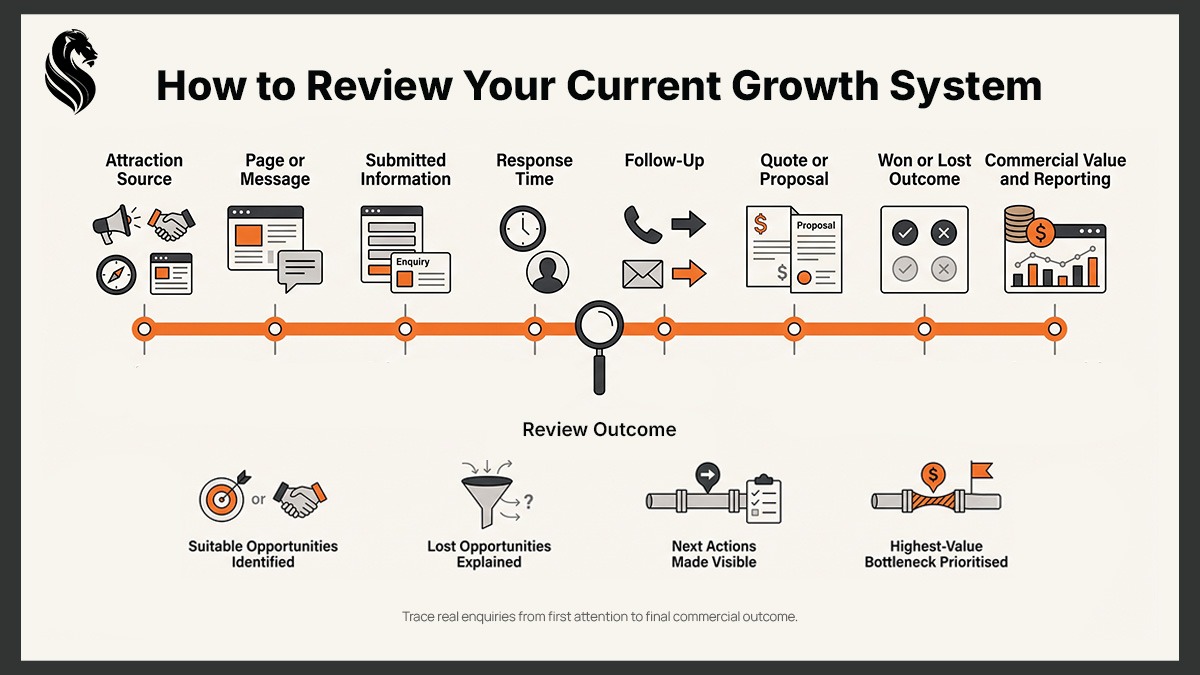
Owners do not need to replace every tool immediately. The first step is to understand how the existing parts connect.
Start by reviewing one recent group of enquiries from beginning to end.
Ask:
- What attracted each customer?
- Which page or message did they see?
- What information did they submit?
- How quickly did the business respond?
- What happened during follow-up?
- Was a quote sent?
- Was the opportunity won or lost?
- What was the final commercial value?
- Did the outcome appear in reporting?
This review often exposes gaps that are difficult to see when each platform is assessed separately.
The website may be producing suitable enquiries, but the sales process may be losing them. The sales team may be performing well, but the brand may be attracting too many poor-fit prospects. The CRM may contain the data, but reporting may not turn it into useful decisions.
Record the findings in one shared view that shows each enquiry, its source, its current stage, the next required action and its final commercial outcome. This turns the review into a practical improvement plan rather than a one-off observation.
The purpose of the review is not to assign blame. It is to make the system visible.
Connected Systems Support More Predictable Growth
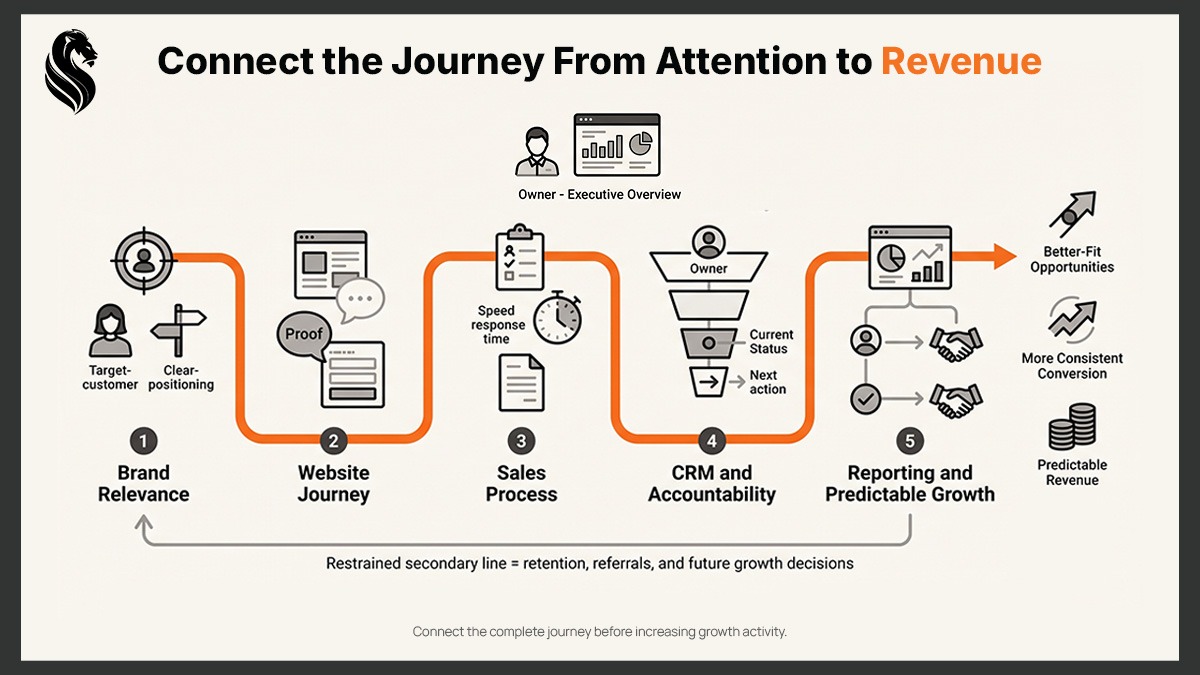
Connecting brand, website, sales, CRM and reporting gives the business a clearer view of how customers move from first contact to a buying decision. That visibility helps the team address missed opportunities and plan growth with greater confidence.
When the full journey is visible, the business can identify where suitable opportunities are being lost, improve the process and invest with greater confidence.
The owner gains more than better marketing performance. The business gains clearer decisions, stronger follow-up, reduced wasted spend and less reliance on the owner to hold everything together.
The path to scale begins with the foundation. Review the system, build the missing connections and measure the full journey before increasing activity.
Review the System Before Adding More Activity
Wandering Lion helps growth-focused owners identify where brand, website, sales, CRM and reporting have become disconnected. We review the foundations, map the customer journey and build the systems required to bring in the right work with greater clarity and less owner dependency.
Request a Growth Audit to identify where suitable opportunities are being lost, which foundations need attention and what should be built before the business invests in additional growth activity.
FAQs
How long does it take to build a connected growth system?
The timeline depends on the number of tools, team members and customer journeys involved. A focused review can identify the main bottlenecks quickly, while implementation may happen in stages based on commercial priority.
Implementation usually takes longer when the business has several disconnected platforms, incomplete data, unclear ownership, multiple sales journeys or no agreed process for follow-up and reporting. The priority is to resolve the highest-value bottlenecks first rather than attempt to rebuild every component at once.
The most important factor is not speed. It is building each part in the right order so later activity is supported by a reliable foundation.
Does a business need expensive software to use this framework?
No. A connected system can often be built using the tools the business already has.
The customer journey, sales stages, ownership rules and reporting requirements should be defined before new software is selected. Technology should support the agreed process rather than determine how the business manages its customers.
Who should own the growth system inside the business?
Responsibility may be shared across marketing, sales and operations, but one person should have oversight of the complete journey.
The accountable owner should have visibility across all three functions and enough authority to resolve gaps between lead generation, sales follow-up and operational delivery.
This person does not need to manage every task. They need to ensure information moves between teams, follow-up standards are maintained, and reporting reflects real commercial outcomes.

Predictable Growth Comes From a Connected Commercial System
Established businesses often have the right tools but lack a clear system connecting brand, website, sales, CRM and reporting. This creates missed opportunities, inconsistent follow-up and limited visibility into revenue, so the foundations must be reviewed and connected before the business increases marketing activity.

Predictable Growth Requires One Connected System
More channels and software will not create predictable growth when the customer journey, sales process and reporting remain disconnected. The business must diagnose the bottlenecks, connect each commercial component and build the foundations properly before scaling demand.
Diagnose the Bottleneck Before Adding Activity
More traffic cannot repair unclear positioning, weak website journeys, inconsistent follow-up or incomplete reporting. The priority is identifying where suitable opportunities are being lost.
Connect Every Commercial Component
Brand positioning creates relevance, the website guides the customer journey, sales protects conversion, the CRM controls follow-up, and reporting shows what produces commercial value. These components must operate as one measurable growth system rather than as separate tools.
Protect Follow-Up and Accountability
A CRM should do more than store contact details. It should make lead ownership, sales stages, next actions, quote status and outcomes visible so opportunities do not depend on individual memory or manual administration.
Build the Foundation Before You Scale
The correct sequence is Foundation First, Build Properly, Scale Predictably. Advertising and other growth channels should only be increased after positioning, customer journeys, sales follow-up, CRM discipline and commercial reporting are ready to support them.

Review the System Before Adding More Activity
Before investing in more campaigns, review how your brand, website, sales process, CRM and reporting work together from first contact through to completed sale. A Wandering Lion Growth Audit identifies the bottlenecks limiting conversion, creates a clear foundation-first roadmap and helps build the system that brings in the right work with less owner dependency.
KEEP READING
Explore more






FEEDBACK FROM THE FIELD
No polished scripts. Just the raw operational reality from owners who cleaned up their pipelines and got out of the daily administrative loop.
“When we set out to grow Discmania in the US market, Ryan was a key part of laying that foundation. He helped us cut through the noise & restructured how we told the story of each release, aligning our athlete partnerships with the brand, and building the kind of community touchpoints that turned buyers into fans. The results spoke for themselves. I’d work with him again without hesitation.”



“In 2019, Ryan from Wandering Lion helped transform the Kalamunda Eastern Suns’ presence in the community. He lifted our social profile, drove some of the strongest brand engagement in the league, and helped turn sparse crowds into sellouts. His work also strengthened sponsor interest and raised the overall profile of the club in a way that felt polished, professional, and genuine.”

“Young people who had switched off from school were not going to reconnect because of a campaign headline or a polished message. They needed a genuine reason to turn up again. Wandering Lion brought a strong sense of care to how the story was told. That gave the foundation a clearer public identity.”





“Working with Wandering Lion on the Discmania project was a standout experience. The team’s position work, blended creative vision with strategic execution, was a major asset as we built the Discmania brand globally. The work he produced didn’t just look great. It elevated our brand presence and supported measurable growth across multiple markets.”




“Wandering Lion understood from the outset that the Pacific Hockey League could not simply be another competition with a new name. Their work helped shape a player-first league with the right balance of ambition, fairness, and professionalism. What they brought was not just branding or communication, but real strategic thinking that gave the PHL a stronger and more credible foundation.”

“Authenticity is the centrepiece of all Lajosi Putter customisation works. The brand is reflected in each of our hand-made custom putters. Ryan’s team solidified that identity in our online presence. It led to higher social media engagement from a golfing community who value hand-crafted putters over overly polished ones.”

‹
›
READY TO FIX YOUR GROWTH?
Stop guessing. Get clarity on what's actually slowing your business down.
