
Growth Should Give the Owner Time Back
Growth should reduce owner workload, not quietly create another full-time job for the person already carrying the business. Yet many owners find that every increase in leads, customers, staff, or revenue brings more decisions, more follow-up, and more problems that eventually land back on their desk.
The business may look healthier from the outside. Revenue is rising. Enquiries are coming in. More work is being delivered. Behind the scenes, the owner is still approving every quote, checking every lead, answering team questions, chasing suppliers, reviewing campaigns, and trying to understand what is actually producing results.
That is not scalable growth. It is increased activity held together by owner effort.
A proper growth system should help the business generate more of the right revenue while reducing its reliance on the owner for routine work over time. Building that system may initially require additional owner involvement to document processes, clarify responsibilities, and support the team. The aim is for that investment to return time as the system becomes established. Diagnose the foundation first, build the connected system properly, and scale when the business can handle more demand without routinely sending the workload back to the owner.
Growth Is Not Working If the Owner Becomes the System

Many businesses grow through effort before they grow through structure. The owner remembers which leads need follow-up, which customers require special handling, which services are profitable, and which opportunities need immediate attention.
This knowledge may help the business survive its early stages. It becomes a constraint once the company starts expanding.
When information, decisions, and relationships continue flowing through one person, the owner becomes the connection between every part of the business. Marketing depends on their input. Sales depend on their follow-up. Operations depend on their approvals. Reporting depends on their interpretation.
The company has people, tools, and suppliers, but the owner is still acting as the operating system.
It can feel like the business has grown while personal freedom has moved in the opposite direction.
Why Workload Reduction Is a Commercial Growth Metric
Owner workload is often treated as a personal issue rather than a business performance issue.
That is a mistake.
When too much work depends on the owner, several commercial problems appear.
- Leads wait longer for a response
- Quotes are delayed or forgotten
- Customer communication becomes inconsistent
- Team members stop making independent decisions
- Marketing feedback arrives too late
- Reporting becomes reactive
- Opportunities are lost because nobody owns the next step
- Growth decisions are made using incomplete information
These issues affect revenue, conversion, customer experience, profitability, and capacity. They also make the business harder to scale because every increase in volume creates more pressure at the centre.
Consider a business where every quote still requires owner approval. Increasing enquiry volume from 20 to 40 leads per month may look like growth, but it can double the approval burden, slow response times, and increase the number of opportunities that go cold. More demand has entered the business, but the system has not created more capacity.
A company cannot become reliably scalable while its growth process still depends on the owner remembering, checking, and chasing everything.
Workload reduction should therefore be measured alongside lead quality, conversion rate, sales outcomes, cost per qualified lead, and revenue influenced.
Useful indicators may include the number of owner hours spent on administration, the percentage of leads requiring owner intervention, quote turnaround time, reporting preparation time, follow-up speed, and the number of decisions that can be made without escalation.
The business should establish a simple workload baseline before making changes. This creates a practical way to measure whether new systems are returning time to the owner rather than merely shifting tasks between people or platforms.
These measures reveal whether growth is creating leverage or simply creating more work.
More Leads Do Not Fix a Weak Business System
When growth slows, the immediate reaction is often to increase marketing activity.
The business may invest in paid ads, content, SEO, outreach, or another supplier. This can create a temporary lift in traffic and enquiries, but it does not automatically improve the system receiving those opportunities.
A weak customer journey will remain weak at a higher volume.
More leads entering a disconnected process can mean more manual qualification, more missed calls, more inconsistent follow-up, and more pressure on the owner to prevent opportunities from disappearing.
More activity cannot compensate for a system that is unclear before, during, or after the enquiry. This is why Wandering Lion works from a clear belief.
Ads amplify clarity. They do not create it.
If the positioning is unclear, the website lacks trust, the offer is difficult to understand, or the sales process is inconsistent, additional traffic can make inefficiency more expensive.
The answer is not always more activity. The answer may be a stronger foundation and a better-connected journey.
The Parts of the Business That Must Work Together
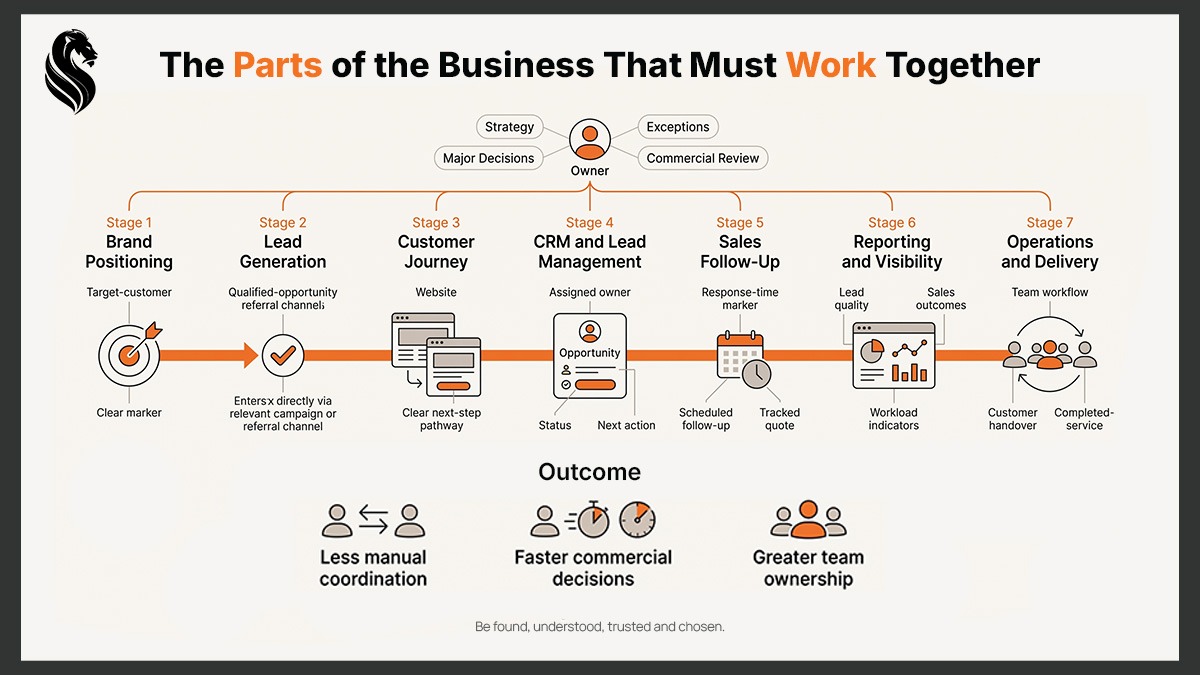
Reducing owner dependency requires more than installing one automation tool or hiring an assistant.
The full growth system must connect several commercial functions.
The Growth System at a Glance
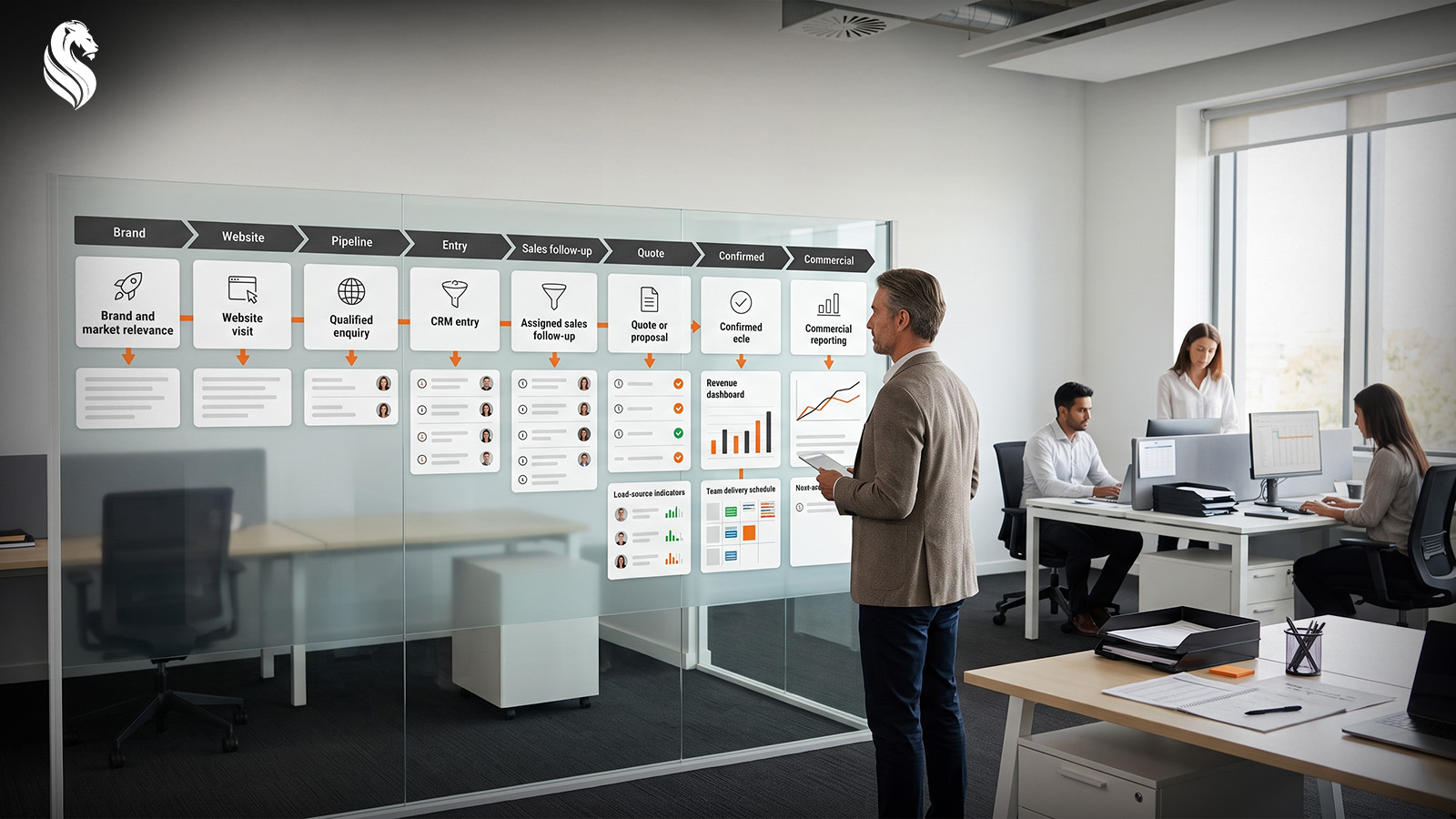
Clear positioning attracts the right audience. Relevant lead generation creates suitable opportunities. The customer journey moves those opportunities forward. CRM and follow-up provide ownership and visibility. Reporting supports decisions. Operations deliver the work without pulling the owner back into routine coordination.
If one part is disconnected, the owner often becomes the person responsible for closing the gap.
Brand Positioning
Clear positioning helps the right customers understand what the business does, who it serves, and why it is the right choice.
When the brand is unclear, the owner often becomes the person responsible for explaining the business repeatedly. They clarify the offer during sales calls, correct customer expectations, and step in when the team struggles to communicate value.
For example, if a prospective customer cannot distinguish between a specialist commercial service and a lower-cost general option, the owner may have to join every sales conversation to explain the difference. Clear positioning allows the website and sales process to do more of that work before the owner becomes involved.
Strong positioning removes some of this burden before the conversation begins. It gives the website, marketing, sales team, and customer communications a consistent message.
Lead Generation
Lead generation should bring in suitable opportunities rather than creating an unfiltered volume of enquiries.
Poor-fit leads create work. They require calls, emails, qualification, quoting, and follow-up even when there is little chance of a profitable sale.
A better lead generation system connects campaigns to clear offers, relevant audiences, specific landing pages, and meaningful qualification criteria.
Those criteria may include service need, project value, location, business stage, urgency, or readiness to proceed. The aim is to collect enough information to guide the next step without turning the form into more administration for the prospect or the team.
The objective is not simply to produce more leads. It is to generate more of the right work.
The Customer Journey
Every prospective customer follows a path from first contact to completed sale.
That path includes the page they visit, the form they complete, the response they receive, the sales conversation, the quote, the follow-up, and the final decision.
When this journey is unclear, the owner often fills the gaps manually.
They forward enquiries, remind staff to call prospects, rewrite proposals, explain delays, and check whether quotes were sent. Each gap becomes another task requiring their attention.
A clear journey might move an enquiry from a relevant landing page to a qualified form, an assigned CRM record, a scheduled sales call, a tracked quote, and a defined follow-up sequence. At each stage, the team knows who is responsible and what must happen next.
A defined customer journey gives every stage a purpose, an owner, and a clear next action.
CRM and Lead Management
A customer relationship management system should provide a single, visible record of leads, conversations, quotes, and sales progress.
Without that visibility, information becomes scattered across inboxes, notebooks, spreadsheets, messaging platforms, and individual memory.
The owner then has to ask basic questions.
- Who followed up on this enquiry?
- Was the quote sent?
- When was the last contact?
- Why did the opportunity go cold?
- Which campaign produced the sale?
A properly structured CRM allows the team to answer those questions without relying on the owner.
Sales Follow-Up
Many growth systems break after the enquiry arrives.
A business may generate strong leads and still lose revenue because response times are slow, responsibilities are unclear, or quotes are not followed up consistently.
Sales follow-up should define who receives each lead, how quickly contact should occur, what happens after the first conversation, how quotes are tracked, and when missed opportunities are reviewed.
For example, every qualified lead could be assigned to a named team member, acknowledged immediately, contacted within an agreed timeframe, and moved to a visible next stage after each interaction. Exceptions can then be escalated instead of every opportunity requiring owner oversight.
This stage matters because marketing performance cannot be judged accurately when the sales process is inconsistent.
The commercial journey does not end when a form is submitted. It ends when the opportunity is closed, lost, or moved into a defined next step.
Reporting and Visibility
Owners are often given more data than clarity.
They receive platform dashboards, traffic numbers, impressions, clicks, and lead totals without a clear explanation of what those numbers mean for the business.
Useful reporting should connect activity to commercial decisions.
Weekly reporting should provide operational visibility. It should show what happened, what changed, what needs attention, and what happens next. Monthly reporting should interpret the wider commercial picture, including lead quality, conversion, sales outcomes, workload reduction, and the next recommended action.
Good reporting removes the need for the owner to investigate every channel personally.
Operations and Delivery
Growth creates pressure beyond marketing and sales.
New customers must be onboarded, scheduled, communicated with, delivered to, invoiced, and supported. If those processes remain manual or undocumented, increasing demand can reduce service quality and profitability.
Operational systems should define responsibilities, handovers, communication standards, access requirements, timelines, and escalation points.
Common pressure points include the handover from sales to delivery, scheduling work, collecting customer information, approving scope changes, and confirming that completed work is ready to invoice. When these handovers are unclear, the owner is often pulled in to resolve avoidable questions.
Automation can help with reminders, notifications, data entry, scheduling, and routine communication. It should support a clear process rather than hide a broken one.
How To Reduce Owner Workload Before Scaling
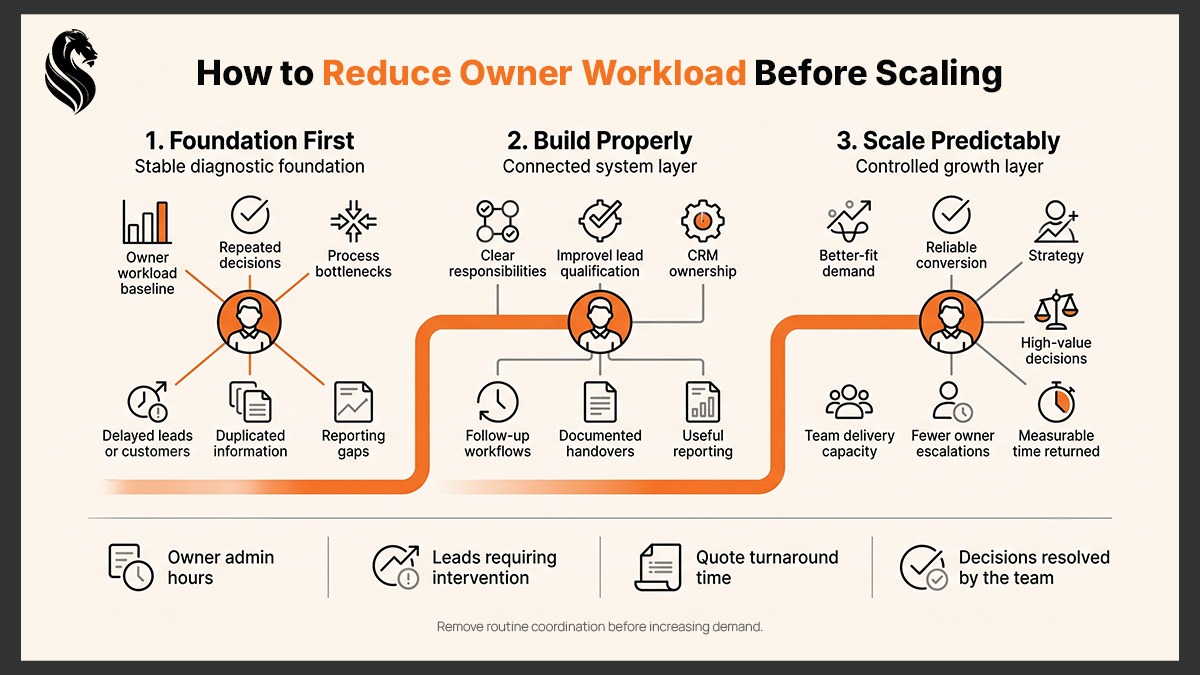
The sequence matters.
A business should not increase marketing spend before reviewing the foundations, customer journey, follow-up process, reporting, and operational capacity.
A practical approach follows three connected stages. Foundation First identifies the bottlenecks. Build Properly connects the people, processes, and systems. Scale Predictably increases demand only after the business can manage it with control and visibility.
Foundation First
The first stage is diagnosis.
Review the business plan, revenue streams, ideal customers, brand position, website, current marketing, sales process, CRM, automation, reporting, and operational handovers.
The aim is to identify where the owner is still acting as the bridge between disconnected parts of the business.
Questions may include the following.
- Which decisions always return to the owner
- Where do leads or customers experience delays
- Which processes depend on memory
- Where is information duplicated or lost
- Which reports fail to support decisions
- What work could be delegated if the process were clearer
- Which growth activities are creating work without enough return
Record the current number of owner hours spent on administration, lead follow-up, approvals, reporting, and internal coordination. Also identify how many opportunities or decisions require owner intervention each week.
This stage moves the owner from general frustration to a specific understanding of the bottlenecks.
Build Properly
The next stage connects the system.
This may involve refining the positioning, restructuring the website, creating targeted landing pages, improving lead capture, configuring the CRM, building follow-up workflows, clarifying sales responsibilities, and improving reporting.
Operational processes may also need documentation, automation, and clearer ownership.
Each improvement should remove a defined source of friction. Better positioning reduces repeated explanations. Stronger lead qualification reduces wasted sales effort. CRM ownership reduces chasing. Follow-up workflows reduce missed opportunities. Clear reporting reduces manual investigation. Documented handovers reduce unnecessary escalation.
The goal is not to remove the owner from every important decision. It is to stop using their time for routine coordination, preventable checking, and repetitive administration.
The owner should remain involved where their judgement creates value, not where the system has failed to create clarity.
Scale Predictably
Only once the system can receive, process, convert, and report on opportunities should the business increase demand.
Paid ads, SEO, content, partnerships, referral systems, retargeting, and outreach can then feed a stronger commercial journey.
Readiness signals may include consistent lead assignment, defined response times, visible quote tracking, reliable conversion reporting, clear delivery capacity, and fewer routine decisions requiring owner intervention.
At this stage, growth activity becomes easier to evaluate because the business can see what happened after the lead arrived.
The owner gains confidence because marketing, sales, reporting, and operations are working as a connected system rather than a collection of separate activities.
Automation Should Remove Friction, Not Responsibility
Automation is often presented as the solution to excessive workload.
It can help, but automation is only useful when the underlying process is clear.
Automating a weak process can create faster confusion. Leads may receive irrelevant messages. Tasks may be assigned to the wrong person. Reports may collect inaccurate data. Customers may move through workflows that do not reflect their real needs.
For example, an automated quote reminder will not improve conversion if nobody is responsible for updating the quote status. The system may continue sending messages after the customer has already responded, creating more confusion and more manual clean-up.
Start by defining the human process.
Clarify the trigger, responsible person, expected action, timeframe, and required outcome. Automation can then support that process through reminders, status changes, notifications, follow-up sequences, scheduling, and data updates.
The objective is not to automate every interaction. It is to remove repetitive work while preserving accountability and a strong customer experience.
Visibility Gives the Owner Confidence To Step Back
Owners often remain heavily involved because they do not trust what they cannot see.
When reporting is unclear and responsibilities are vague, stepping back feels risky. The owner worries that leads will be missed, customers will be disappointed, or problems will remain hidden.
Visibility changes that.
A clear dashboard, structured pipeline, weekly update, and monthly commercial review give the owner access to the information they need without requiring them to manage every task.
Weekly communication should answer four practical questions.
- What happened
- What changed
- What needs attention
- What happens next
Monthly reporting should add commercial interpretation. It should explain what the results mean and which action is recommended next.
Trust does not come from receiving more reports. It comes from knowing the business can identify issues, assign responsibility, and respond without constant owner intervention.
The Real Goal Is Better Owner Involvement
Reducing workload does not mean making the owner irrelevant. It means using their attention where it creates the most commercial value.
The owner may still guide strategy, protect standards, approve major investments, support key relationships, and make high-value decisions. Those responsibilities are different from chasing updates, checking whether someone returned a call, rebuilding reports, or correcting routine handovers.
A stronger growth system moves the owner away from constant coordination and towards leadership.
That creates more time for commercial planning, team development, partnerships, innovation, and the decisions that genuinely require their experience.
It also creates a business that is more resilient because progress no longer depends on one person maintaining every connection.
Growth Should Create Freedom, Not More Work
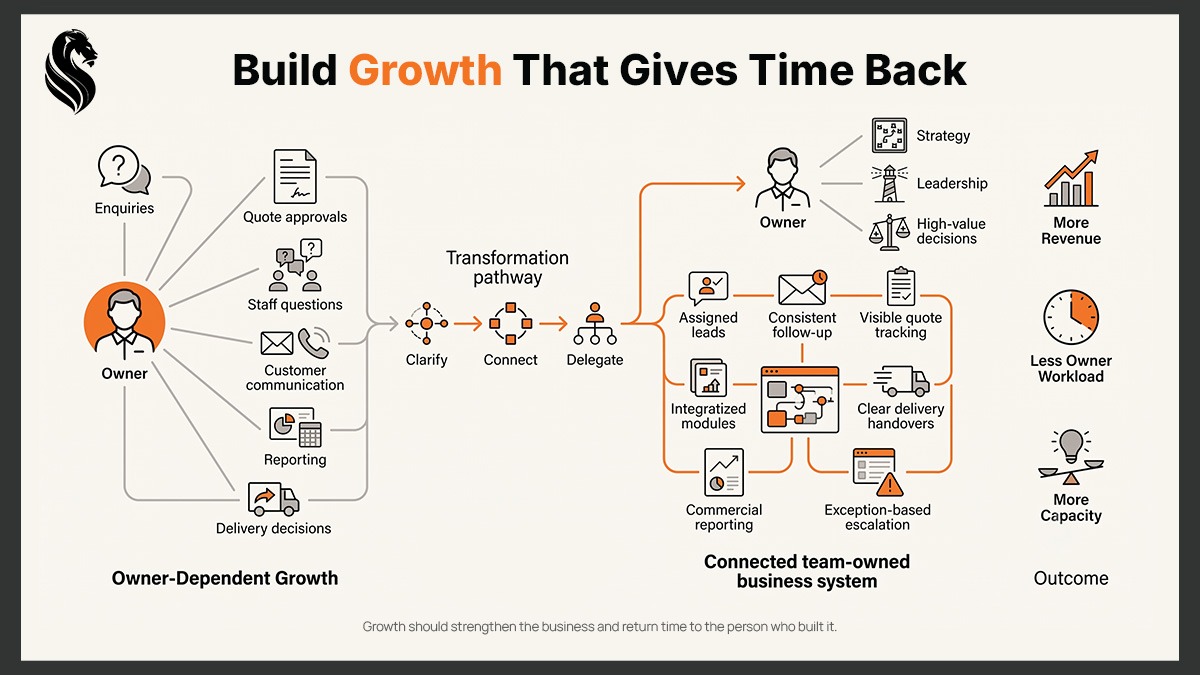
Growth should improve the business and the life of the person who built it.
When rising revenue creates more administration, more checking, and more owner dependency, the business has increased activity without creating enough leverage.
The solution is to connect brand, lead generation, the customer journey, CRM, sales follow-up, reporting, automation, and operations into one visible commercial system.
Start with the foundation. Build the process properly. Scale only when the business can handle more demand without transferring the pressure back to the owner.
Revenue, profitability, lead quality, and conversion all matter. So does the amount of time and attention the growth system gives back to the owner.
Build Growth That Gives Time Back
Wandering Lion helps operator-led and owner-led businesses diagnose growth bottlenecks, strengthen their foundations, connect their customer journey, and build systems that bring in the right work without creating more chaos.
A Growth Audit identifies where owner dependency is slowing the business down, which customer journey or follow-up gaps are affecting commercial performance, and what should be fixed first. The outcome is a clear set of priorities and a practical Foundation First, Build Properly, Scale Predictably roadmap.
Request a Growth Audit to identify where owner dependency is slowing the business down and what must be built before expansion can scale predictably.
FAQs
Can owner workload be reduced without hiring more staff?
Yes. Additional staff may help, but unclear processes often cause more workload regardless of team size. Defining responsibilities, improving lead qualification, centralising information, and automating repetitive tasks can reduce pressure before new roles are added.
Hiring into an unclear system can increase coordination work because the owner must manage another person without removing the underlying bottleneck.
Which business tasks should be automated first?
Begin with repetitive, rules-based tasks that create little value when completed manually.
Common opportunities include lead management tasks such as notifications and follow-up prompts, customer communication such as appointment reminders, reporting tasks such as data updates, and internal handovers such as status changes and task assignments.
Keep judgement-heavy conversations and sensitive customer decisions under human control.
How do you know when an owner can safely step back?
The owner can reduce involvement when responsibilities are clear, information is visible, follow-up is consistent, exceptions are escalated correctly, and results can be reviewed without manually checking every task.
The system should also show who owns each stage, when an issue requires escalation, and how the owner can review performance without becoming responsible for daily coordination.
Stepping back should happen gradually as the system demonstrates reliability.

Growth Must Create Leverage, Not More Owner Dependency
Growth becomes a commercial problem when every new lead, customer, and decision creates more work for the owner. Reducing owner workload requires a connected system across brand positioning, lead generation, customer journey, CRM, sales follow-up, reporting, automation, and operations, built in the right sequence before more demand is added.

Growth Should Give the Owner Time Back
A business is not scaling properly when increased revenue still depends on the owner remembering, checking, approving, and chasing every important task. Sustainable growth comes from strengthening the foundation, connecting the commercial system, and scaling only when the business can handle more demand without increasing owner dependency.
Owner Dependency Is a Growth Constraint
When information, decisions, follow-up, and approvals continue flowing through one person, the owner becomes the business operating system. This slows response times, limits team accountability, and makes every increase in volume harder to manage.
Workload Reduction Is a Commercial Metric
Owner workload affects lead response, quote turnaround, conversion, customer experience, profitability, and capacity. It should be measured alongside revenue, lead quality, sales outcomes, and cost per qualified lead.
The Growth System Must Work End to End
Brand positioning, lead generation, customer journey, CRM, sales follow-up, reporting, automation, and operations must function as one connected system. Fixing one isolated tool or channel will not reduce dependency if the owner still has to hold the process together.
Build Before You Scale
More leads will amplify weak positioning, poor follow-up, unclear responsibilities, and disconnected reporting. Review the foundation first, build the right process properly, and scale only when the business can receive, convert, deliver, and report on more work without transferring pressure back to the owner.

Build a Growth System That Gives Time Back
A Growth Audit can identify where owner dependency, disconnected systems, weak follow-up, and limited visibility are slowing the business down. Wandering Lion reviews the foundation first, then defines what must be built before additional marketing activity or expansion can scale predictably.
KEEP READING
Explore more





FEEDBACK FROM THE FIELD
No polished scripts. Just the raw operational reality from owners who cleaned up their pipelines and got out of the daily administrative loop.
“When we set out to grow Discmania in the US market, Ryan was a key part of laying that foundation. He helped us cut through the noise & restructured how we told the story of each release, aligning our athlete partnerships with the brand, and building the kind of community touchpoints that turned buyers into fans. The results spoke for themselves. I’d work with him again without hesitation.”



“In 2019, Ryan from Wandering Lion helped transform the Kalamunda Eastern Suns’ presence in the community. He lifted our social profile, drove some of the strongest brand engagement in the league, and helped turn sparse crowds into sellouts. His work also strengthened sponsor interest and raised the overall profile of the club in a way that felt polished, professional, and genuine.”

“Young people who had switched off from school were not going to reconnect because of a campaign headline or a polished message. They needed a genuine reason to turn up again. Wandering Lion brought a strong sense of care to how the story was told. That gave the foundation a clearer public identity.”





“Working with Wandering Lion on the Discmania project was a standout experience. The team’s position work, blended creative vision with strategic execution, was a major asset as we built the Discmania brand globally. The work he produced didn’t just look great. It elevated our brand presence and supported measurable growth across multiple markets.”




“Wandering Lion understood from the outset that the Pacific Hockey League could not simply be another competition with a new name. Their work helped shape a player-first league with the right balance of ambition, fairness, and professionalism. What they brought was not just branding or communication, but real strategic thinking that gave the PHL a stronger and more credible foundation.”

“Authenticity is the centrepiece of all Lajosi Putter customisation works. The brand is reflected in each of our hand-made custom putters. Ryan’s team solidified that identity in our online presence. It led to higher social media engagement from a golfing community who value hand-crafted putters over overly polished ones.”

‹
›
READY TO FIX YOUR GROWTH?
Stop guessing. Get clarity on what's actually slowing your business down.
