

The Hidden Cost of Manual Follow-Up
A lead comes in while everyone is busy.
Someone means to call back. A quote gets sent. The customer says they need a few days. No reminder is set. No next step is recorded. Then the opportunity goes cold.
Nothing dramatic happened. The business simply relied on memory.
That is the hidden cost of manual follow-up.
For many owner-led businesses, the issue is not always lead volume. It is what happens after the enquiry arrives. Leads sit in inboxes. Quotes go unfollowed. Sales conversations live in someone's phone. The owner ends up checking whether customers were called, whether quotes were sent, and what needs to happen next.
Wandering Lion treats this as a systems problem, not just a sales problem. Inconsistent follow-up, weak CRM discipline, too much manual work, and owner dependency can all slow growth even when demand already exists.
The cost shows up in lost revenue, wasted marketing spend, slower response times, poor sales data, and more work landing back on the owner. Most of it happens quietly.
Manual Follow-Up Looks Cheap Until You Measure What It Costs

Manual follow-up often survives because it looks inexpensive. There is no software investment, implementation project, or major process change. Someone simply sends the email, updates the spreadsheet, makes the call, or remembers to follow up later.
The real cost is not the lack of software. It is the opportunities, time, and visibility lost when follow-up depends on people remembering the next step.
A lead that waits too long for a response. A quote that never gets followed up. A prospect who said “call me next month” and disappears from view. An owner spending time checking whether the team has done what should already be visible.
Wandering Lion’s customer journey identifies inconsistent sales follow-up, too much manual work, weak CRM discipline, and owner dependency as growth problems because they create friction well after the lead has been generated.
Manual follow-up can therefore create costs across the business:
- lost opportunities
- slower response times
- repeated admin
- inconsistent customer communication
- poor pipeline visibility
- unreliable sales data
- management time spent chasing updates
None of these costs usually appear as a single line item, which makes them easy to ignore. A manual process can feel free while quietly costing the business revenue, time, and control.
The Six Hidden Costs of Manual Follow-Up
The cost of manual follow-up spreads across sales, marketing, customer experience, reporting, and owner workload. Each issue may look small on its own, but together they create a process that becomes increasingly difficult to control as the business grows.
Leads That Never Become Proper Opportunities
Not every lost lead was a bad lead.
Some simply never received the follow-up needed to become a real sales opportunity.
An enquiry sits in an inbox. Someone calls once and gets no answer. A prospect asks to be contacted later, but no reminder is created. Another lead changes hands without clear ownership.
The marketing may have worked perfectly.
The commercial process did not.
This is why Wandering Lion treats sales handover and close-out as a critical part of the customer journey. Generating the enquiry is only valuable if the business has a reliable process for following it through to sale completion.
Quotes That Quietly Go Cold
Sending a quote can feel like progress.
But a quote sitting in a customer's inbox is not a sales process.
Without a clear follow-up date, ownership, and next action, good opportunities can disappear simply because nobody restarted the conversation.
The customer may still be interested, have questions, be comparing options, or simply be busy.
Manual systems leave too much of that to chance.
A better process makes every quote visible and gives every opportunity a clear next action.
The Owner Becomes the Follow-Up System
Manual follow-up often pushes responsibility back onto the owner.
They start asking whether the lead was called, whether the quote went out, who is handling the customer, and what needs to happen next.
Growth then creates more supervision instead of more leverage. Before long, the owner becomes the human CRM, creating owner dependency rather than a more scalable business.
Wandering Lion's customer journey specifically identifies too much manual work and owner dependency as barriers to scalable growth. The goal is not simply to bring in more work, but to build systems that allow the business to handle that work without adding more pressure to the owner.
Slow Follow-Up Damages Trust
Customers do not see the internal reasons for a delayed response. They only experience the delay. They do not know the team is busy, the owner is on-site, or the enquiry went to the wrong inbox. They simply know they reached out and did not hear back when expected.
That experience affects how they judge the business.
A company can invest heavily in branding, a strong website, quality content, and advertising, then lose credibility through a poor follow-up experience.
The sales process is part of the brand. Customers judge reliability before they become customers. If communication is slow or inconsistent during the sales process, they have little reason to assume service will improve after they buy.
Your Sales Data Becomes Unreliable
Manual follow-up also makes it difficult to know what is actually happening in the pipeline.
If conversations, quote status, next actions, and outcomes are not recorded consistently, the business cannot confidently answer basic commercial questions:
- How many leads became qualified opportunities?
- How many received quotes?
- How many quotes were followed up?
- Why were opportunities lost?
- Which marketing channels generated customers, not just enquiries?
Without reliable answers, decisions are made on instinct instead of evidence.
Inconsistent follow-up creates incomplete or unreliable data, making it harder to identify where the sales process is breaking down and what should be fixed next.
Weak Follow-Up Makes Marketing More Expensive
This is where the cost of manual follow-up compounds.
A business may invest heavily in ads, SEO, content, partnerships, or outreach to create demand. But if the follow-up process is weak, that demand is being sent into a system that cannot reliably convert it.
The instinct is often to generate more leads.
That can make the problem worse.
Wandering Lion's core belief is that ads amplify clarity. They do not create it. The same principle applies here. More traffic cannot repair a weak customer journey, inconsistent follow-up, or poor sales discipline. It simply sends more opportunities into the same weak system.
Before increasing acquisition, the business needs to know that the opportunities it already generates are being handled properly.
Why Manual Follow-Up Usually Breaks as the Business Grows
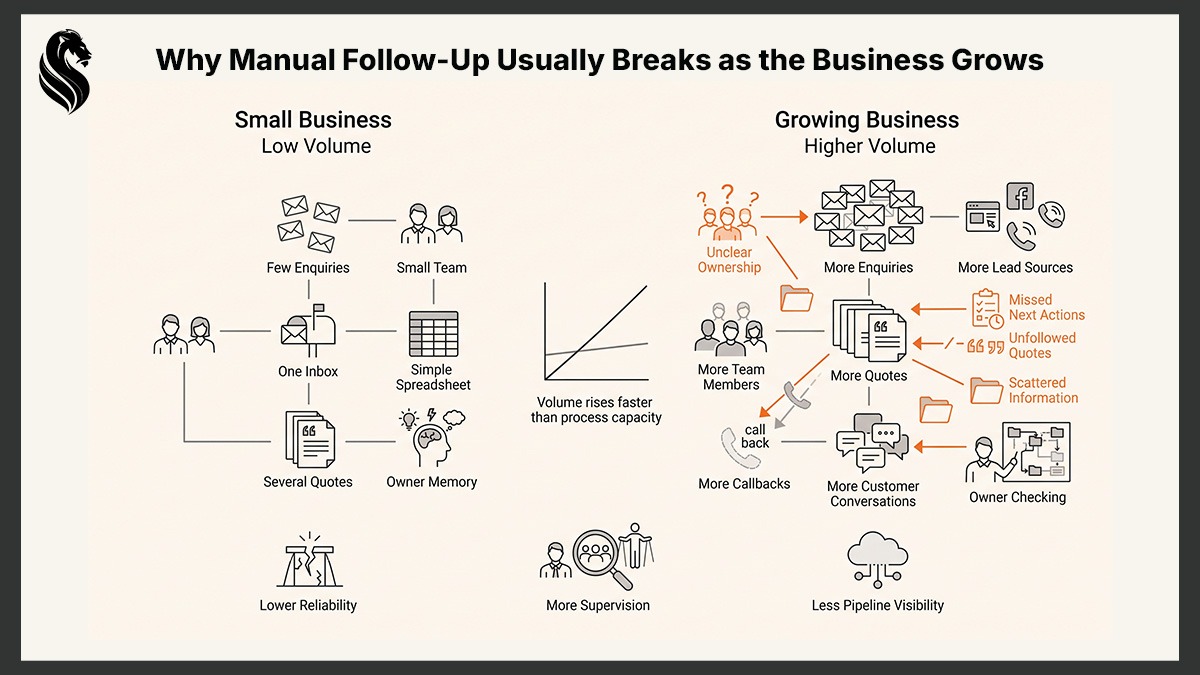
Manual follow-up can work while the business is small. There are fewer enquiries, fewer people involved, and fewer customer conversations to track. Then the business grows.
Lead volume increases. More people handle enquiries. More quotes go out. More channels generate demand. Customer conversations become spread across inboxes, phones, spreadsheets, and individual memory.
The process does not usually fail all at once.
It becomes less reliable.
Ownership becomes less clear, quotes are sent without recorded next actions, and future callbacks disappear from view. The owner starts checking the pipeline manually because there is no single place to see what is happening.
This is where growth creates operational pressure.
Wandering Lion's customer journey identifies too much manual work, inconsistent sales follow-up, weak CRM discipline, and owner dependency as common problems in established businesses where growth has become messy or difficult to manage.
The instinct is often to add more reminders, meetings, checks, and spreadsheets. But adding more manual effort does not make a fragile process scalable.
A process that depends on people remembering every next step becomes more fragile as volume and complexity increase.
The better approach is to build a system where ownership, status, next actions, and follow-up dates are visible without the owner needing to chase them.
The process that helped the business reach its current size may not be the process capable of taking it to the next one.
What a Proper Follow-Up System Should Look Like
A good follow-up system should reduce uncertainty.
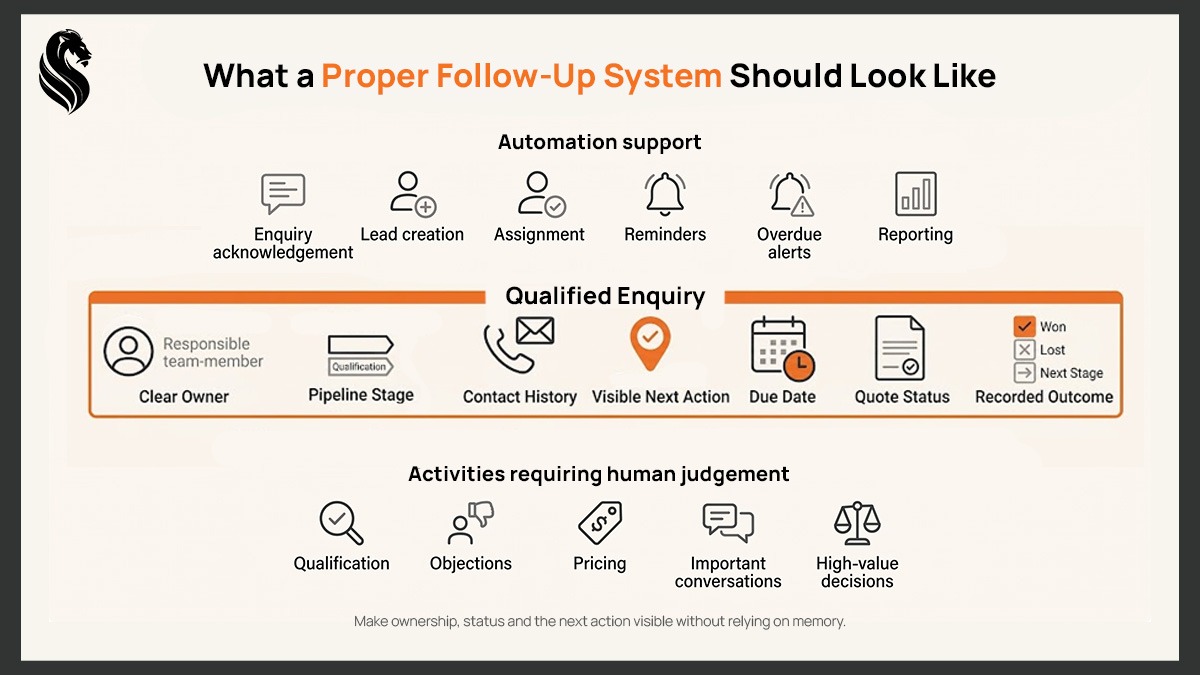
The team should know who owns the lead, what stage it is in, what needs to happen next, and when that action is due. The owner should be able to see the state of the pipeline without chasing people for updates.
The goal is not more admin. It is a process that makes ownership and next actions visible without relying on memory.
The Core Elements of a Reliable Follow-Up Process
Every qualified enquiry should have:
- a clear owner
- a defined pipeline stage
- a recorded contact history
- a visible next action
- a due date for that action
- a quote status where relevant
- a recorded win, loss, or next-stage outcome
Wandering Lion's customer journey treats this as part of the sales handover and close-out process, with emphasis on lead follow-up, quote tracking, CRM visibility, customer communication, and knowing where opportunities are being lost.
A good system should make ownership, status, and the next action obvious.
A Simple Manual Follow-Up Audit
Before changing software or adding automation, look at how the current process is actually working.
Review the last 20–30 enquiries and trace each one through the business.
Ask:
- When did the enquiry arrive?
- Who received it?
- How quickly was it contacted?
- What happened after the first conversation?
- Was it qualified?
- Was a quote sent?
- Was the next follow-up scheduled?
- How many follow-up attempts were made?
- What was the outcome?
- Can the business prove this from its current system?
The purpose is simple: replace “I think we're following up” with evidence of what actually happens after every enquiry. That makes it easier to separate a lead-generation problem from a sales-process problem.
Where Automation Helps and Where It Should Not
Automation is most useful when it removes repetitive work and prevents opportunities from being forgotten.
That can include:
- enquiry acknowledgements
- CRM lead creation
- lead assignment
- follow-up reminders
- quote follow-up tasks
- overdue opportunity alerts
- email sequences
- pipeline updates
- reporting dashboards
But automation should not replace judgement.
Important conversations, qualification, objections, pricing discussions, and high-value sales decisions still require human attention.
The objective is not to automate the customer relationship. It is to automate the repetitive work around it so the team has more time for conversations and decisions that require human judgement.
The Most Expensive Follow-Up System Is the One You Cannot See Failing
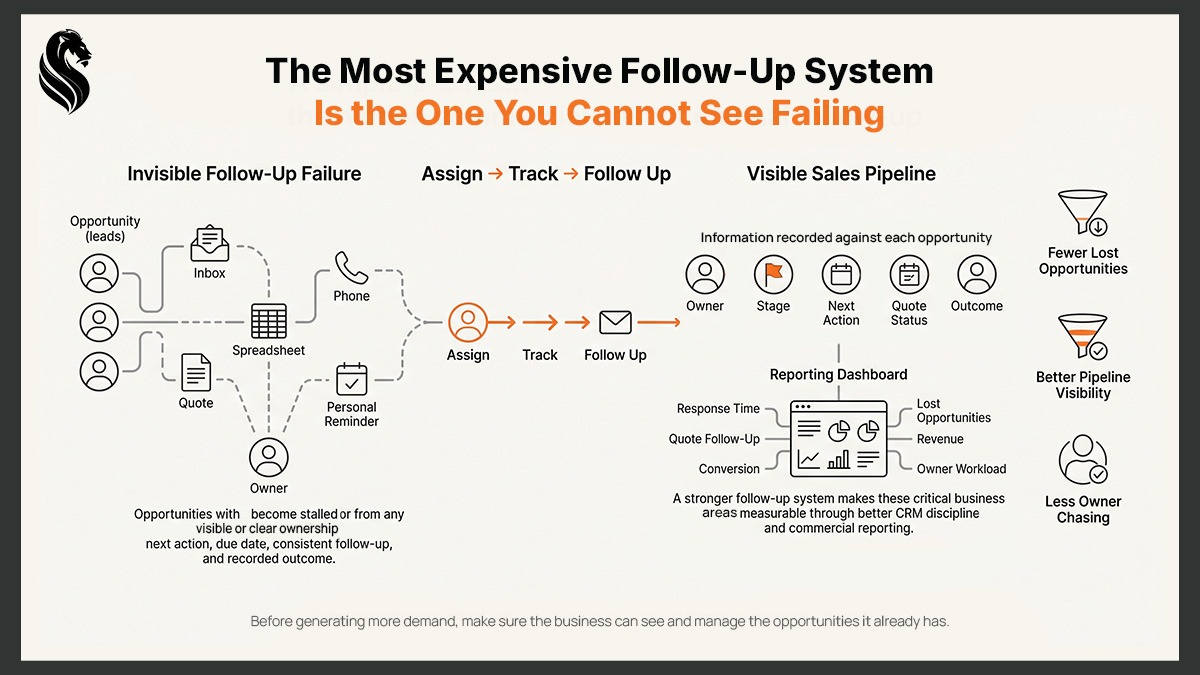
Manual follow-up rarely fails dramatically. It fails through small delays, missed next steps, and opportunities nobody realises have stalled. Across dozens or hundreds of enquiries, those small failures become a commercial problem.
The real cost is not just the opportunity you know you lost. It is the revenue leakage you cannot see because the process gives you no reliable way to measure where opportunities stall.
That is why Wandering Lion treats sales follow-up as part of the wider growth system. The business should be able to see who owns each lead, how quickly follow-up happens, whether quotes are tracked, where opportunities are being lost, and what needs to happen next.
Before spending more to generate demand, make sure the business can properly manage the demand it already has.
Not sure where your follow-up process is leaking revenue?
Wandering Lion can review your customer journey, sales process, CRM, follow-up, automation, and reporting to identify what is slowing growth and what should be fixed first.
FAQs
What is manual follow-up in a business?
Manual follow-up is when leads, quotes, callbacks, and next actions depend on people remembering to complete them. It often involves inboxes, spreadsheets, phone notes, or informal reminders rather than a structured CRM or sales process. The risk is that follow-up becomes inconsistent, opportunities become difficult to track, and next actions are easy to miss.
How can manual follow-up cost a business revenue?
Manual follow-up can lead to delayed responses, forgotten quotes, missed callbacks, and poor visibility over where opportunities are being lost. Even when lead generation is working, weak follow-up can reduce conversion and waste marketing spend because enquiries are not being moved consistently through to sale completion.
When should a business automate its follow-up process?
Automation becomes useful when lead volume, team size, or sales complexity makes manual follow-up difficult to manage consistently. The aim is not to automate every customer interaction. It is to remove repetitive tasks such as reminders, lead assignment, acknowledgements, and overdue alerts so the team can focus on conversations that require human judgment.

Manual Follow-Up Creates Revenue Leakage You Cannot Always See
The real cost of manual follow-up is not the software a business avoids paying for. It is the lost opportunities, wasted marketing spend, unreliable sales data, repeated admin, and owner dependency created when leads, quotes, and next actions rely on memory. The strategic response is to diagnose the existing follow-up process first, then build a visible, accountable system before spending more to generate demand.

More Leads Will Not Fix a Follow-Up System That Is Already Leaking Revenue
Manual follow-up can appear inexpensive while quietly weakening conversion, customer experience, pipeline visibility, and owner capacity. Businesses need to understand where opportunities are being lost, build a reliable follow-up process, and only then increase acquisition.
The Hidden Costs Compound Across the Business
Missed leads and forgotten quotes are only part of the problem. Manual follow-up also creates slower responses, repeated admin, unreliable data, inconsistent customer communication, and more management work for the owner.
Growth Makes Memory-Based Follow-Up More Fragile
Manual processes can work while enquiry volume and team complexity are low, but they become less reliable as more people, channels, quotes, and conversations enter the sales process. Growth requires clear ownership, visible next actions, and a system that does not depend on the owner checking everything.
A Proper System Makes Every Next Step Visible
Reliable follow-up means every qualified enquiry has an owner, pipeline stage, contact history, next action, due date, and recorded outcome. Automation can remove repetitive work and prevent opportunities being forgotten, while important sales conversations and decisions remain human.
Fix Follow-Up Before Paying for More Demand
More ads, SEO, content, outreach, or other acquisition activity cannot repair an inconsistent sales process. If existing opportunities are not being handled properly, generating more leads can simply send more demand into a system that is already leaking revenue.

Find Where Your Follow-Up Process Is Leaking Revenue
Before investing in more lead generation, establish what actually happens to the enquiries and quotes your business already receives. A Growth Audit can review your customer journey, sales process, CRM, follow-up, automation, and reporting to identify where opportunities are being lost and what needs to be fixed first.
KEEP READING
Explore more





FEEDBACK FROM THE FIELD
No polished scripts. Just the raw operational reality from owners who cleaned up their pipelines and got out of the daily administrative loop.
“When we set out to grow Discmania in the US market, Ryan was a key part of laying that foundation. He helped us cut through the noise & restructured how we told the story of each release, aligning our athlete partnerships with the brand, and building the kind of community touchpoints that turned buyers into fans. The results spoke for themselves. I’d work with him again without hesitation.”



“In 2019, Ryan from Wandering Lion helped transform the Kalamunda Eastern Suns’ presence in the community. He lifted our social profile, drove some of the strongest brand engagement in the league, and helped turn sparse crowds into sellouts. His work also strengthened sponsor interest and raised the overall profile of the club in a way that felt polished, professional, and genuine.”

“Young people who had switched off from school were not going to reconnect because of a campaign headline or a polished message. They needed a genuine reason to turn up again. Wandering Lion brought a strong sense of care to how the story was told. That gave the foundation a clearer public identity.”





“Working with Wandering Lion on the Discmania project was a standout experience. The team’s position work, blended creative vision with strategic execution, was a major asset as we built the Discmania brand globally. The work he produced didn’t just look great. It elevated our brand presence and supported measurable growth across multiple markets.”




“Wandering Lion understood from the outset that the Pacific Hockey League could not simply be another competition with a new name. Their work helped shape a player-first league with the right balance of ambition, fairness, and professionalism. What they brought was not just branding or communication, but real strategic thinking that gave the PHL a stronger and more credible foundation.”

“Authenticity is the centrepiece of all Lajosi Putter customisation works. The brand is reflected in each of our hand-made custom putters. Ryan’s team solidified that identity in our online presence. It led to higher social media engagement from a golfing community who value hand-crafted putters over overly polished ones.”

‹
›
READY TO FIX YOUR GROWTH?
Stop guessing. Get clarity on what's actually slowing your business down.
