

Why Better Systems Create Better Customers
Owner-led businesses often assume problems with the customer journey begin with the quality of the leads coming in. If enquiries are inconsistent, customers are difficult to close, or sales feel unpredictable, the natural response is to look at marketing first.
But if the system behind those enquiries is weak, increasing volume rarely solves the commercial problem.
A customer experiences far more than your marketing. They experience your positioning, website, enquiry process, response time, sales conversations, quoting process, communication, onboarding, delivery, and follow-up.
When those parts are disconnected, even a strong prospect can become a difficult customer.
The real issue is often not the customer alone. It is the system shaping the relationship.
That does not mean every poor-fit sales customer can be transformed into the right one. It means the systems around your brand, process, reporting, and operations have a significant influence on who enters the business, what they expect, how they behave, and whether the relationship becomes commercially valuable.
Customer Problems Often Start Before the Enquiry
When an owner says they need better customers, they may be describing several different problems.
They might be receiving too many price shoppers. Prospects might take too long to make decisions. Quotes may go unanswered. Leads may disappear after making contact. The team might spend too much time chasing people who were never going to buy.
It is easy to group all of these issues under one label.
We need better leads.
Sometimes that is true. But often the bigger issue starts earlier.
If the brand does not make your value clear, prospects enter the customer journey without understanding why they should choose you. A website that attracts broad interest without qualifying intent then pushes more filtering onto the sales team.
Forms that capture too little context create more manual qualification, while inconsistent follow-up allows good prospects to go cold.
The quality of the customer is therefore influenced by the quality of the system they move through.
A Weak Customer Journey Creates More Work

Owner-led businesses often grow by relying on individual effort.
The owner answers the phone. A team member remembers to send the quote. Someone checks an inbox for missed enquiries. Follow-up happens when there is time. Customer information sits across spreadsheets, emails, notes, and personal memory.
That approach can work while the business is small.
As volume increases, it becomes fragile.
A customer journey built around manual effort usually creates more work at exactly the point where the business is trying to grow.
Common signs include:
- Enquiries sitting unanswered for too long
- Leads being handled differently by different team members
- Quotes being sent without structured follow-up
- Customer details being stored across multiple systems
- Marketing reports that do not connect to sales outcomes
- Staff repeatedly asking the owner what should happen next
The visible problem might be conversion.
The underlying problem is often system design.
Better Positioning Filters Customers Earlier
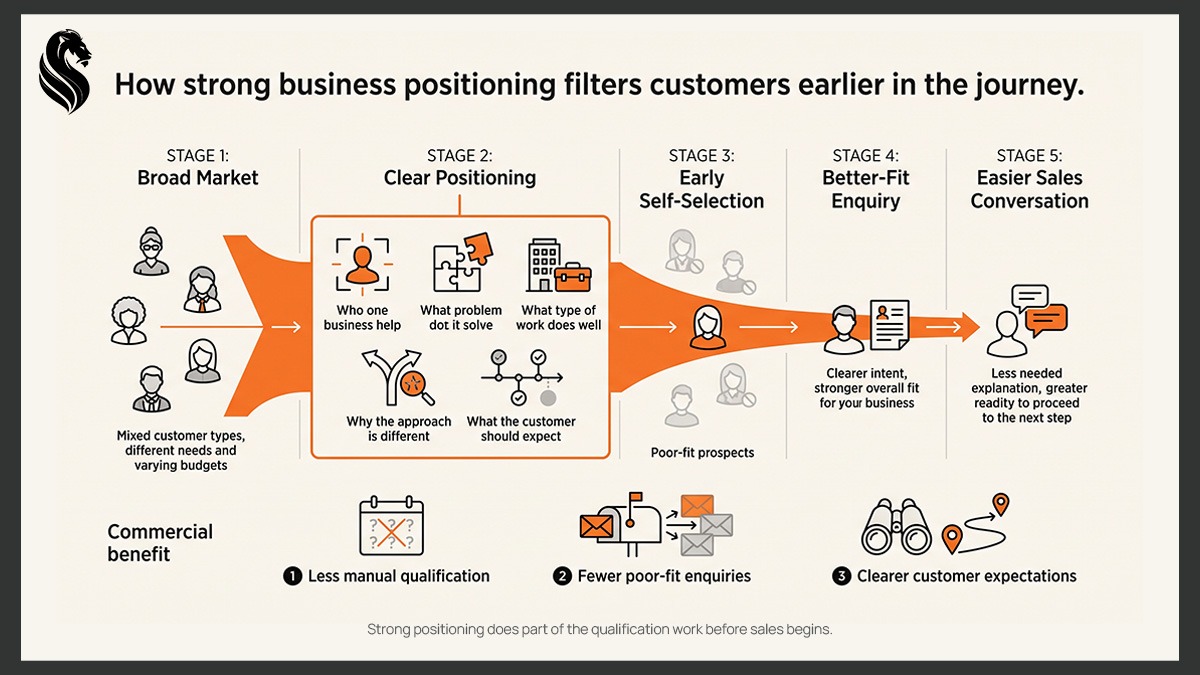
Good customer systems start before someone fills in a form.
Your positioning influences who sees themselves as a fit for your business.
When a brand tries to appeal to everyone, it often attracts a wider range of enquiries but gives prospects very little guidance about who the business is best suited to.
That pushes qualification further down the journey.
The sales team then has to explain the offer, establish the value, understand the customer's problem, determine whether they are a fit, and correct any expectations created by vague marketing.
Strong positioning does some of this work earlier.
It should help a potential customer understand:
- Who the business is built to help
- What problem it solves
- What type of work it does well
- Why its approach is different
- What the customer should expect next
This is not simply a branding exercise.
Clear positioning is an operational filter because it helps the right customers recognise themselves earlier and reduces the time spent educating poor-fit prospects later.
Lead Capture Should Reduce Admin, Not Create It
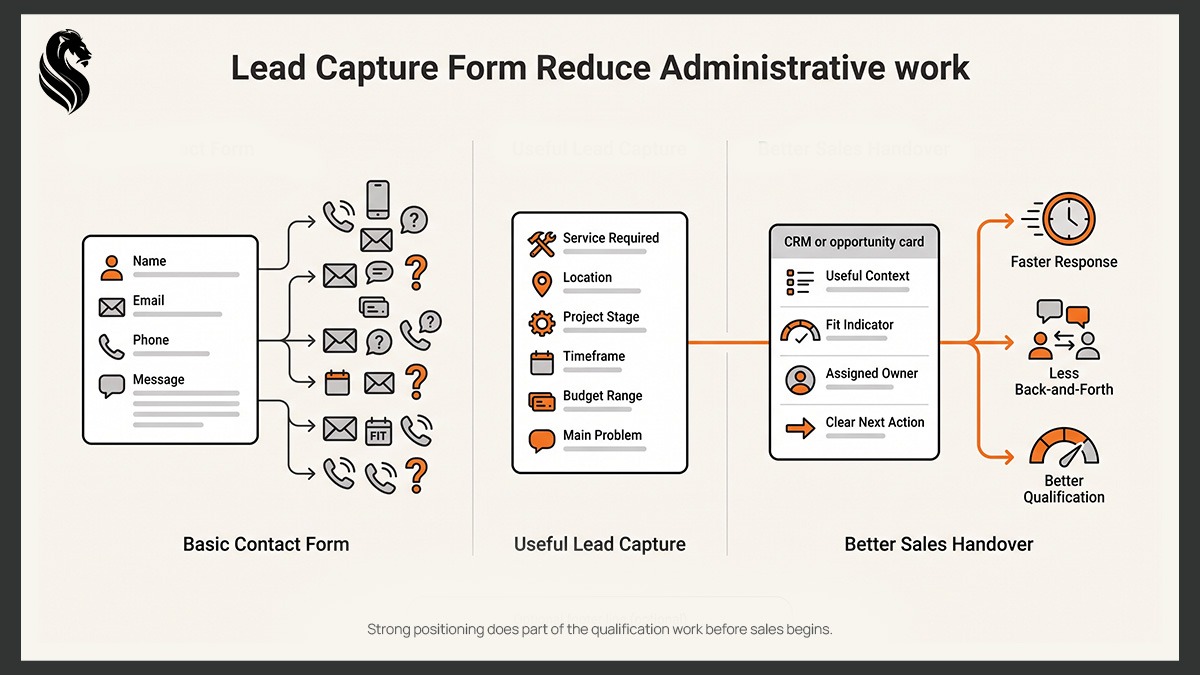
Many businesses treat lead capture as a basic contact function.
Name. Email. Phone number. Message.
That gives the team very little useful context.
The result is often another round of questions, calls, emails, and manual qualification.
A better lead capture system collects enough information to improve the next commercial decision without turning the form into an interrogation.
Depending on the business, useful questions might identify the type of service required, location, project stage, budget range, timeline, or current problem.
The goal is not to create a longer form for the sake of gathering data.
It is to improve the handover between interest and sales so the team can respond with more relevance, qualify efficiently, and reduce unnecessary admin for both the business and the prospect.
Sales Follow-Up Shapes Customer Quality
Lead generation receives a lot of attention because it is easy to see.
A new enquiry arrives. Marketing appears to be working.
But the commercial outcome depends on what happens next.
How quickly does someone respond?
Is there a clear next step?
Are quotes followed up?
A strong prospect can become a poor commercial outcome when follow-up is inconsistent. That does not change the inherent quality of the lead. It means the business has failed to protect the value of a good-fit opportunity.
This is particularly important in owner-led businesses where the owner is often involved in sales as well as delivery, operations, recruitment, finance, and decision-making.
Follow-up gets pushed aside because something more urgent appears.
A proper system reduces that dependency.
CRM workflows, clear sales stages, reminders, templates, and accountability can make follow-up more consistent without requiring the owner to remember every conversation.
The purpose of the system is not to remove the human relationship. It is to protect it.
Reporting Should Explain What Is Actually Happening
Another weakness in many customer journeys appears in reporting.
Marketing may report clicks, impressions, leads, or website traffic.
Sales may report closed jobs.
Operations may know which customers are profitable.
But those pieces are often viewed separately.
That makes it difficult to answer the questions an owner actually cares about.
Which sources are bringing in the best-fit customers?
Which enquiries turn into quotes?
Which quotes turn into revenue?
Where are commercially strong opportunities being lost?
Without connected reporting, the business can easily scale the wrong activity.
For example, a campaign may appear successful because it produces a high number of enquiries. If very few of those enquiries become profitable customers, lead volume alone is not a useful measure of performance.
The more useful question is whether the journey is producing qualified opportunities, sales, profitable work, and less wasted effort.
The customer journey needs to be measured further than the initial enquiry.
Operations Affect the Customer Experience Too
Marketing and sales do not own the entire customer journey.
Operations play a major role in what customers experience after the sale.
If onboarding is unclear, communication is inconsistent, or responsibilities are poorly defined, a customer who was enthusiastic during the sales process can quickly become frustrated.
That creates additional workload.
The team answers avoidable questions. Customers chase updates. The owner gets pulled into problems that should have been handled by the system.
Good operations reduce that friction.
The customer should know what is happening, what is required from them, who is responsible, and what comes next.
That clarity creates a smoother customer experience, reduces avoidable admin, and helps the business deliver on the expectations set during marketing and sales.
Foundation First Before Adding More Traffic
When a business wants faster growth, the temptation is to increase traffic.
Run more ads. Spend more on SEO. Publish more content. Generate more enquiries.
Adding traffic to a weak customer journey usually increases the pressure already inside the business.
More leads create more follow-up.
More customers expose more operational gaps.
More campaigns create more reporting complexity.
If the systems are not ready, scale can make the business feel less controlled rather than more successful.
That is why the priority should be the foundation.
Before increasing marketing activity, review the parts of the system that influence conversion and customer quality.
That includes:
- Brand positioning
- Website messaging
- Customer pathways
- Landing pages
- Lead capture
- Sales follow-up
- CRM discipline
- Quoting
- Reporting
- Customer communication
- Operational handovers
This is the logic behind Foundation First. Strengthen the structure before adding more demand to it.
Build Properly by Connecting the System
Once the gaps are visible, the next step is not to add random tools.
A CRM alone will not fix sales.
A new website alone will not fix positioning.
Automation alone will not fix a poor process.
Each part has to support the customer journey around it.
Building properly means connecting the commercial system.
The positioning should inform the landing page. The landing page should qualify intent. The form should capture what sales needs. The CRM should track what happens next. Reporting should then connect activity back to real commercial outcomes.
Operations should then continue the experience that marketing and sales promised.
When those parts work together, the business operates as a connected system rather than a collection of separate tasks. That improves consistency for the customer and reduces manual work for the owner.
Scale Predictably Once the Journey Works
Scaling becomes more useful once the foundation and build stages are working.
At that point, paid advertising, SEO, content, partnerships, referrals, retargeting, and outreach can direct more potential customers into a journey that has already been designed to handle them.
This changes the purpose of marketing.
Ads amplify clarity. They do not create it.
Instead of compensating for weak foundations, marketing becomes an amplifier of a commercial system that already knows how to attract, qualify, follow up, and convert the right work.
The business can assess growth using stronger measures such as:
- Qualified lead volume
- Lead to quote conversion
- Quote to sale conversion
- Cost per qualified enquiry
- Revenue influenced by each channel
- Owner workload reduction
These measures provide a clearer picture of whether growth is genuinely improving the business.
More activity is not automatically better.
Predictable growth comes from knowing what works, why it works, and what the system can handle next.
Better Systems Also Create Better Expectations
Customer quality is not only about budget or purchasing intent.
Expectations matter.
A prospect who understands your value, process, pricing approach, timelines, and responsibilities before becoming a customer is usually easier to work with than someone who enters the relationship with unclear assumptions.
Good systems create those expectations early by making each stage of the customer journey clearer.
The website sets the position.
The enquiry process establishes relevance.
Sales confirms fit.
The proposal explains the scope.
Onboarding explains the working relationship.
Reporting maintains transparency.
Each step removes uncertainty.
Together, those stages reduce uncertainty and help the right customers move forward with clearer expectations while making poor-fit prospects easier to identify earlier.
The Owner Should Not Be the System
One of the strongest signs that a business needs better systems is when the owner becomes the connection between every stage.
Marketing sends leads to the owner.
Staff ask the owner what to do.
Customers call the owner when they need an update.
The owner remembers which opportunities need chasing and steps in whenever the process breaks down.
Growth then creates a strange problem.
Revenue can increase while the owner's workload becomes worse.
Better systems should do the opposite.
They should make responsibilities clearer, information easier to access, follow-up more reliable, and commercial decisions easier to make.
The owner remains important, but they stop being the manual process holding the business together.
Better Customers Are a System Outcome
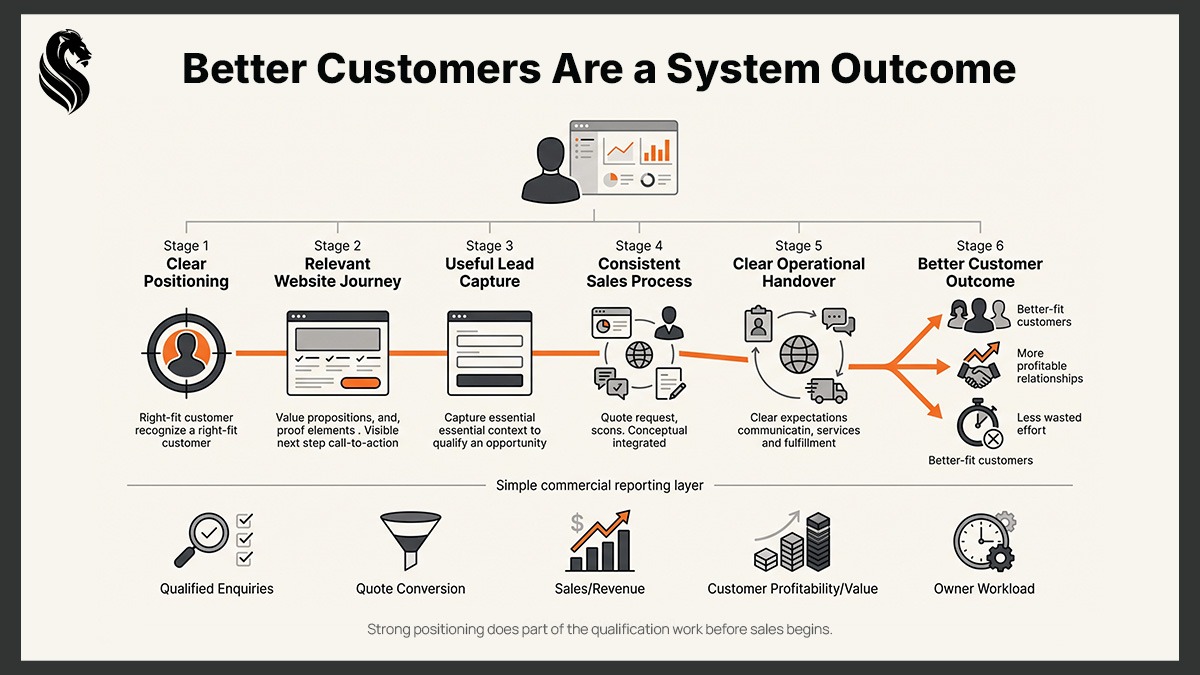
Businesses cannot control every customer who enters the market.
But they can control far more of the conditions that determine who enquires, how they are qualified, what they expect, how quickly they receive a response, and how the relationship develops.
That is why customer quality should not be treated purely as a marketing problem.
It is a connected commercial system. Brand shapes relevance, the customer journey builds trust, sales follow-up protects conversion, reporting improves decisions, and operations determine whether the experience holds together after the sale.
When those parts work together, the business is more likely to attract better-fit customers, convert stronger opportunities, reduce wasted effort, and create commercially worthwhile relationships.
The sequence matters.
Foundation First. Build Properly. Scale Predictably.
Scaling before the system is ready tends to expose and magnify inefficiency. Strengthening the system first gives growth something solid to build on.
If your business is generating enquiries but still dealing with poor-fit customers, inconsistent follow-up, unclear reporting, or too much manual work, the problem may sit deeper than your marketing.
A Brand & Growth Scan helps identify where the customer journey, brand, sales process, reporting, and operational systems are creating friction.
Book a Brand & Growth Scan to understand what should be fixed before you invest in more growth activity.
FAQs
How do I know if my customer journey is too dependent on the owner?
Look for areas where progress stops unless the owner responds, approves something, remembers a follow-up, or explains what should happen next. Repeated owner intervention usually signals that responsibilities or processes are not sufficiently defined.
Can automation improve customer quality?
Automation can improve consistency, response times, qualification, and follow-up when the underlying process is already clear. Automating a poorly designed process can make the same problems happen faster.
How often should an established business review its customer journey?
A customer journey should be reviewed when the business changes its offer, enters a new market, adds significant marketing activity, changes its sales process, or begins experiencing unexplained conversion or workload problems. Regular reviews can also identify friction before it becomes a larger commercial issue.

Customer Quality Is Shaped by the System Around the Sale
Poor-fit customers, weak conversion, and inconsistent sales are often symptoms of a disconnected commercial system rather than a simple lead generation problem. Stronger positioning, lead capture, follow-up, reporting, and operations help attract better-fit prospects, move them through the customer journey more effectively, and reduce unnecessary workload before additional growth activity is scaled.

Better Customers Start With Better Systems
Customer quality is influenced by much more than marketing. Owner-led businesses create stronger commercial outcomes when they fix the foundations, connect the customer journey properly, and scale only after the system can support more demand.
Customer Problems Start Earlier Than Most Owners Think
Poor lead quality can begin with unclear positioning, weak qualification, or friction before the enquiry ever reaches sales. Fixing those early stages helps the right prospects understand the business and filters out weaker-fit opportunities sooner.
Sales Follow-Up Protects Commercial Value
Generating an enquiry is only the start. Clear sales stages, consistent follow-up, CRM discipline, and quote tracking help prevent strong opportunities from becoming lost revenue.
Connect the System Before You Scale It
Websites, lead capture, CRM, reporting, sales, and operations need to work together rather than as disconnected tools. Building that connected system creates a more consistent customer journey and reduces the owner's reliance on manual intervention.
Scale Only When the Journey Is Ready
More traffic can magnify weak follow-up, poor qualification, and operational gaps. Once the foundation and customer journey are working properly, growth channels can amplify a system that already produces stronger commercial outcomes.

Find the Gaps Before You Add More Growth Activity
If poor-fit customers, inconsistent follow-up, unclear reporting, or manual processes are creating unnecessary workload, the first step is understanding where the system is breaking down. Book a Brand & Growth Scan to review the brand, customer journey, sales process, reporting, and operational foundations before investing in additional scale.
KEEP READING
Explore more






FEEDBACK FROM THE FIELD
No polished scripts. Just the raw operational reality from owners who cleaned up their pipelines and got out of the daily administrative loop.
“When we set out to grow Discmania in the US market, Ryan was a key part of laying that foundation. He helped us cut through the noise & restructured how we told the story of each release, aligning our athlete partnerships with the brand, and building the kind of community touchpoints that turned buyers into fans. The results spoke for themselves. I’d work with him again without hesitation.”



“In 2019, Ryan from Wandering Lion helped transform the Kalamunda Eastern Suns’ presence in the community. He lifted our social profile, drove some of the strongest brand engagement in the league, and helped turn sparse crowds into sellouts. His work also strengthened sponsor interest and raised the overall profile of the club in a way that felt polished, professional, and genuine.”

“Young people who had switched off from school were not going to reconnect because of a campaign headline or a polished message. They needed a genuine reason to turn up again. Wandering Lion brought a strong sense of care to how the story was told. That gave the foundation a clearer public identity.”





“Working with Wandering Lion on the Discmania project was a standout experience. The team’s position work, blended creative vision with strategic execution, was a major asset as we built the Discmania brand globally. The work he produced didn’t just look great. It elevated our brand presence and supported measurable growth across multiple markets.”




“Wandering Lion understood from the outset that the Pacific Hockey League could not simply be another competition with a new name. Their work helped shape a player-first league with the right balance of ambition, fairness, and professionalism. What they brought was not just branding or communication, but real strategic thinking that gave the PHL a stronger and more credible foundation.”

“Authenticity is the centrepiece of all Lajosi Putter customisation works. The brand is reflected in each of our hand-made custom putters. Ryan’s team solidified that identity in our online presence. It led to higher social media engagement from a golfing community who value hand-crafted putters over overly polished ones.”

‹
›
READY TO FIX YOUR GROWTH?
Stop guessing. Get clarity on what's actually slowing your business down.
