

Business Growth Framework: 9 Blocks Before Scaling
Growth can look healthy on paper while creating problems underneath the surface.
More leads can expose a weak sales process. More customers can put pressure on delivery. Increased marketing spend can amplify unclear positioning, while higher revenue can increase workload without improving profitability.
That is why scaling should not begin with the question, “How do we get more?”
It should begin with, “What needs to be working properly before we add more demand?”
A practical business growth framework helps answer that question. It gives owners a structured way to review the commercial foundations, customer journey, sales process, systems, delivery capacity and reporting that support sustainable growth.
The goal is not to slow growth down. It is to make sure the business can handle it.
When the foundations are weak, scaling can make inefficiency more expensive. When the right systems are in place and performance is clear, growth becomes easier to manage.
Before investing more heavily in ads, SEO, content, hiring or other growth activities, these are the nine building blocks every business should review.
What is a Business Growth Framework?
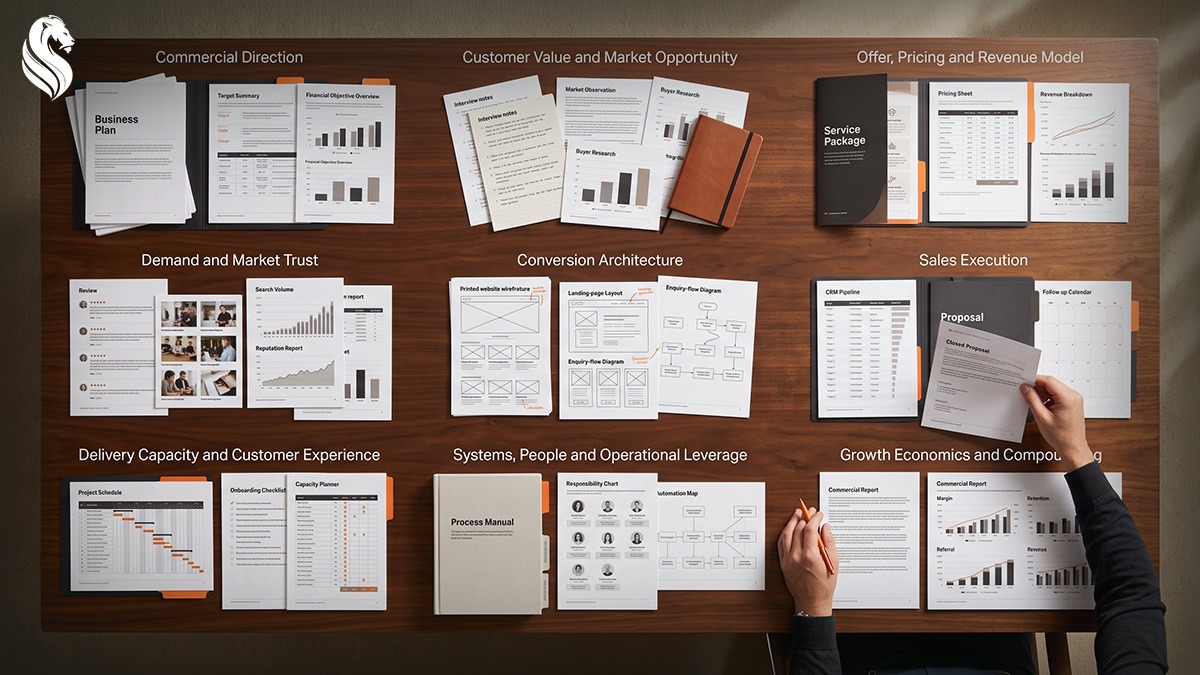
A business growth framework is a structured way to identify where growth should come from, what needs to improve to support it, and how progress will be measured. Instead of relying on disconnected tactics, it connects strategy, execution, systems and commercial outcomes.
That distinction matters because a business growth framework is not simply a marketing plan.
Marketing can create more awareness, traffic and enquiries, but those inputs still have to move through the rest of the business. The offer needs to be clear. The brand needs to establish trust. Enquiries need to be captured and followed up. The business needs enough capacity to deliver the work profitably, and owners need reporting that shows what is actually contributing to growth.
For an owner-led business, the practical purpose is simple: find the constraint before adding more pressure to the system.
If demand is strong but enquiries are being lost through poor follow-up, sales may be the constraint. If new customers are creating delivery pressure, capacity may need attention first. If performance cannot be connected to revenue, measurement may be the problem.
The 9 Building Blocks of a Practical Business Growth Framework
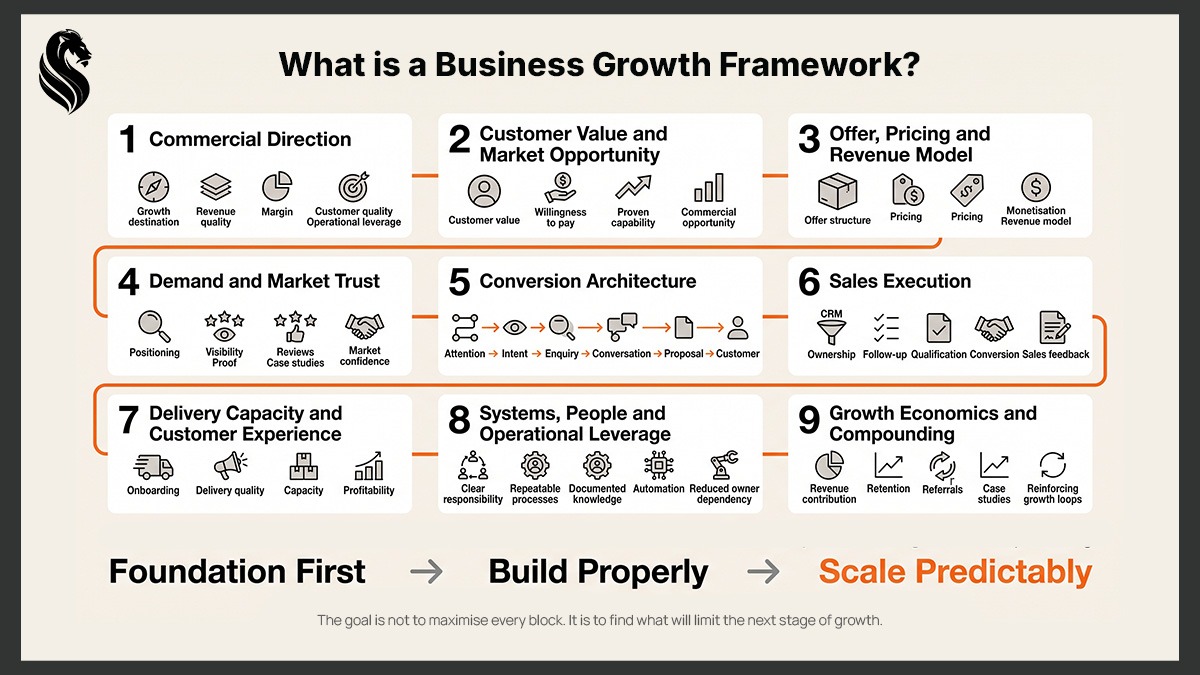
A practical business growth framework should do more than list ways to grow. It should help you decide where growth should come from, where value is being lost, and what will come under pressure as demand increases.
For an established business, the better question is not simply: How can we grow? It is: Where will growth create friction, and what needs to become stronger before we increase demand? These nine building blocks help organise that review across the foundations, systems and growth activities that support profitable scale. The sequence matters: Foundation First → Build Properly → Scale Predictably.
Commercial Direction
Growth needs a destination before it needs more activity.
Revenue is an obvious measure, but growth should also improve margin, customer quality and operational leverage. A business can increase turnover while becoming less profitable or more dependent on the owner.
The key question is what kind of growth will make the business stronger?
Growth could come from more customers, larger projects, better pricing, greater retention, new markets or more revenue from existing customers. Trying to pursue every opportunity at once usually spreads resources too thin.
Commercial direction helps determine which opportunities deserve attention first.
Customer Value and Market Opportunity
Knowing your ideal customer is useful. Understanding where customers see enough value to support profitable growth is more useful.
That means looking beyond broad customer profiles and examining what customers actually value, what problems they are willing to pay to solve and which segments represent the strongest commercial opportunity.
The objective is not simply to find more customers.
It is to determine where the business has the strongest combination of customer demand, proven capability and commercial opportunity, and where additional investment is most likely to create value.
Offer, Pricing and Revenue Model
Businesses often look for growth outside the company when significant opportunity may already exist inside the offer.
The question is not only whether customers understand what you sell. It is whether the business is packaging, pricing and monetising that value effectively.
This shifts the question from “How do we sell more?” to “Are we capturing enough value from what we already sell?”
Sometimes the best growth opportunity is not another acquisition channel. It is improving the economics of the customers and demand the business already has.
Demand and Market Trust
Growth depends on more than getting seen. The business needs to attract the right market, communicate a clear position and give potential customers enough confidence to keep moving.
That makes demand generation a quality problem as much as a volume problem.
If the wrong audience is seeing the business, more visibility will not help. If the offer is difficult to understand, more traffic will not fix it. And if the market does not trust the business, attention may never become buying intent.
Trust reduces perceived risk and can strengthen repeat purchase, retention and customer confidence when problems occur.
For an established business, this means examining how positioning, proof and visibility work together.
The market should be able to understand who the business is for, what problem it solves, why its approach is different and what evidence supports those claims. Case studies, reviews, referrals, useful content and clear expertise all help reduce the perceived risk of choosing one provider over another.
As search, social platforms and AI-assisted research change how buyers discover and compare businesses, clear positioning and credible proof matter before a prospect ever reaches the website.
Conversion Architecture
Attention only becomes valuable when it can move efficiently towards a commercial outcome.
That makes conversion bigger than a website conversion rate. Conversion architecture is the connected system that moves a prospect from initial interest through to becoming a customer.
Map the transitions between:
Attention → Intent → Enquiry → Conversation → Proposal → Customer
The critical point is what happens between each stage.
A business may have a good website, capable salespeople and strong services while still losing revenue because those parts do not connect properly.
The framework should expose where intent, opportunities or revenue are being lost between stages.
Sales Execution
Generating a lead is not the commercial outcome. Converting the right opportunity into profitable work is.
That requires a sales process with clear ownership, consistent follow-up and enough visibility to understand why opportunities progress or disappear.
Marketing and sales should not operate as separate systems.
If leads are arriving but consistently failing to convert, simply generating more of them may make the problem more expensive. The business needs to understand whether the issue is lead quality, positioning, pricing, follow-up, sales capability or the offer itself.
The stronger the feedback loop between marketing and sales, the easier it becomes to improve the quality of future demand.
Delivery Capacity and Customer Experience
Winning more customers only helps if the business can continue delivering what made those customers buy in the first place.
For service businesses, that means looking closely at onboarding, delivery quality, communication and fulfilment.
Revenue growth without delivery discipline can increase rework, customer friction and pressure on the team.
The real test of scalability is whether the business can deliver more work without eroding quality or profitability.
Systems, People and Operational Leverage
A scalable business should not require every increase in revenue to create an equal increase in manual effort.
Scalability depends on more than technology. Responsibilities must be clear, processes repeatable, and critical knowledge documented rather than held by a few individuals.
If every new customer creates more administration, greater owner involvement and more coordination problems, the business may be growing without becoming more scalable or less dependent on the owner.
The aim is to build enough operational leverage that volume can increase without workload rising at the same rate.
Growth Economics and Compounding
The final building block is understanding whether each cycle of growth is making the business economically stronger.
Reporting should not simply describe what happened. It should show what is contributing to revenue, where workload or margin pressure is increasing, what needs to improve and where the business should invest next.
A customer who stays longer improves lifetime value. A successful project can become a case study. A strong customer experience can generate referrals. Better sales data can improve targeting. Better targeting can improve acquisition efficiency.
That is when separate growth activities begin to compound.
Taken together, these nine building blocks create a different way to think about scale:
Direction → Value → Offer → Demand → Conversion → Sales → Delivery → Leverage → Compounding
The objective is not to score perfectly across every area before doing anything else. It is to identify the constraint most likely to limit the next stage of growth. Then fix what matters, build the supporting system and increase demand with greater confidence.
Foundation First → Build Properly → Scale Predictably.
How the Nine Building Blocks Reveal Your Biggest Growth Bottleneck
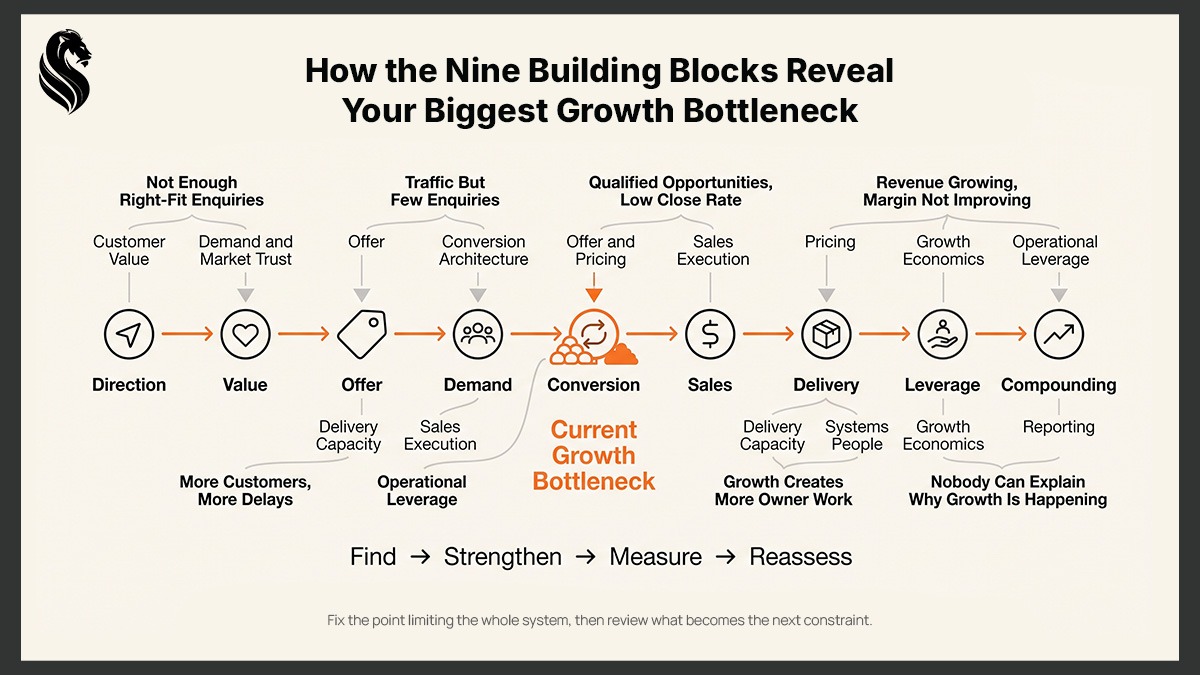
The nine building blocks operate as a connected system, which means strength in one area cannot always compensate for a constraint elsewhere. Strong demand can be undermined by weak sales execution, while rising sales can create delivery pressure or declining margins.
This is the core idea behind the Theory of Constraints: overall performance is limited by the system’s biggest constraint. Improving areas that are not limiting performance may create more activity without materially improving the result.
Think of the framework as a flow:
Direction → Value → Offer → Demand → Conversion → Sales → Delivery → Leverage → Compounding
The goal is to find where that flow starts to break down.
Look for patterns such as:
- Not enough of the right enquiries: Review customer value, positioning and demand generation.
- Strong traffic but few enquiries: Review the offer, trust and conversion architecture.
- Plenty of enquiries but few qualified opportunities: Review targeting, qualification and customer fit.
- Qualified opportunities but a low close rate: Review pricing, sales execution and follow-up.
- Revenue is growing, but margins are not: Review pricing, service mix and delivery costs.
- More customers are creating delays or quality issues: Review delivery capacity and processes.
- Growth creates more admin or owner involvement: Review systems, automation and operational leverage.
- Customers rarely return or refer: Review customer value, experience and retention.
- The business is growing, but nobody can explain why: Review measurement and reporting.
The important step is separating the symptom from the constraint.
Low revenue is a result, not a diagnosis. The underlying problem could be weak demand, poor conversion, low pricing, limited capacity or weak retention.
That is why the better question is not:
“Where could we improve?”
It is:
“Which improvement would remove the biggest constraint on profitable growth right now?”
The bottleneck will also change over time. Once one constraint is removed, another part of the system may become the next limiting factor. The Theory of Constraints treats this as an ongoing cycle of identifying, improving and reassessing the constraint.
A practical business growth framework should work the same way.
Find the area creating the most friction, strengthen it, measure the effect, then review the system again.
Scale What Has Earned More Investment
Once you have reviewed the nine building blocks, the next decision is not simply what to improve. It is where additional investment will produce the strongest commercial return.
Not every weak area needs to be fixed at once, and not every successful activity deserves to be scaled. The priority should be the part of the system that is either restricting growth or has shown enough evidence to justify more resources.
If demand is strong but enquiries are not converting, investment may need to go into the offer, conversion path or sales process rather than generating more traffic. If sales are increasing while delivery becomes slower, more expensive or harder to manage, the priority may shift to capacity, processes or operational leverage.
If a channel is producing qualified opportunities, those opportunities are converting profitably, and the business can deliver the work consistently, that channel has a stronger case for more investment. The key is to look for three things: where value is leaking, whether the system can absorb more volume, and whether the opportunity has already proved itself.
This changes the growth question from:
“What should we do more of?”
to:
“What has earned the right to receive more resources?”
That might mean increasing spend on a proven acquisition channel. It could just as easily mean investing in pricing, sales capability, automation, retention or delivery capacity.
A practical business growth framework helps you make that decision with evidence rather than assumption.
Build for the Next Stage, Not Just More Activity
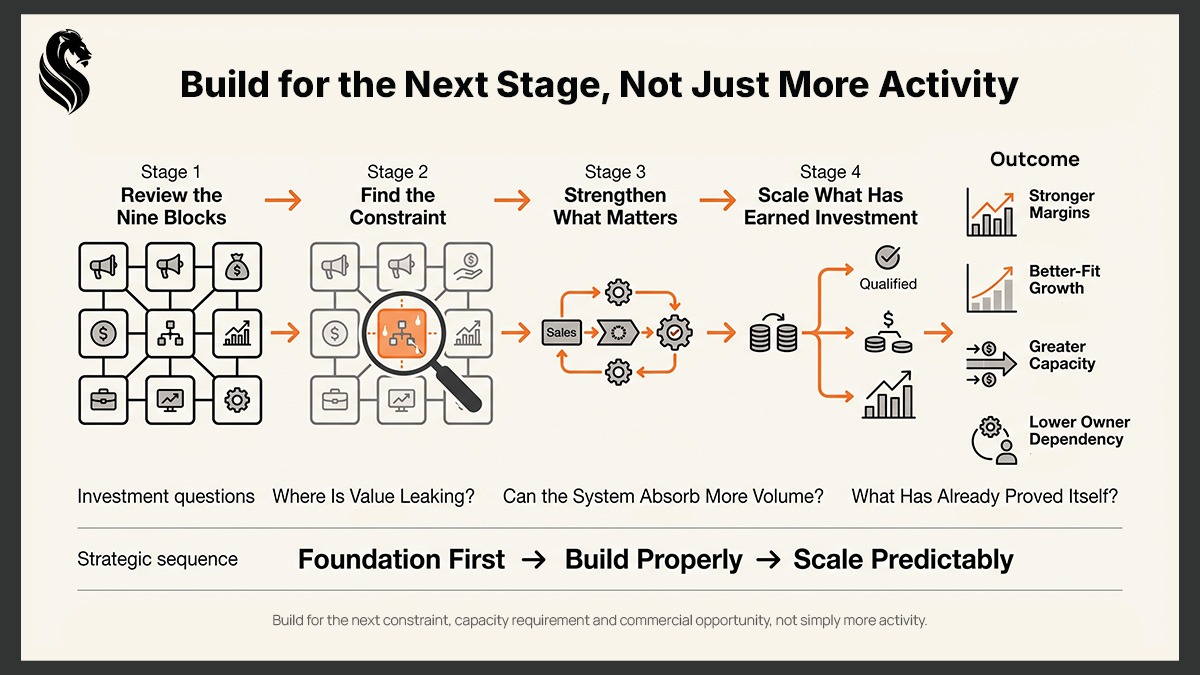
Growth does not usually stall because a business has run out of tactics. It stalls because one part of the system is no longer strong enough to support the next stage.
A business growth framework gives you a way to identify where value is being lost, find the constraint that matters most and decide where additional investment is justified. Because that constraint can move as the business grows, the framework should be revisited as priorities, capacity and opportunities change.
The businesses that scale well are the ones that keep asking better questions about where growth is coming from, what is limiting it, and what has genuinely earned more resources.
If your business has momentum but growth still feels harder, more manual or less predictable than it should, the next step may not be another campaign. It may be identifying which part of the commercial system is holding growth back.
Wandering Lion’s Growth Audit identifies the bottlenecks limiting growth, clarifies what needs attention first and turns that diagnosis into a practical roadmap for building the right system before scaling further.
FAQs
What is a business growth framework?
A business growth framework is a structured way to assess how different parts of a business support growth. It helps identify where value is being created, where it is being lost, and which areas need attention before more resources are committed to scaling.
How do you know if your business is ready to scale?
A business is more ready to scale when demand is converting profitably, delivery can absorb more volume, systems reduce manual effort, and performance can be measured clearly. If growth creates more friction, owner dependency or margin pressure, there may still be a constraint to address first.
What is the biggest barrier to business growth?
There is no single barrier that applies to every business. The biggest constraint could be demand, pricing, conversion, sales follow-up, delivery capacity, systems or retention. The purpose of a business growth framework is to identify which constraint is limiting profitable growth right now.

Fix the Constraint Before You Add More Growth
Growth becomes harder and more expensive when demand is added to weak positioning, sales, delivery, systems or reporting. The article’s central argument is to identify the constraint limiting profitable growth, strengthen the supporting system, then invest further only when the business can absorb and convert more demand.

Scale the System, Not the Problem
Sustainable growth comes from understanding how direction, value, demand, conversion, sales, delivery and systems work together. Review the foundations first, fix the biggest commercial constraint, then scale what has earned further investment.
Review the Whole Growth System
A business growth framework should connect commercial direction, customer value, offer, demand, conversion, sales, delivery, operational leverage and growth economics rather than treating growth as a collection of disconnected tactics.
Find the Constraint Limiting Growth
Weak revenue, poor conversion or rising workload are symptoms, not diagnoses. Identify where value is actually being lost before committing more time, budget or demand to the system.
Scale What Has Proved Itself
More investment only makes sense when an opportunity is producing the right demand, converting profitably and can be delivered without creating excessive workload, margin pressure or operational friction.
Build for the Next Stage
Growth should make the business stronger, not simply busier. Keep reassessing the system as constraints move, strengthening the foundations and operating capacity required for the next stage before adding more activity.

Find What Is Holding Growth Back
If growth is becoming harder, more manual or less predictable, adding another campaign may only put more pressure on the problem. Wandering Lion’s Growth Audit reviews the commercial foundations, customer journey, sales process, systems and reporting to identify the biggest constraint and build a practical roadmap for what needs attention first.
KEEP READING
Explore more







FEEDBACK FROM THE FIELD
No polished scripts. Just the raw operational reality from owners who cleaned up their pipelines and got out of the daily administrative loop.
“When we set out to grow Discmania in the US market, Ryan was a key part of laying that foundation. He helped us cut through the noise & restructured how we told the story of each release, aligning our athlete partnerships with the brand, and building the kind of community touchpoints that turned buyers into fans. The results spoke for themselves. I’d work with him again without hesitation.”



“In 2019, Ryan from Wandering Lion helped transform the Kalamunda Eastern Suns’ presence in the community. He lifted our social profile, drove some of the strongest brand engagement in the league, and helped turn sparse crowds into sellouts. His work also strengthened sponsor interest and raised the overall profile of the club in a way that felt polished, professional, and genuine.”

“Young people who had switched off from school were not going to reconnect because of a campaign headline or a polished message. They needed a genuine reason to turn up again. Wandering Lion brought a strong sense of care to how the story was told. That gave the foundation a clearer public identity.”





“Working with Wandering Lion on the Discmania project was a standout experience. The team’s position work, blended creative vision with strategic execution, was a major asset as we built the Discmania brand globally. The work he produced didn’t just look great. It elevated our brand presence and supported measurable growth across multiple markets.”




“Wandering Lion understood from the outset that the Pacific Hockey League could not simply be another competition with a new name. Their work helped shape a player-first league with the right balance of ambition, fairness, and professionalism. What they brought was not just branding or communication, but real strategic thinking that gave the PHL a stronger and more credible foundation.”

“Authenticity is the centrepiece of all Lajosi Putter customisation works. The brand is reflected in each of our hand-made custom putters. Ryan’s team solidified that identity in our online presence. It led to higher social media engagement from a golfing community who value hand-crafted putters over overly polished ones.”

‹
›
READY TO FIX YOUR GROWTH?
Stop guessing. Get clarity on what's actually slowing your business down.
