
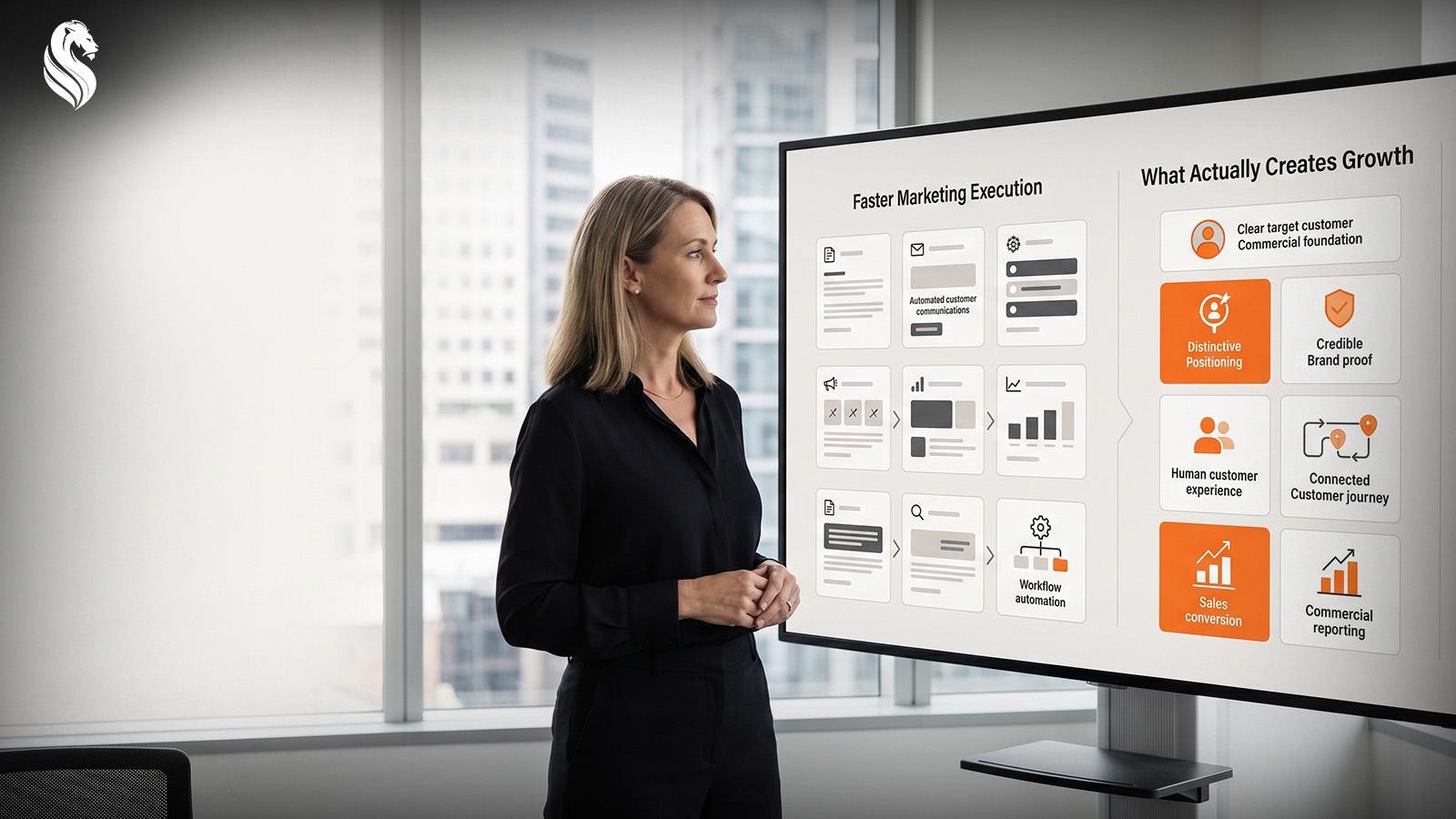
RESET 2026: Why AI Makes Brand Clarity More Valuable
AI can make marketing faster. It cannot make a weak business proposition stronger.
That was one of the clearest lessons from RESET 2026, held in Sydney on 6 August under the theme “Growth Through Disruption.” Across sessions on AI, automation, trust and marketing effectiveness, the same issue kept coming up: businesses have more tools than ever, but better tools do not automatically produce better growth.
For owner-led businesses, the lesson is fairly simple.
AI can produce more content, automate more tasks and analyse more data. But it cannot compensate for weak positioning, an unclear offer, a poor customer journey or disconnected sales systems.
As marketing becomes easier to produce, clarity becomes more valuable.
For businesses deciding how to use AI in marketing, that may be one of the most useful lessons from RESET 2026.
AI Is Making Marketing Easier. That Does Not Make Growth Easier.

AI is reducing the time, cost and effort required to produce marketing. But RESET 2026 repeatedly returned to a more important question: does greater efficiency actually create stronger growth?
The answer depends on the business underneath it. Again and again, the discussion returned to differentiation, customer behaviour, trust and brand value.
Optimisation Can Make Every Business Look the Same
Rory Sutherland challenged the tendency to rely too heavily on optimisation, benchmarks and rational decision-making.
When businesses use the same data, platforms and best practices, they often arrive at similar conclusions. Marketing may become more efficient, but it can also become harder to tell apart.
Optimisation can improve performance within an existing system. It does not necessarily create the distinctive reason customers need to choose one business over another.
Before Marketing Technology, Understand Human Behaviour
Raja Rajamannar argued that marketing has become too influenced by platforms, measurement systems and technology, while losing sight of how people actually make decisions.
Customers do not make decisions on rational information alone. Behaviour, emotion, familiarity and perceived risk all influence how people assess a brand and decide whether to act.
Technology may help you reach the right person. It cannot replace understanding what makes that person trust, prefer and choose your business.
As AI Becomes Common, Human Experience Becomes Scarcer
Catherine Ball’s discussion of AI adoption raises a broader question for businesses: as more processes become automated, the human parts of the customer experience may become more valuable.
Personal interaction, thoughtful service and memorable real-world experiences are difficult to automate well.
For businesses, the opportunity is not to remove people from every process. It is to automate the work customers do not value while protecting the moments they remember.
Trust Is Becoming a Commercial Asset
Nick Bryant’s contribution reinforced how valuable trust becomes when audiences are surrounded by conflicting claims, misinformation and AI-generated content.
As customers encounter more content, more claims and more AI-generated information, credibility becomes increasingly important.
Trust affects whether someone believes your message, an enquiry, completes a purchase and recommends the business afterwards. That makes trust more than a brand value. It directly affects commercial performance.
Efficiency Without Brand Value Is a False Economy
AI creates obvious opportunities to reduce costs and increase output. But efficiency alone is not growth. Research from the IPA highlights the value of balancing short-term sales activation with long-term brand building to support stronger business results.
Producing more content achieves little if customers cannot distinguish the business from its competitors. Automating lead generation achieves just as little if enquiries enter a sales process that fails to convert them.
The better use of AI is to remove wasted effort while protecting the things customers actually notice: clear differentiation, a strong experience and a brand they trust.
AI can make marketing faster. Growth still depends on giving people a clear and credible reason to choose you.
The Foundations AI Cannot Supply
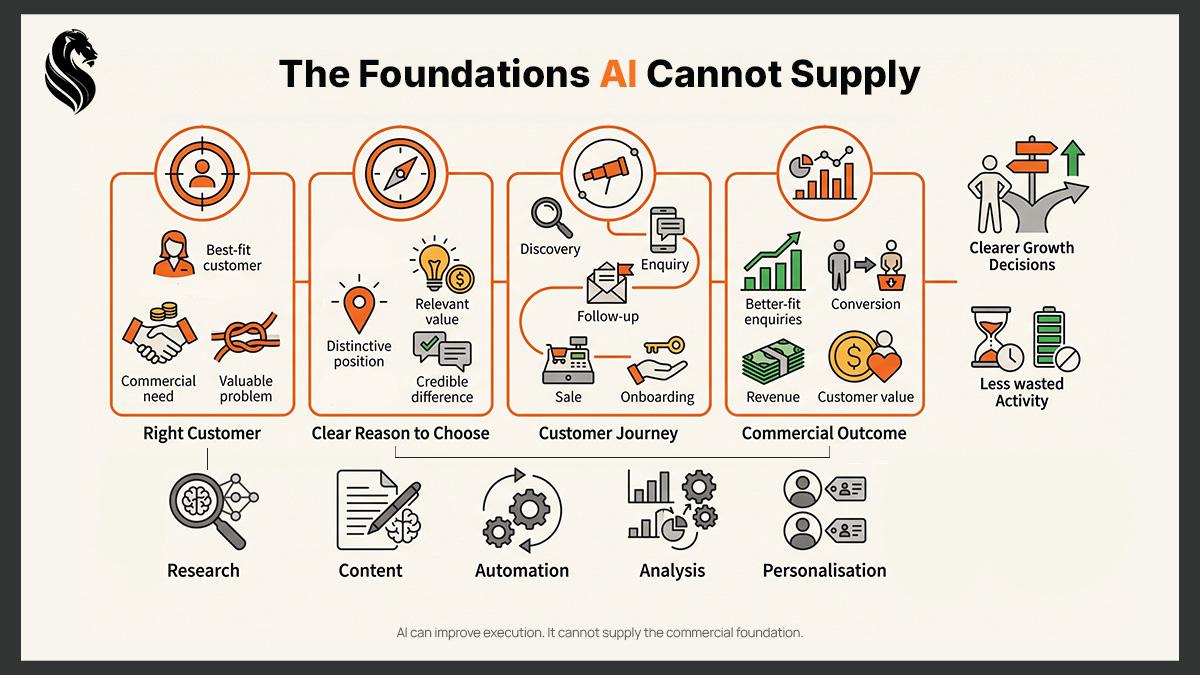
AI can improve execution, but it cannot decide what a business should stand for.
Before adding more automation, content, or media spend, a business still needs a clear commercial foundation. That means knowing who it serves, why customers should choose it, how those customers move from interest to sale, and which outcomes actually matter.
Without those answers, AI simply increases activity.
Know Who You Are Trying to Serve
Many businesses define their audience too broadly.
Marketing gets easier when you know exactly which customers you are best placed to help. That clarity improves the offer, message, sales process and customer experience, while making it easier to attract better-fit leads and reduce wasted effort.
Customer data and AI tools may reveal useful patterns, but choosing which customers matter most is still a business decision.
Give Customers a Clear Reason to Choose You
Most businesses can list their strengths.
Fewer can explain, in a sentence, why a customer should choose them over a competitor.
That difference matters.
Claims such as quality, service and experience only become meaningful when they are specific, credible and relevant to the customer making the decision. A clear position makes the decision easier because customers understand what is different about you and why that difference matters.
AI can help refine the wording.
It cannot create genuine differentiation where none exists.
Understand the Path From Interest to Sale
Marketing does not end when somebody clicks, calls or fills in a form.
Think about what happens from the first time someone hears about you through to enquiry, follow-up, sale, onboarding and, eventually, repeat business or referral.
Weakness at any point can reduce the return on everything that came before it.
There is little value in generating more leads if enquiries are followed up slowly, quotes are not tracked, or opportunities disappear between marketing and sales. More traffic will not solve a weak sales process, and better content will not fix a poor onboarding experience.
Automation only helps once the customer journey and sales handover work properly.
Use AI as an Amplifier, Not a Substitute for Strategy
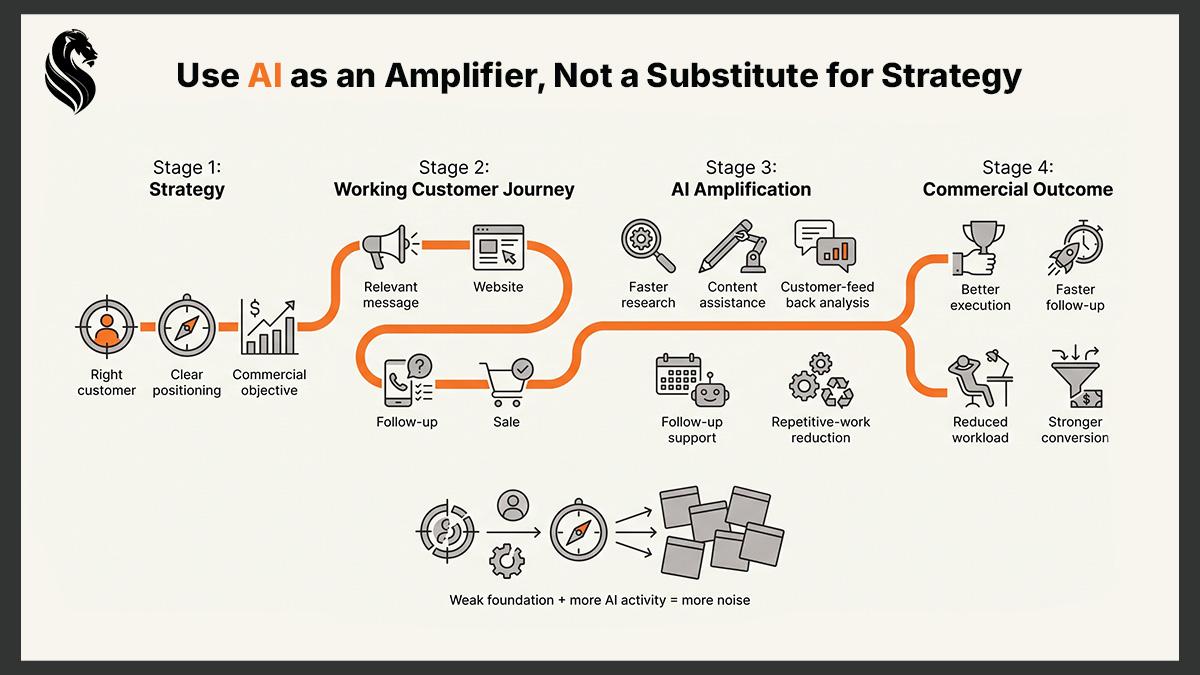
AI can make a good system faster.
It can accelerate research, improve follow-up, analyse customer feedback, personalise communication and reduce repetitive work. But it works best when the business already knows what it is trying to achieve.
Without those foundations, AI risks creating more content, more automation and more data without producing more growth.
That may be the most useful lesson from RESET 2026.
As marketing becomes easier to produce, clarity becomes harder to replace.
The businesses that benefit most from AI will be the ones that already understand who they serve, why they are different, how customers move from interest to sale, and which outcomes actually matter.
AI should amplify those decisions, not make them for you. The same principle applies to marketing more broadly: activity amplifies clarity. It does not create it.
If your marketing feels busy but disconnected, the first step is to identify what is actually slowing growth across your positioning, customer journey, sales process and systems.
Talk to Wandering Lion about a foundation-first Growth Audit to clarify what needs fixing before you add more marketing, automation or spend.
FAQs
What was the main theme of RESET 2026?
RESET 2026 centred on “Growth Through Disruption.” The event looked at how AI, automation, trust and changing customer behaviour are affecting marketing. Across the event, the recurring message was that technology may help businesses move faster, but growth still depends on differentiation, trust, customer understanding and a clear reason to choose.
Can AI replace marketing strategy?
Not really. A tool can help you work through research, draft ideas or speed up reporting, but it cannot decide what your business should be known for. That still comes down to judgement: who you want to serve, what makes you worth choosing and where you want the business to go.
How should businesses use AI in marketing?
Start with the foundations. Make sure your offer, positioning, customer journey and sales process are clear, then use AI to reduce repetitive work, improve follow-up and make the system more efficient. Adding technology to a weak process usually just makes the weakness move faster.

AI Creates More Value When the Business Is Clear First
AI can increase marketing output, automate repetitive work and improve efficiency, but it cannot fix weak positioning, an unclear offer or a disconnected customer journey. Businesses should strengthen the commercial foundation first, then use AI to improve and accelerate a system that already gives customers a clear reason to choose.

AI Should Amplify a Strong Growth System, Not Replace One
RESET 2026 reinforced a practical growth lesson: better technology does not automatically create better marketing or stronger commercial outcomes. Businesses still need differentiation, trust, a clear customer journey and sound strategic decisions before automation can create meaningful value.
Efficiency Does Not Guarantee Growth
AI can make marketing faster and cheaper, but greater output does not matter if the business still lacks differentiation, trust or a compelling reason to choose.
Optimisation Can Reduce Differentiation
When businesses rely on the same platforms, benchmarks and best practices, their marketing can become increasingly similar. Efficiency should strengthen a distinctive position rather than make the business harder to tell apart.
Strong Foundations Still Come First
AI cannot decide who the business should serve, why customers should choose it or how the journey from interest to sale should work. Those decisions need to be clear before more automation or marketing activity is added.
AI Works Best as an Amplifier
Once the strategy, positioning and customer journey are clear, AI can support research, follow-up, analysis, personalisation and repetitive work. The goal is to make a good growth system more effective, not use technology as a substitute for one.

Get the Foundation Clear Before Adding More Activity
If your marketing feels busy but disconnected, start by identifying what is actually limiting growth across your positioning, offer, customer journey and sales process. A foundation-first Growth Audit can help clarify what needs fixing before you add more automation, content or marketing spend.
KEEP READING
Explore more





FEEDBACK FROM THE FIELD
No polished scripts. Just the raw operational reality from owners who cleaned up their pipelines and got out of the daily administrative loop.
“When we set out to grow Discmania in the US market, Ryan was a key part of laying that foundation. He helped us cut through the noise & restructured how we told the story of each release, aligning our athlete partnerships with the brand, and building the kind of community touchpoints that turned buyers into fans. The results spoke for themselves. I’d work with him again without hesitation.”



“In 2019, Ryan from Wandering Lion helped transform the Kalamunda Eastern Suns’ presence in the community. He lifted our social profile, drove some of the strongest brand engagement in the league, and helped turn sparse crowds into sellouts. His work also strengthened sponsor interest and raised the overall profile of the club in a way that felt polished, professional, and genuine.”

“Young people who had switched off from school were not going to reconnect because of a campaign headline or a polished message. They needed a genuine reason to turn up again. Wandering Lion brought a strong sense of care to how the story was told. That gave the foundation a clearer public identity.”





“Working with Wandering Lion on the Discmania project was a standout experience. The team’s position work, blended creative vision with strategic execution, was a major asset as we built the Discmania brand globally. The work he produced didn’t just look great. It elevated our brand presence and supported measurable growth across multiple markets.”




“Wandering Lion understood from the outset that the Pacific Hockey League could not simply be another competition with a new name. Their work helped shape a player-first league with the right balance of ambition, fairness, and professionalism. What they brought was not just branding or communication, but real strategic thinking that gave the PHL a stronger and more credible foundation.”

“Authenticity is the centrepiece of all Lajosi Putter customisation works. The brand is reflected in each of our hand-made custom putters. Ryan’s team solidified that identity in our online presence. It led to higher social media engagement from a golfing community who value hand-crafted putters over overly polished ones.”

‹
›
READY TO FIX YOUR GROWTH?
Stop guessing. Get clarity on what's actually slowing your business down.
