

What Your Business Needs Before It Can Scale
A business can look successful from the outside while still being unprepared for its next stage of growth. Demand may be increasing, enquiries may be arriving, and revenue may be moving in the right direction, but weak growth foundations can make every new opportunity harder to manage.
The owner often becomes the person holding everything together. They monitor leads, check quotes, solve customer issues, approve marketing, review team performance, and try to work out which activities are producing revenue.
The natural response is often to generate more demand through advertising, content, search, referrals, or another sales channel. But additional demand does not repair the system behind the marketing. It places more pressure on it.
More leads enter a website that does not communicate the offer clearly. Enquiries reach a team without a consistent follow-up process. Quotes are sent but not tracked. Marketing reports show clicks and traffic without explaining what became real work.
Scale is not simply an increase in activity. It is the ability to handle more demand without losing control, profitability, service quality, or owner time.
That requires a deliberate sequence.
Foundation First. Build Properly. Scale Predictably.
Scaling Is Different From Getting Busier
Many owners treat increasing workload as evidence that the business is scaling. The two are not the same.
A business can become busier because it is receiving more enquiries, delivering more jobs, managing more suppliers, and handling more customer requests. But if revenue is inconsistent, margins are unclear, follow-up depends on memory, and the owner must approve every decision, the business has increased its workload rather than its capacity.
Real scale means the business can produce stronger commercial outcomes without requiring the owner to absorb a matching increase in pressure.
A scalable business should be able to:
- Attract better-fit customers
- Convert enquiries consistently
- Deliver work without constant owner intervention
- Track commercial performance
- Identify where opportunities are being lost
- Give team members clear responsibilities
- Increase volume without weakening the customer experience
- Return time and decision-making capacity to the owner
If the business cannot do these things, higher volume is likely to create missed follow-ups, slower decisions, delivery pressure, and more owner involvement.
Why More Marketing Does Not Fix Weak Growth Foundations

Marketing is often treated as the first solution because the visible symptom is a lack of leads, inconsistent sales, or slow revenue growth.
The deeper issue may sit elsewhere.
The brand may not clearly explain why the business is different. The offer may be difficult to understand. The website may not build enough trust. The sales team may respond slowly. Quotes may not be followed up. Reporting may not connect marketing activity to confirmed revenue.
In that situation, more advertising sends additional people into an inefficient system.
Ads amplify clarity. They do not create it.
A clear offer supported by a strong website, relevant proof, effective lead capture, disciplined follow-up, and useful reporting can convert increased attention into commercial value.
A weak system does the opposite. It increases cost, admin, confusion, and pressure.
Questions to Ask Before Increasing Demand
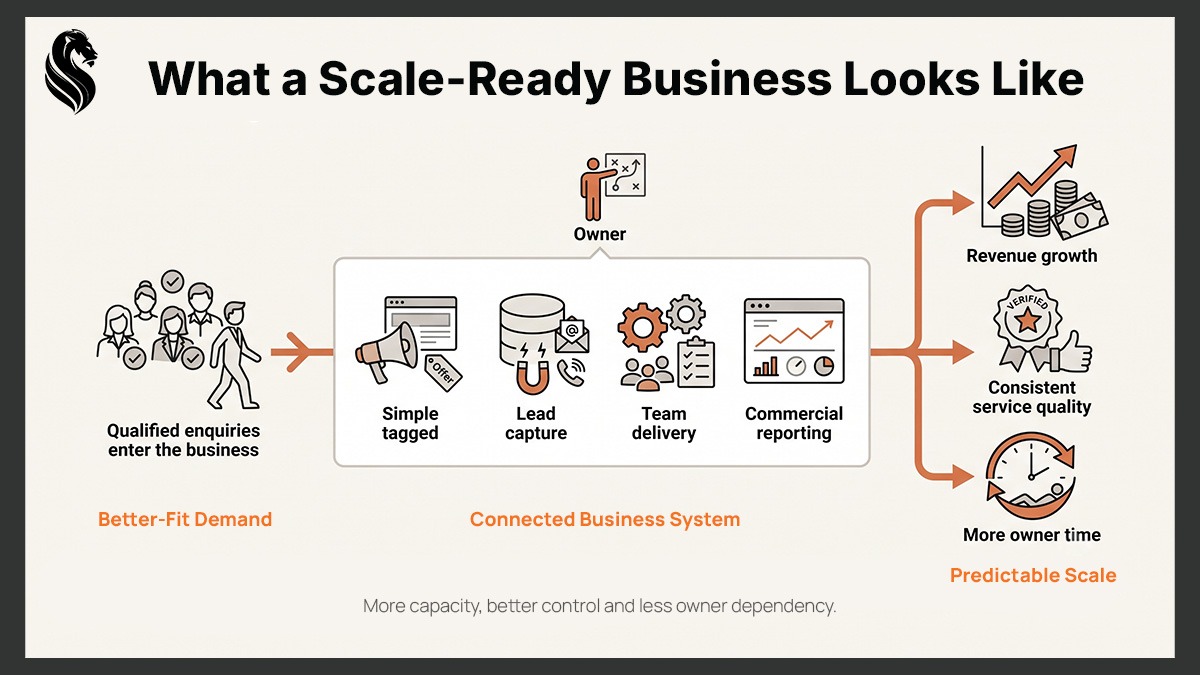
Before increasing demand, the owner needs to understand what happens from first contact through to confirmed sale.
- Where does the potential customer go?
- What do they understand about the business?
- What action are they encouraged to take?
- Who receives the enquiry?
- How quickly does the business respond?
- What happens after the first conversation?
- How are quotes and proposals tracked?
- Can the owner see which opportunities became revenue?
The answers show whether the business is ready to scale or is simply trying to generate more activity.
Growth Foundations Begin With Clear Positioning
A business cannot scale predictably when customers struggle to understand what it does, who it serves, or why they should choose it.
Clear positioning improves website messaging, sales conversations, proposals, advertising, referrals, and customer expectations.
Clear positioning should show:
- Who the business is built to serve
- What commercial or practical problem it solves
- Why its approach is different
- What outcome the customer can expect
- What proof supports the claim
- What the customer should do next
Without this clarity, the business may attract a broad range of enquiries that are difficult to qualify, expensive to service, or unlikely to convert.
The team then spends more time explaining the offer, handling poor-fit leads, preparing unnecessary quotes, and competing primarily on price.
Better positioning does more than improve marketing. It reduces waste throughout the customer journey.
The Offer Must Be Easy to Understand and Buy
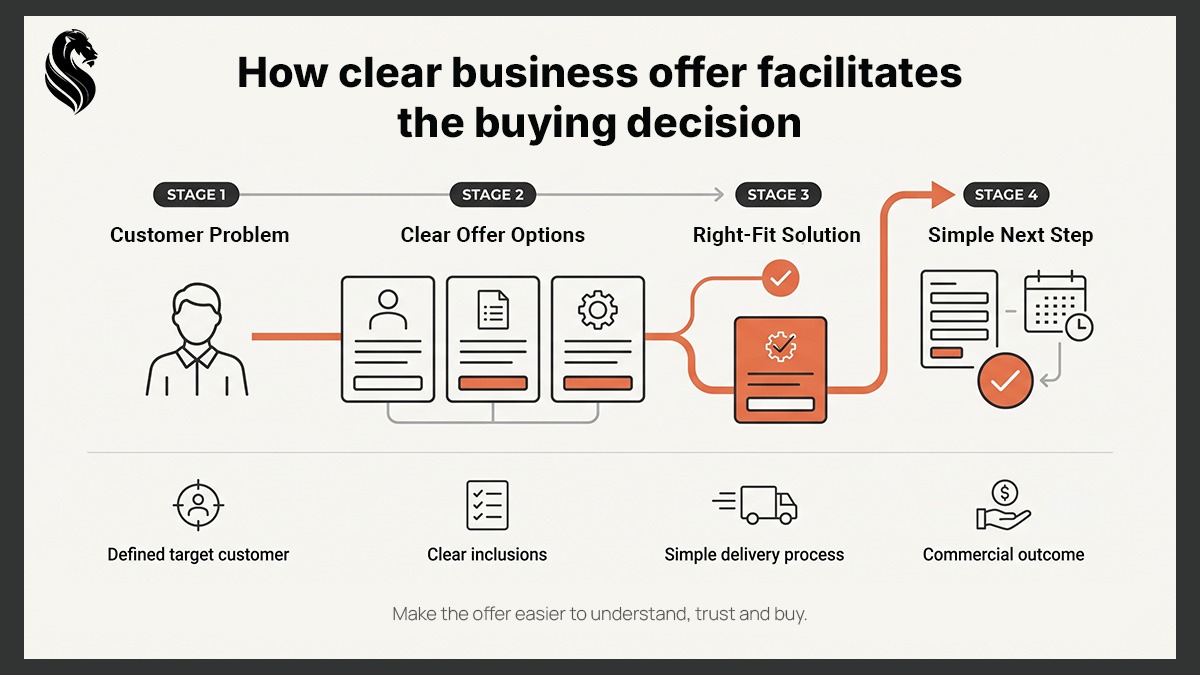
Some established businesses have strong technical capability but weak offer structure.
They provide several services, solve multiple problems, and adjust their work for each customer. This flexibility may be valuable, but it can make the buying decision harder.
Prospects may not know which service they need. Sales conversations become inconsistent. Quotes take too long to prepare. Team members describe the business differently. Marketing promotes activities rather than outcomes.
Before scaling, the business should clarify:
- The primary services or solutions
- The customers each offer is designed for
- The problem each offer addresses
- What is included
- What the delivery process looks like
- How the offer creates commercial value
- The next step for an interested customer
The goal is not to remove flexibility or force every customer into a rigid package. It is to make the buying decision easier and create a clear pathway into the business.
For example, a consultancy may provide ten individual services but find that customers usually approach it with three recurring problems. Structuring the website and sales process around those problems can help prospects identify the right starting point without needing the owner to explain every option.
The Website Must Support the Customer Journey
A website is not ready for scale simply because it looks professional.
It must help the right visitor understand the business, trust its capability, recognise the relevant service, and take a clear next step.
For many established businesses, the website has been built around internal information rather than customer decisions. It explains the company history, lists services, and displays general claims, but it does not guide different customer types through a relevant journey.
A scale-ready website should provide:
- Clear positioning on the homepage
- Service-specific and audience-specific pages
- Evidence of capability and outcomes
- Clear calls to action
- Simple lead capture
- Useful qualification questions
- Consistent messaging across key pages
- A logical path from interest to enquiry
The goal is not to add more pages for the sake of search visibility. The goal is to create a clearer route for customers with different needs and levels of intent.
A trade business owner looking for better-fit local work may need a different message from a professional consultancy pursuing larger commercial projects. Both may need growth support, but their concerns, buying triggers, and evidence requirements are different.
Relevance improves trust, and trust improves action.
Lead Handling Must Work Without the Owner
Generating an enquiry is only one part of the commercial process.
Many businesses lose opportunities after the lead arrives. An enquiry may sit in an inbox. A team member may call once but fail to follow up. A quote may be sent without a reminder. The prospect may ask a question that only the owner can answer.
This creates a costly blind spot. Marketing appears ineffective even though the real failure sits in the sales follow-up process.
A scale-ready lead handling system should cover four stages.
Capture
- Record every enquiry in one agreed system
- Collect the information needed to assess fit and intent
Assignment
- Identify who is responsible for responding
- Set a clear response-time standard
Follow-Up
- Define when calls, emails, reminders, and quote follow-ups occur
- Make the next action visible to the team
Outcome Reporting
- Mark opportunities as won, lost, delayed, or unsuitable
- Feed sales information back into marketing and operations
These steps do not need to create a complicated corporate process. They need to create consistency.
The owner should not have to search through emails, messages, spreadsheets, and team updates to understand what happened to an enquiry.
CRM and Automation Should Reduce Manual Work
A customer relationship management system, or CRM, can support growth, but software alone does not create a process.
Many businesses purchase a CRM and continue working through inboxes, spreadsheets, notebooks, and memory. The technology becomes another place to update rather than the central system for managing opportunities.
The process should be designed before automation is added.
The business must first decide what information matters, which stages an opportunity moves through, who owns each stage, and what action should happen next.
Automation can then support tasks such as:
- Confirming that an enquiry has been received
- Assigning leads to the right person
- Creating follow-up reminders
- Sending useful pre-appointment information
- Tracking quote status
- Requesting customer feedback
- Triggering internal notifications
- Supporting reporting
Each automation should solve a defined problem. It might reduce response time, prevent missed follow-up, improve customer communication, or give the owner clearer pipeline visibility.
Automating an unclear process only allows confusion to move faster.
The process must be agreed before the technology is configured.
Reporting Must Show Commercial Meaning
A business is not ready to scale if the owner cannot see what is working.
Marketing reports often focus on impressions, clicks, reach, engagement, and website traffic. These figures may help explain activity, but they do not tell the owner whether the business is attracting profitable work.
Commercial reporting should connect the full customer journey.
It should help the business understand:
- Which channels produce qualified enquiries
- Which services receive the strongest demand
- How quickly leads are contacted
- How many enquiries become quotes
- How many quotes become sales
- Which customer types produce stronger margins
- Where opportunities are lost
- What revenue is influenced
- What workload is being reduced
- What should happen next
This information allows the owner to make better decisions about marketing spend, team capacity, service priorities, pricing, and operational improvement.
Reporting should explain what happened, what it means, what needs attention, and what the business should do next.
Operations Must Be Ready to Deliver More Work
Marketing and sales can create demand faster than operations can absorb it.
A business may have a strong pipeline but still struggle because scheduling is manual, responsibilities are unclear, suppliers are unreliable, customer communication is inconsistent, or quality control depends on the owner.
Before increasing demand, the business should assess:
- Current team capacity
- Delivery timelines
- Role clarity
- Scheduling and workflow management
- Customer communication
- Quality control
- Supplier or contractor capacity
- Handover between sales and delivery
- Escalation processes
- Owner involvement
The goal is not to remove every operational challenge. It is to identify the weaknesses that will become more expensive when volume increases.
For example, a business handling ten enquiries a week through a shared inbox may manage through informal communication. At forty enquiries a week, the same approach can produce missed messages, slow responses, duplicate work, and frustrated customers.
Higher volume turns informal workarounds into missed deadlines, delivery pressure, and reduced margins.
Owner Dependency Is a Scale Readiness Warning
Owner involvement is natural in an established owner-led business. Owner dependency is different.
Dependency exists when progress stops without the owner.
The owner may be the only person who can approve pricing, explain the offer, resolve customer concerns, assess lead quality, interpret reports, or make delivery decisions.
This creates a ceiling on growth because the business can only move as quickly as the owner has time to respond.
Ask a practical question.
What happens when the owner is unavailable for one week?
If leads wait, quotes remain unsent, decisions stall, customers receive inconsistent answers, or the team becomes uncertain, the business is not yet operating through a reliable system.
Reducing owner dependency requires clear roles, documented processes, access to the right information, defined decision-making authority, and transparent reporting.
The goal is not to remove the owner from the business. It is to free them to focus on the decisions that genuinely require their judgement.
A Practical Growth Foundations Checklist
Before increasing advertising or lead generation, review the following areas.
Area
Key question
Warning sign
Brand and positioning
Can the right customer quickly understand who the business serves, what it solves, and why it is credible?
Enquiries are broad, poorly matched, or highly price-sensitive.
Offers
Are the services clear enough for customers and team members to understand the correct pathway?
The owner must repeatedly explain what the business provides.
Website and customer journey
Does the website create relevance, build trust, capture intent, and guide the visitor towards a useful next step?
Visitors arrive, but few become suitable enquiries.
Lead capture and follow-up
Is every enquiry recorded, assigned, contacted, followed up, and tracked?
Leads sit in inboxes or disappear after a quote is sent.
CRM and automation
Do systems reduce manual work and support the agreed sales process?
Staff update several systems or rely on memory.
Reporting
Can the owner connect activity to lead quality, sales outcomes, revenue, and workload?
Reports show activity but do not support commercial decisions.
Operations and capacity
Can the team deliver additional work without reducing quality or increasing owner intervention?
Backlogs, delays, rework, or customer complaints rise with demand.
Roles and responsibilities
Does each person know what they own, when they must act, and when to escalate an issue?
Decisions repeatedly return to the owner.
A weakness in one area does not necessarily mean the business should stop all growth activity. It means the next investment should address the part of the system currently holding growth back.
Foundation First, Then Build Properly
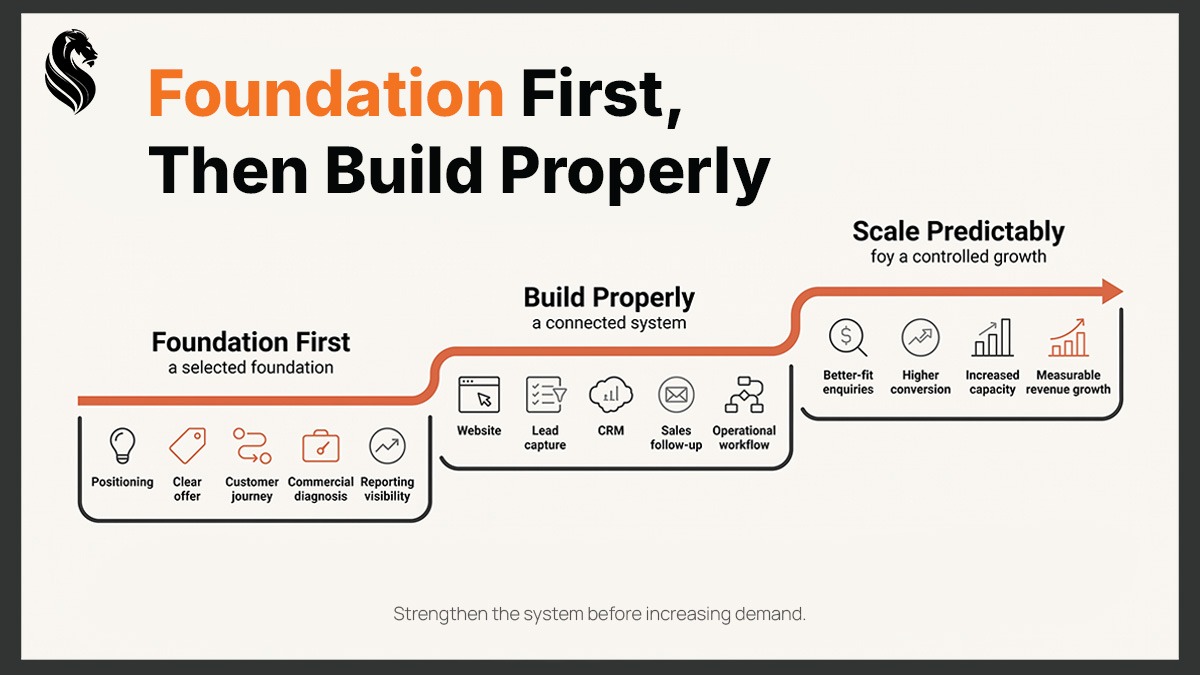
Once the current gaps are clear, the business can begin building the systems required for scale.
This may include improving positioning, restructuring website pages, clarifying offers, creating lead qualification forms, implementing a CRM, documenting follow-up, defining reporting, or improving the handover between sales and delivery.
The build stage should address the bottleneck currently costing the business the most revenue, time, customer confidence, or delivery capacity.
If strong enquiries are being lost after quoting, the priority may be sales follow-up rather than more lead generation.
Poor-quality enquiries may point to weak positioning, unclear offers, unsuitable targeting, or landing pages that fail to establish relevance.
Rising sales combined with delivery pressure may require clearer workflows, additional capacity, or better customer communication before another campaign begins.
The right sequence prevents the business from spending money on activity that the current system cannot convert or support.
Scale Predictably by Expanding What Works
Once the foundations are clear and the required systems are operating, the business can begin increasing demand with greater control.
The aim is not to scale every channel at once. It is to expand the activity that is producing the right customers, commercial returns, and manageable delivery outcomes.
Advertising, search, content, partnerships, and referral activity can then direct demand into a customer journey capable of turning attention into qualified enquiries and sales.
At this stage, the business can see which customers are the best fit, which offers convert, how quickly leads are handled, where sales are lost, and whether operations can support more work.
That evidence allows the business to increase investment gradually, monitor the impact across sales and delivery, and correct problems before they become expensive.
Scaling becomes a controlled process of increasing what works, measuring the result, and improving the system.
It does not remove risk. It makes risk more visible and manageable.
Build the Foundation Before You Scale
A business is not ready to scale simply because the owner wants more revenue or the market is producing more demand.
Scale readiness depends on the strength of the full commercial system.
The brand, offer, website, sales process, CRM, reporting, and operations must work together. Sustainable growth depends on the business being able to capture, convert, deliver, and measure demand without placing the full burden back on the owner.
Strong growth foundations protect more than marketing performance. They protect revenue, service quality, team capacity, customer trust, and owner time.
Foundation First. Build Properly. Scale Predictably.
Before investing in more activity, review the system that activity will feed into.
Book a Brand & Growth Scan to identify what is slowing growth, what needs to be fixed first, and what your business requires before it can scale predictably.
FAQs
How long does it take to strengthen growth foundations?
The timeline depends on the size of the business and the condition of its current systems. Some businesses may need focused improvements in one or two areas, while others require a broader review of positioning, website, sales, CRM, reporting, and operations.
Can a business keep marketing while improving its foundations?
Yes, but existing activity should be reviewed carefully. Marketing that is already producing profitable work may continue, while underperforming campaigns may need to be reduced until the business fixes the issues affecting lead quality, conversion, follow-up, or delivery.
Does a small team need formal growth systems?
A small team does not need unnecessary complexity, but it still needs clarity. Simple processes for lead ownership, follow-up, quoting, customer communication, and reporting can prevent missed opportunities and reduce reliance on the owner.

Scale Readiness Is a Systems Question
Increasing demand does not create sustainable growth when the brand, website, sales process, reporting, and operations are disconnected. A business becomes ready to scale when these foundations work together to convert the right enquiries, protect delivery quality, reduce owner dependency, and support better commercial decisions.

Build the System Before Increasing Demand
A business should not treat more marketing as the automatic answer to slow or inconsistent growth. Strong foundations must come first, followed by connected sales, delivery, automation, and reporting systems that allow the business to scale with control.
More Activity Is Not the Same as Scale
Higher enquiry volume can increase workload without improving capacity, profitability, or owner freedom. Real scale means the business can handle more demand without creating more pressure or weakening the customer experience.
Clarity Must Come Before Campaigns
Advertising cannot repair unclear positioning, weak offers, poor website journeys, or inconsistent sales follow-up. Ads amplify clarity, so the commercial foundations must be reviewed before more demand is added.
Build a Connected Enquiry-to-Sale System
Lead capture, ownership, follow-up, CRM, automation, and reporting must work as one process. This gives the team consistency, prevents opportunities from being lost, and reduces the owner’s need to monitor every lead personally.
Scale What the Business Can Convert and Deliver
Once the foundations and systems are operating properly, the business can increase investment in the channels producing the right customers and manageable commercial outcomes. Scaling then becomes a controlled process of measuring, improving, and expanding what works.

Find the Growth Constraint Before Adding More Activity
A Brand & Growth Scan reviews the foundations affecting lead quality, sales conversion, reporting, delivery capacity, and owner workload. It identifies what is holding growth back, what needs to be fixed first, and what the business must build before it can scale predictably.
KEEP READING
Explore more




FEEDBACK FROM THE FIELD
No polished scripts. Just the raw operational reality from owners who cleaned up their pipelines and got out of the daily administrative loop.
“When we set out to grow Discmania in the US market, Ryan was a key part of laying that foundation. He helped us cut through the noise & restructured how we told the story of each release, aligning our athlete partnerships with the brand, and building the kind of community touchpoints that turned buyers into fans. The results spoke for themselves. I’d work with him again without hesitation.”



“In 2019, Ryan from Wandering Lion helped transform the Kalamunda Eastern Suns’ presence in the community. He lifted our social profile, drove some of the strongest brand engagement in the league, and helped turn sparse crowds into sellouts. His work also strengthened sponsor interest and raised the overall profile of the club in a way that felt polished, professional, and genuine.”

“Young people who had switched off from school were not going to reconnect because of a campaign headline or a polished message. They needed a genuine reason to turn up again. Wandering Lion brought a strong sense of care to how the story was told. That gave the foundation a clearer public identity.”





“Working with Wandering Lion on the Discmania project was a standout experience. The team’s position work, blended creative vision with strategic execution, was a major asset as we built the Discmania brand globally. The work he produced didn’t just look great. It elevated our brand presence and supported measurable growth across multiple markets.”




“Wandering Lion understood from the outset that the Pacific Hockey League could not simply be another competition with a new name. Their work helped shape a player-first league with the right balance of ambition, fairness, and professionalism. What they brought was not just branding or communication, but real strategic thinking that gave the PHL a stronger and more credible foundation.”

“Authenticity is the centrepiece of all Lajosi Putter customisation works. The brand is reflected in each of our hand-made custom putters. Ryan’s team solidified that identity in our online presence. It led to higher social media engagement from a golfing community who value hand-crafted putters over overly polished ones.”

‹
›
READY TO FIX YOUR GROWTH?
Stop guessing. Get clarity on what's actually slowing your business down.
