

Why Growth Problems Need Diagnosis Before Solutions
Growth problems are rarely as simple as they first appear.
A drop in sales can look like a lead problem. Rising acquisition costs can look like an advertising problem. Poor conversion can look like a sales problem. An overloaded owner can assume the business simply needs more staff. But the visible symptom is not always the real constraint.
That is where many businesses make expensive decisions. They react to what is easiest to see, then invest in a solution before understanding what is actually limiting growth. More campaigns are launched. Websites are rebuilt. New systems are added. Budgets increase. Yet the underlying issue remains untouched.
The better approach is to diagnose the business as a connected system. Positioning affects lead quality. Lead quality affects sales. Sales processes affect conversion. Delivery capacity affects how much growth the business can actually handle. Reporting determines whether anyone can see where revenue and opportunities are being lost.
Understanding these connections is how you identify the real business growth bottlenecks. Before deciding what to fix, the first job is to understand where the constraint sits, why it is affecting performance, and which change is most likely to improve the commercial outcome.
Why Owner-Led Businesses Often Diagnose Growth Problems in the Wrong Place

Owner-led businesses often feel a growth problem before they fully understand it. Revenue slows, acquisition becomes more expensive, conversion weakens, or the owner finds themselves carrying more of the workload.
Those signals matter, but they do not necessarily reveal where the problem began.
This is particularly important in owner-led businesses, where decisions often need to be made quickly, and the owner is close to every part of the operation. The pressure to respond can make the most visible problem feel like the most logical place to intervene.
That is how a business can execute a solution well while still solving the wrong problem.
The Loudest Growth Problem Isn't Always the Limiting Problem
Imagine a trade business that wants more revenue.
Enquiry volume looks lower than expected, so the immediate response is to increase advertising. But a closer look shows that existing enquiries are taking too long to receive a response, quotes are not being followed up consistently, and missed opportunities are not being tracked.
These findings do not explain the lower enquiry volume. They reveal a separate problem: the business may be losing work it already has an opportunity to win. Before increasing advertising, the owner needs to establish whether insufficient demand, poor conversion or both are limiting revenue.
If enquiry and quote records show that slow responses and missed follow-up are the main constraint, improving that process should take priority. If too few suitable enquiries remain the limiting factor, increasing demand may be the right next step.
In a connected system, performance can deteriorate in one area because of friction somewhere else. Improving the most visible part of the process therefore does not always improve the overall result.
More traffic into a weak follow-up process simply gives the business more enquiries to lose.
The visible problem is a starting point for investigation, not the diagnosis itself.
Why Businesses Misdiagnose Growth Problems
Misdiagnosis often happens because the business is under pressure to act.
An owner seeing a decline in revenue rarely has the luxury of treating it as an abstract strategy exercise. Payroll continues. Targets remain. Staff need direction. Marketing spend is still going out.
The temptation is to move quickly from problem to solution.
Proximity creates another challenge. Owners often have deep knowledge of the day-to-day business, but being close to every decision can make wider patterns harder to see.
Supplier expertise can narrow the diagnosis further.
A media specialist will naturally investigate campaigns. A web developer will examine the website. A sales consultant will look at the pipeline. Each may identify a genuine weakness, but they are diagnosing the business through one part of the commercial system.
That becomes risky when a recommendation is made before the relationship between those parts has been understood. Most established businesses can find plenty to improve. The real challenge is understanding why the commercial result is occurring before choosing the intervention.
Diagnose the Business as a Connected Growth System
An owner-led business becomes easier to diagnose when growth is viewed from end to end.
A useful way to trace growth from end to end is:
Market → Positioning → Offer → Customer Journey → Enquiry → Sales → Delivery → Measurement
These stages do not operate independently.
Positioning influences who becomes interested. The offer and customer journey determine whether that interest becomes an enquiry. Qualification and follow-up shape what reaches sales and how much opportunity becomes revenue. Delivery determines whether additional growth can be handled profitably, while measurement shows the owner where performance is improving or breaking down.
The handoffs matter just as much.
A strong lead can be lost between enquiry and first contact. A good sales opportunity can disappear between proposal and follow-up. More demand can create operational pressure if delivery systems have not kept pace with growth.
This is why a single metric rarely provides a complete diagnosis.
A falling conversion rate shows where performance changed. It does not automatically explain what produced the change. The cause could sit in positioning, acquisition, the offer, the landing page, qualification, or what happens after the enquiry.
Good diagnosis follows the commercial result across the system before deciding where the problem actually sits.
Only after that should the business decide which issue deserves priority.
Not Every Problem Deserves the Same Priority
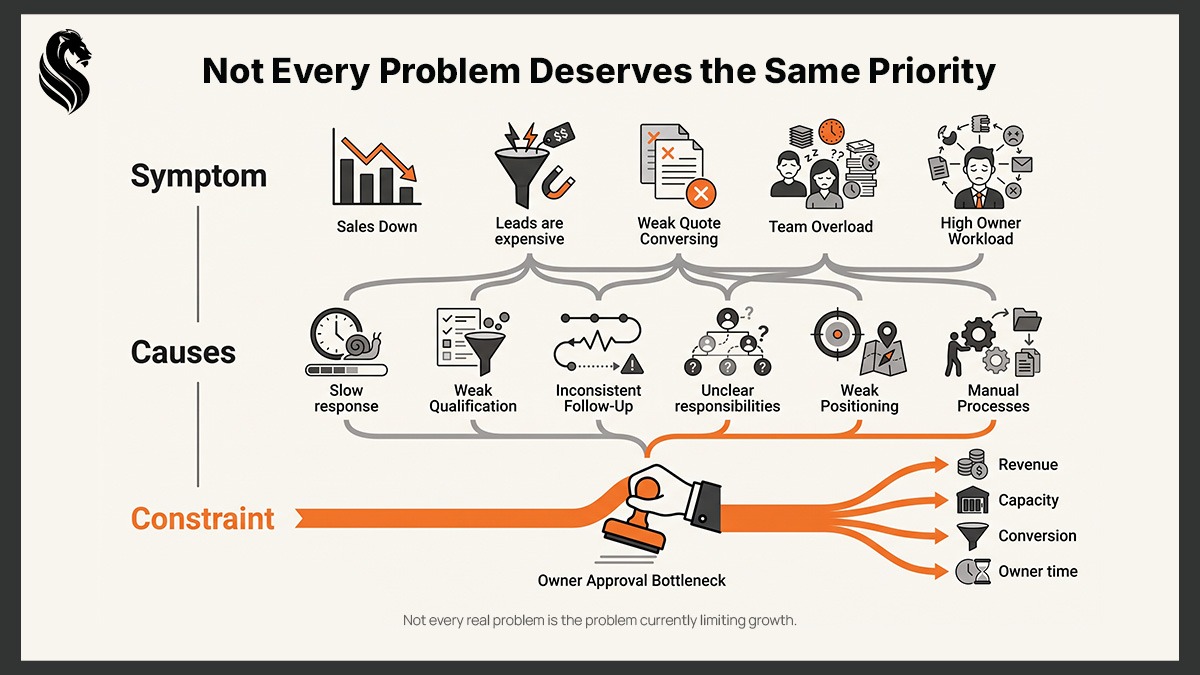
Once the business understands where its growth problems are coming from, the next challenge is deciding what to fix first.
Several issues may be real at the same time, including weak positioning, poor follow-up, an underperforming website, or too much owner involvement. The question is which one deserves priority.
For an owner-led business with limited time, budget and management capacity, the key question is:
Which issue is having the greatest effect on the outcome we want to improve?
That is where symptoms, causes and constraints need to be separated.
Symptom, Cause and Constraint Are Three Different Things
A symptom is what the owner can see.
Sales are down. Leads are expensive. Quotes are not converting. The team is overloaded. The owner is still working too many hours.
A cause helps explain why that symptom is occurring.
Quotes may not be converting because follow-up is inconsistent. Enquiries may be poor because qualification is weak. The owner may be overloaded because routine decisions still depend on them.
Diagnosing the cause matters because treating the symptom alone may improve the visible problem without removing what is producing it. There may also be several contributing causes, so the first explanation should not automatically be accepted as the final one.
A constraint is different again. It is the factor currently limiting the wider system from producing more of the outcome the business wants.
Consider a hypothetical established trade business receiving a steady flow of enquiries each month.
The owner may see:
Symptom: Not enough jobs are being won.
Further investigation might find:
Causes: Slow response times, inconsistent quote follow-up and weak lead qualification.
Constraint: Every significant quote still requires the owner's approval, limiting how much work can move through the business.
Even if marketing produces more enquiries and the sales team improves its follow-up, the same approval queue continues to limit how much work can move through the business.
That matters because a business can have several real problems without all of them having the same effect on growth.
Positioning, lead capture, follow-up, CRM discipline, reporting and owner dependency can all restrict growth at different points. Diagnosis becomes commercially useful when the business can distinguish a genuine weakness from the constraint that deserves priority.
Find the Constraint That Controls the Outcome
Owners rarely have unlimited time, budget or management capacity.
That makes prioritisation part of the diagnosis.
The useful question is not:
What could we improve?
There will almost always be a long answer to that.
The better question is:
What is currently preventing the business from achieving more of the outcome we want?
If the goal is more profitable revenue, the answer might be poor lead quality, slow sales follow-up, limited delivery capacity or owner dependency.
If the goal is to reduce workload, the constraint may not be demand at all. It could be a manual quoting process, unclear responsibilities or a system that requires the owner to intervene whenever something falls outside the normal workflow.
Constraint thinking is useful here because improving a part of the business that is not limiting overall performance can create local gains without materially improving the whole system. Focusing on the limiting point concentrates effort where it has the greatest chance of affecting the overall result.
A constraint does not have to be the weakest or easiest-to-measure part of the business. It is the issue currently placing the greatest limit on the outcome the business wants to improve, so priority should follow commercial impact rather than dashboard visibility.
Fix the Constraint, Then Watch What Changes
A diagnosis becomes useful when it leads to a measurable intervention.
Once a likely constraint has been identified, the business can make a targeted change and measure its effect on the wider outcome. Improvement provides evidence that the diagnosis was useful, but the intervention still needs to be assessed against the result it was intended to change.
For example:
Constraint: Good enquiries are sitting too long before receiving a response.
Change: Introduce clear ownership, CRM alerts and a defined response process.
Watch: Response time, quote rate, conversion and revenue from qualified enquiries.
Or:
Constraint: Too many poor-fit leads are entering the pipeline.
Change: Tighten positioning, landing-page messaging and qualification.
Watch: Lead quality, quote rate, average project value and sales conversion.
The point is not to make one change and declare the business fixed.
Once one constraint improves, another may become the new limiting factor. A business that once needed more enquiries may later need better qualification, sales capacity or delivery systems. Growth changes the system, so diagnosis needs to continue as the business develops.
That is why good diagnosis should not produce an endless list of things to optimise. It should create a clear sequence:
Identify the outcome → Find the constraint → Make the change → Measure the effect → Reassess the system.
That turns growth from a collection of reactive fixes into a more disciplined commercial process.
Don't Optimise Everything. Fix Things in the Right Order
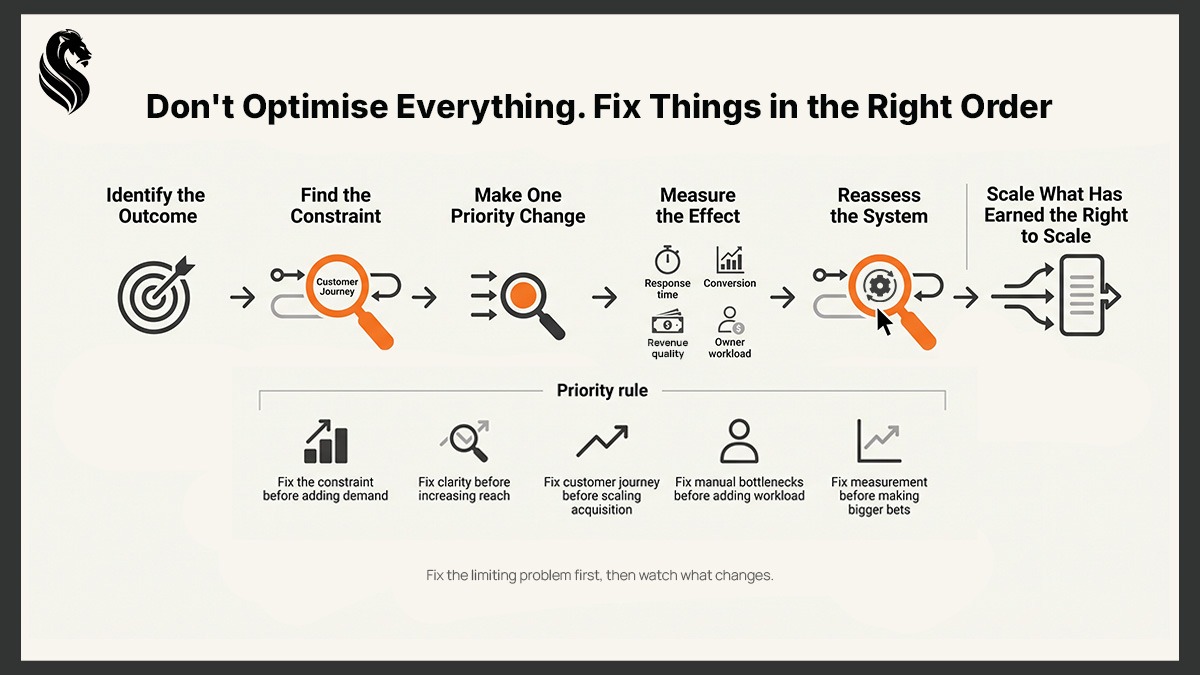
Once the constraint is clear, execution needs an order. Trying to improve every weakness at once spreads time, budget and management attention across too many priorities.
In practice, that means:
- Fix the constraint before adding more demand. If good enquiries are already being lost through slow follow-up or weak sales processes, generating more leads will not solve the core problem.
- Fix clarity before increasing reach. If positioning, messaging or the offer is unclear, sending more traffic into the same confusion is unlikely to improve efficiency.
- Fix the customer journey before scaling acquisition. Make sure enquiries can move cleanly from first contact through qualification, quote and sale before increasing demand.
- Fix manual bottlenecks before creating more workload. If the owner is still approving every quote, answering routine enquiries or moving information between disconnected systems, additional growth can increase pressure rather than reduce it.
- Fix measurement before making bigger bets. If the business cannot see where leads come from, how they progress or which activity influences revenue, it becomes difficult to know what deserves more investment.
- Scale only what has earned the right to scale. Once the foundations, journey, follow-up and reporting are working, growth activity can be increased with much greater confidence.
The practical sequence is straightforward: review the foundations first, build the systems that support the customer journey, then scale what is already working. This is the logic behind Wandering Lion’s Foundation First → Build Properly → Scale Predictably approach.
The goal is not to create a perfect business before taking action.
It is to avoid spending money improving areas that are not currently limiting growth.
For an owner-led business, that usually means asking one practical question before the next investment:
What needs to work better before more growth is added?
Better Growth Decisions Start With Better Diagnosis
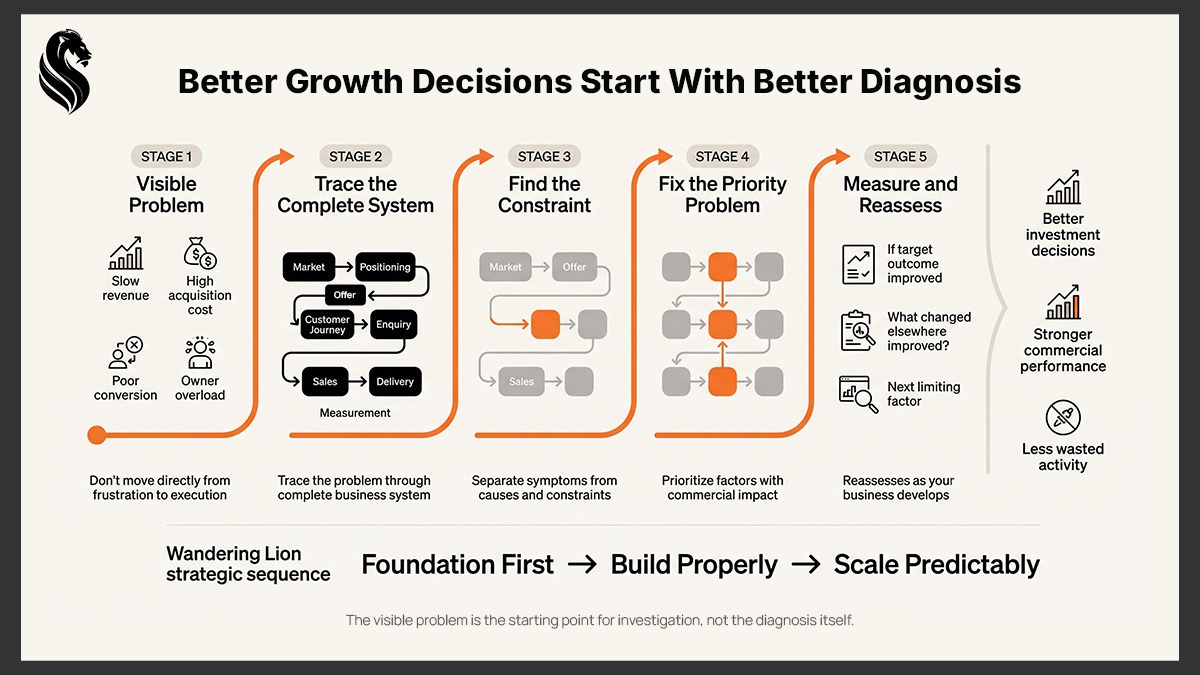
Growth problems become expensive when businesses move from frustration straight into execution.
More ads, a new website, extra content, another salesperson or a new CRM can all be useful. But only if they address the problem that is actually limiting growth.
For owner-led businesses, better growth starts by creating enough clarity to invest in the right problem.
That is the thinking behind Wandering Lion’s approach. Rather than prescribing more marketing activity, a Growth Audit reviews the foundations of the business, including positioning, website performance, customer journey, sales follow-up, marketing channels, CRM, automation and reporting. The aim is to identify what is slowing growth and what needs to happen next.
It identifies where revenue, opportunities or owner time are being lost, then turns the diagnosis into a practical roadmap ordered by commercial priority.
Where deeper work is required, Wandering Lion can then help build the systems, customer journeys, positioning, automation and reporting needed to fix the foundation properly. Growth activity such as paid media, SEO, AEO, content, partnerships and outreach comes later, once the system is ready to support it.
The principle is simple:
Foundation First → Build Properly → Scale Predictably.
Good growth decisions do not begin with a tactic. They begin with a better diagnosis.
Not sure what is actually slowing your growth down?
A Wandering Lion Growth Audit identifies the real bottlenecks, clarifies what needs attention first, and turns that diagnosis into a practical growth roadmap.
Start with clarity before adding more activity.
FAQs
What is a business growth bottleneck?
A business growth bottleneck is the part of the commercial system currently limiting performance. It may sit in positioning, lead quality, sales follow-up, delivery capacity, reporting or owner dependency. The key is to identify the constraint affecting the wider result, not just the most visible symptom.
How do you identify the real cause of a growth problem?
Trace the problem across the customer and commercial journey, looking at what changed and where friction appears before and after the visible issue. Then separate the symptom from its contributing causes and identify the constraint having the greatest effect on the outcome.
When should an owner-led business consider a Growth Audit?
A Growth Audit is useful when growth feels unclear, inconsistent, expensive, or too dependent on the owner. It helps identify where revenue, opportunities, or time are being lost and creates a clearer priority order before the business invests in more marketing, systems, staff, or growth activity.

Diagnose the Constraint Before You Invest in the Solution
The most visible growth problem is not always the issue limiting commercial performance. Before investing in more marketing, systems, staff or acquisition, owner-led businesses need to trace the problem across positioning, customer journey, sales, delivery and measurement, identify the constraint with the greatest impact, then fix and measure that issue first.

Better Growth Starts With Fixing the Right Problem in the Right Order
Growth becomes expensive when a business reacts to symptoms instead of diagnosing the system behind them. The stronger approach is to identify the real constraint, fix the foundations and customer journey around it, measure the result, and only scale once the system has earned the right to scale.
The Visible Problem May Be a Symptom
Lower sales, weaker conversion or rising acquisition costs can point to a problem without revealing its source. Diagnose the business as a connected commercial system before deciding where to intervene.
Prioritise the Constraint That Controls the Outcome
Several weaknesses can exist at the same time, but they do not have equal commercial impact. Separate symptoms, causes, and constraints, then focus limited time, budget and management attention on the issue placing the greatest limit on the outcome you want to improve.
Fix Foundations Before Adding More Growth
More demand will not solve weak positioning, poor follow-up, customer journey friction, manual bottlenecks or inadequate measurement. Fix the constraint first, build the supporting system properly, and scale only when the foundations, journey, follow-up and reporting can support additional growth.
Diagnosis Turns Growth Into a Commercial Process
Ads, websites, CRMs, content and additional staff can all create value, but only when they address the issue actually restricting growth. A disciplined sequence of diagnosis, targeted change, measurement and reassessment creates clearer investment decisions and a stronger path to predictable growth.

Find What Is Actually Slowing Growth Before Adding More Activity
A Wandering Lion Growth Audit reviews the foundations behind your growth, including positioning, website performance, customer journey, sales follow-up, marketing channels, CRM, automation and reporting, to identify where revenue, opportunities or owner time are being lost. The result is a practical roadmap built around commercial priority: Foundation First → Build Properly → Scale Predictably.
KEEP READING
Explore more





FEEDBACK FROM THE FIELD
No polished scripts. Just the raw operational reality from owners who cleaned up their pipelines and got out of the daily administrative loop.
“When we set out to grow Discmania in the US market, Ryan was a key part of laying that foundation. He helped us cut through the noise & restructured how we told the story of each release, aligning our athlete partnerships with the brand, and building the kind of community touchpoints that turned buyers into fans. The results spoke for themselves. I’d work with him again without hesitation.”



“In 2019, Ryan from Wandering Lion helped transform the Kalamunda Eastern Suns’ presence in the community. He lifted our social profile, drove some of the strongest brand engagement in the league, and helped turn sparse crowds into sellouts. His work also strengthened sponsor interest and raised the overall profile of the club in a way that felt polished, professional, and genuine.”

“Young people who had switched off from school were not going to reconnect because of a campaign headline or a polished message. They needed a genuine reason to turn up again. Wandering Lion brought a strong sense of care to how the story was told. That gave the foundation a clearer public identity.”





“Working with Wandering Lion on the Discmania project was a standout experience. The team’s position work, blended creative vision with strategic execution, was a major asset as we built the Discmania brand globally. The work he produced didn’t just look great. It elevated our brand presence and supported measurable growth across multiple markets.”




“Wandering Lion understood from the outset that the Pacific Hockey League could not simply be another competition with a new name. Their work helped shape a player-first league with the right balance of ambition, fairness, and professionalism. What they brought was not just branding or communication, but real strategic thinking that gave the PHL a stronger and more credible foundation.”

“Authenticity is the centrepiece of all Lajosi Putter customisation works. The brand is reflected in each of our hand-made custom putters. Ryan’s team solidified that identity in our online presence. It led to higher social media engagement from a golfing community who value hand-crafted putters over overly polished ones.”

‹
›
READY TO FIX YOUR GROWTH?
Stop guessing. Get clarity on what's actually slowing your business down.
