

Why Leads Aren’t Converting Into Better Work
You are getting leads.
The phone rings. Enquiries come in. Quotes go out. But too few of those opportunities become the profitable, well-matched work your business actually wants.
The usual response is to generate more leads by increasing ad spend, launching another campaign or publishing more content.
But more leads will not fix a weak conversion system.
The problem may be unclear positioning, poor qualification, a website that does not build enough trust, slow follow-up or a quoting process that allows good opportunities to go cold.
A campaign can attract the right prospect. But if that prospect cannot quickly understand your value, receives a late response or gets a quote with no clear next step, the opportunity is still lost.
Better work is won across the entire customer journey, not at the point of enquiry alone.
Before you spend more money attracting leads, find out where the right ones are being lost.
More Leads Will Not Repair a Broken Conversion System

When leads do not convert, many businesses respond by increasing traffic. But sending more prospects into a weak conversion system usually creates more waste, not more revenue.
Unclear positioning attracts poor-fit prospects. Weak offers make price the main comparison. Slow follow-up lets strong opportunities cool. Poor qualification wastes time. Inconsistent quoting leaves buyers unsure about what happens next.
These are not traffic problems.
They are conversion problems.
The real question is not how many enquiries come in. It is what happens after they arrive.
Who responds? How quickly? How is fit assessed? What happens after the quote is sent? Who follows up? Where is the outcome recorded?
Without clear answers, more marketing usually increases workload before it increases revenue.
Growth becomes reliable only when the foundation is working: clear positioning, strong trust, effective qualification, consistent follow-up and visible sales tracking.
Ads amplify clarity. They do not create it.
Fix the system first. Then scale the traffic.
Why Leads Aren’t Converting
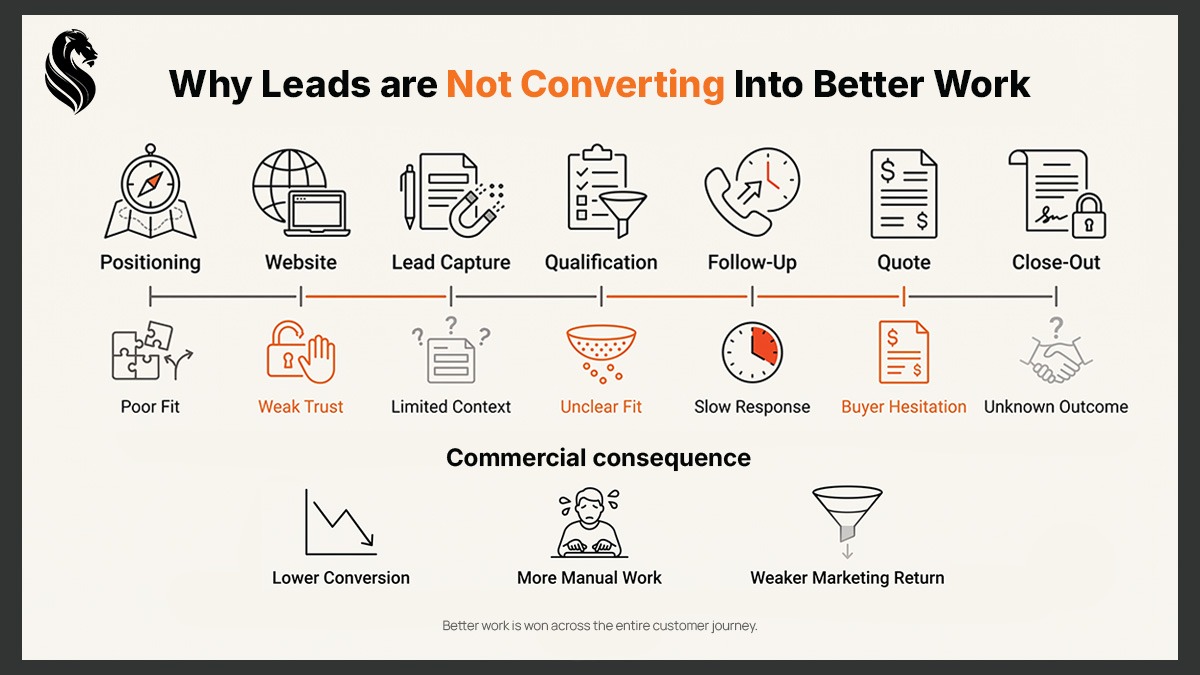
Conversion usually breaks down across several stages of the customer journey. Poor-fit enquiries, unclear positioning, weak trust, slow follow-up and inconsistent quoting can combine to reduce revenue and increase workload.
You Are Attracting the Wrong Enquiries
More leads do not automatically mean better opportunities.
If your messaging is too broad, your campaigns may attract people who want the cheapest option, fall outside your service area or are not suited to the work you want to win.
Lead quality begins before the enquiry. It is shaped by your positioning, offer, targeting and the claims made through your marketing.
When these are unclear, poor-fit prospects enter the system and consume time that could be spent on better opportunities.
Your Positioning Is Not Clear Enough
A prospect should quickly understand who you help, what problem you solve and why your business is the right choice.
If they cannot, they will struggle to see the value behind your price.
Weak positioning makes businesses look interchangeable. When every provider appears similar, the buyer compares quotes instead of outcomes.
Clear positioning helps the right customer recognise that your service was built for their situation.
Your Website Is Not Building Enough Trust
A website can generate enquiries without preparing prospects to buy.
Generic service descriptions, limited proof, weak case studies and unclear process information create uncertainty. The prospect may still make contact, but they arrive with more doubts and more questions.
That places additional pressure on the sales conversation and often pulls the owner back into explaining the business from the beginning.
A strong website should answer the most common buying questions before an enquiry is made. It should clarify who the service is for, explain the process and provide enough proof to reduce perceived risk.
Your Lead Capture Process Is Too Weak
A basic contact form may collect an enquiry, but it rarely provides enough information to qualify it.
Without context, every lead has to be reviewed manually. The business must then spend time finding out what the prospect needs, whether they are a suitable fit and how urgent the opportunity is.
A better lead capture process can identify service needs, location, project type, timing and other relevant indicators of fit before the first conversation.
The purpose is not to create more friction. It is to make the next step faster and more useful for both sides.
Your Follow-Up Is Too Slow
A strong enquiry can still be lost after it enters the business.
The lead may sit in an inbox. A call may not be returned. Nobody may be clearly responsible for following up. The prospect may move on to a business that responds sooner and makes the next step easier.
Lead generation and lead conversion are different responsibilities.
Marketing creates the opportunity. The follow-up system determines whether that opportunity progresses.
Your Sales Process Is Inconsistent
Good leads often go cold because the process after first contact is unclear.
Different team members may handle enquiries in different ways. Important information may not be recorded. Follow-up may depend on memory. Prospects may receive different messages depending on who answers.
This creates uncertainty for both the customer and the business. A clear sales process should define lead ownership, the next step after contact, follow-up timing and how progress is recorded.
Your Quoting Process Creates Friction
Sending a quote is not the same as managing a sale.
Quotes may take too long to prepare, contain too little explanation or arrive without a clear next step. The prospect is left to interpret the value and decide what to do next on their own.
This is where strong opportunities often stall.
A better quoting process explains the recommendation, reinforces its commercial value and defines the next action, such as a scheduled quote review or follow-up call.
Better Work Is Won Across the Entire Customer Journey
A lead becomes commercially valuable when the right prospect moves through a clear journey with enough trust, information and confidence to make a buying decision.
That journey begins long before the first call.
Your positioning shapes who pays attention. Your website influences whether they trust you. Your lead capture process determines what you know about them. Your follow-up affects whether their interest remains active. Your sales process, quote and close-out determine whether the opportunity becomes revenue.
The journey looks like this:
Positioning → Website → Lead Capture → Qualification → Follow-Up → Quote → Sales Handover and Close-Out
A weakness at any stage can reduce the value of everything that came before it.
A well-targeted campaign may bring the right prospect to your website. But if the message is unclear, they may leave. If the website builds trust but the form is too vague, the enquiry may arrive without enough context. If the lead is strong but nobody follows up quickly, the opportunity may cool. If the conversation goes well but the quote has no clear next step, the sale may stall.
In each case, the marketing created an opportunity.
The system failed to protect it.
Lead generation should not be separated from qualification, sales follow-up, quoting and reporting. Revenue depends on how effectively those stages work together.
Better work is won when the right prospects recognise the offer, trust the business, move through a simple process and receive consistent communication until the sale is complete.
That requires more than traffic.
It requires a customer journey built to convert.
How to Find the Real Conversion Problem
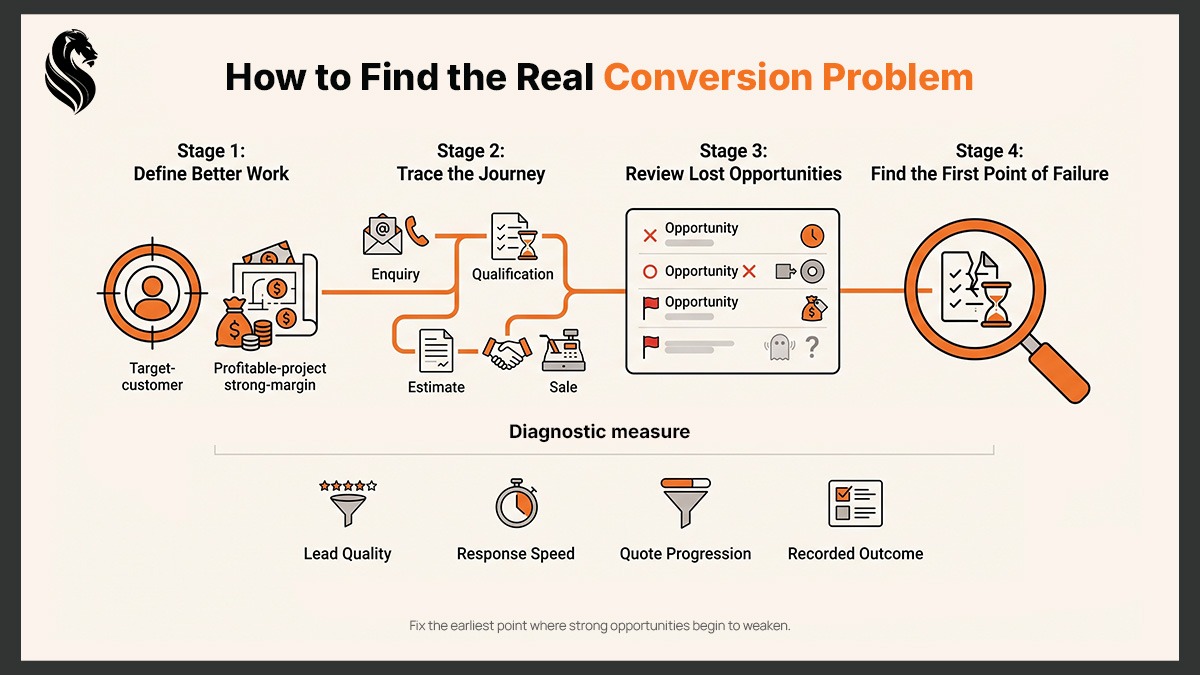
You cannot fix conversion by guessing.
Before changing campaigns or increasing spend, trace what happens from the first interaction through to the point where the opportunity is won or lost.
The goal is to identify the stage where clarity, trust, speed or accountability breaks down.
Review the Work and Leads You Actually Want
Start with the customers, projects or jobs the business wants more of.
Look at the work that is most profitable, best suited to the team and aligned with the direction of the business. Then compare that profile with the enquiries currently coming in.
If most leads do not resemble the work you want, the problem may begin with your positioning, offer or targeting.
Compare each lead source against qualified opportunities, sales, average project value and profitability. The channel generating the most enquiries may not be generating the most valuable work.
Trace the Journey From Enquiry to Quote
Map what actually happens after a prospect makes contact.
Where does the enquiry arrive? Who receives it? How quickly is it answered? What information is collected? How is fit assessed? When is a quote sent?
Review the website and lead capture process as part of this journey. The right prospect should understand who the business helps, why it is credible and what happens next before making contact.
A vague form or unclear handover creates extra work and makes strong opportunities harder to identify.
Examine Follow-Up and Lost Opportunities
Review how consistently leads and quotes are followed up.
Look for enquiries that sat unanswered, calls that were not returned and proposals that were sent without a clear next step.
Every opportunity should have an owner, a visible status and a defined follow-up action. The process should not depend on memory or the owner finding time.
Record why each opportunity was lost, including poor fit, price, slow response, competitor selected, no decision, or missed follow-up. A high number of unknown outcomes indicates weak sales visibility.
Find the First Point of Failure
Do not try to repair every stage at once.
Look for the earliest point where the customer journey consistently weakens. It may be poor-fit traffic, unclear positioning, weak trust, limited qualification, slow follow-up or a quoting process that allows opportunities to stall.
Speak with the people handling enquiries, preparing quotes and talking to prospects. Repeated questions, delays and objections often reveal where the system is failing.
Fixing the first point of failure can strengthen the stages that follow, although additional issues may still need to be addressed.
That is the purpose of diagnosis: to replace vague frustration with a clear commercial priority.
Fix the Foundation Before Increasing Lead Volume
More leads will not improve results if the system behind them is unclear, slow or inconsistent.
Before increasing marketing activity, identify where good opportunities are being weakened, delayed or lost across the customer journey.
Start with the essentials:
- Is your positioning clear enough to attract the right customer?
- Does your website explain the value of your service?
- Can prospects see proof that reduces the risk of choosing you?
- Does your enquiry process collect enough information to assess fit?
- Is every lead assigned to someone responsible for the next step?
- Are quotes followed up and outcomes recorded?
These questions matter because each part of the journey affects the next.
Weak positioning attracts poor-fit enquiries. A vague website creates uncertainty. Limited qualification wastes time. Slow follow-up allows interest to fade. Poor tracking hides the real reason opportunities are lost.
Once the problem is clear, build the system properly. This may involve sharpening the offer, improving key website pages, strengthening proof, qualifying enquiries more effectively, defining lead ownership, standardising follow-up and tracking sales outcomes.
Only increase lead volume when this foundation is working.
Once the foundation is working, additional traffic enters a system that can qualify, manage and convert it. Marketing performance can then be connected more clearly to sales outcomes.
Foundation first. Build properly. Then scale what works.
Better Leads Need a Better System
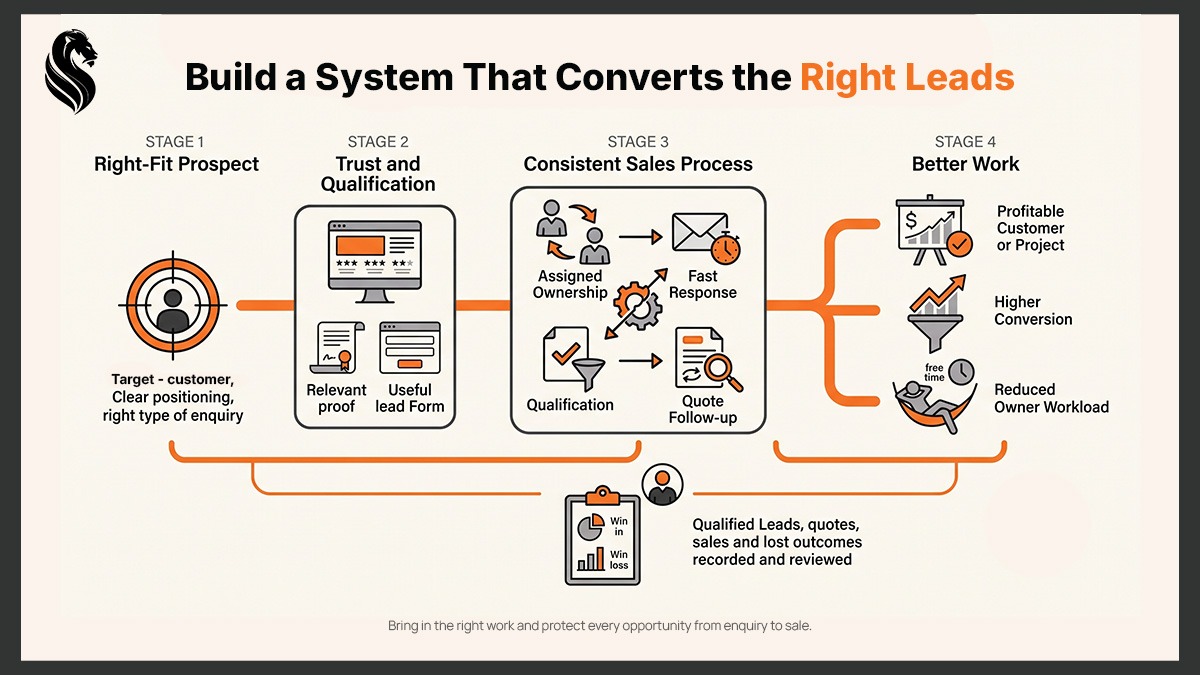
If your leads aren’t converting, the answer is not always more traffic.
The real issue may be the system those leads enter. Unclear positioning, weak qualification, slow follow-up, poor quoting and limited visibility can all reduce the value of a good enquiry before it becomes revenue.
That is why the foundation matters.
When the right prospects understand your value, trust the business, move through a clear process and receive consistent follow-up, conversion improves. Workload falls. Marketing becomes easier to measure. Better opportunities are less likely to be lost.
The goal is not simply to generate more leads.
It is to build a system that brings in the right work and protects every opportunity from first contact through to sale.
Find Out Where Your Leads Are Being Lost
A Wandering Lion Growth Audit reviews your positioning, website, customer journey, lead capture, follow-up, quoting and reporting to identify where strong opportunities are being lost and what should be fixed first.
Grow revenue. Reduce workload. Build the system that brings in the right work.
FAQs
Why are my leads not converting into sales?
Leads often fail to convert because the problem sits beyond lead generation. Unclear positioning, weak website trust, poor qualification, slow follow-up or an inconsistent quoting process can all reduce conversion. The first step is to identify where prospects are dropping out across the customer journey.
Should I generate more leads or improve conversion first?
Improve conversion first. More traffic will not solve a weak sales or follow-up system. Review the process of how leads are qualified, contacted, quoted and tracked before raising spend. Once the foundation is working, additional lead volume is more likely to produce better-fit work and measurable revenue.
How can I improve lead conversion without adding more workload?
Build a clearer system. Use better qualification forms, assign ownership for every enquiry, set response standards, track opportunities in a CRM and schedule quote follow-up. The changes mean less chasing by hand, better visibility, and easier focus of time on the leads most likely to convert.

More Traffic Cannot Fix a Weak Conversion System
Leads often fail to become profitable work because of weaknesses across positioning, website trust, qualification, follow-up, quoting and sales tracking. Before increasing marketing activity, identify where good opportunities are being lost, fix the foundation and build a customer journey that protects each lead through to sale.

Fix the Customer Journey Before Increasing Lead Volume
Generating more enquiries will not improve commercial results if the system behind them is unclear, slow or inconsistent. Better conversion comes from attracting the right prospects, managing each opportunity properly and scaling traffic only after the foundation is working.
More Leads Can Create More Waste
Increasing traffic into a weak conversion system can raise workload and marketing costs without producing more revenue. Clear positioning, qualification, follow-up and sales tracking must be in place first.
Conversion Breaks Across the Journey
Poor-fit enquiries, weak trust, vague forms, slow responses and inconsistent quoting can each reduce the value of a strong lead. The commercial outcome depends on how well every stage works together.
Diagnose the First Point of Failure
Trace each opportunity from initial enquiry through qualification, follow-up, quote and outcome. Reviewing lead quality, response times, ownership and lost-sale reasons reveals where the system is weakening.
Build the Foundation Before Scaling
Improve the offer, website, lead capture, sales ownership, quoting process and reporting before increasing campaign spend. Foundation First → Build Properly → Scale Predictably.

Find Out Where Your Best Leads Are Being Lost
A Wandering Lion Growth Audit reviews your positioning, website, customer journey, lead capture, follow-up, quoting and reporting to identify the real conversion bottlenecks. Start by fixing the system behind the leads so you can grow revenue, reduce workload and build a process that brings in the right work.
KEEP READING
Explore more





FEEDBACK FROM THE FIELD
No polished scripts. Just the raw operational reality from owners who cleaned up their pipelines and got out of the daily administrative loop.
“When we set out to grow Discmania in the US market, Ryan was a key part of laying that foundation. He helped us cut through the noise & restructured how we told the story of each release, aligning our athlete partnerships with the brand, and building the kind of community touchpoints that turned buyers into fans. The results spoke for themselves. I’d work with him again without hesitation.”



“In 2019, Ryan from Wandering Lion helped transform the Kalamunda Eastern Suns’ presence in the community. He lifted our social profile, drove some of the strongest brand engagement in the league, and helped turn sparse crowds into sellouts. His work also strengthened sponsor interest and raised the overall profile of the club in a way that felt polished, professional, and genuine.”

“Young people who had switched off from school were not going to reconnect because of a campaign headline or a polished message. They needed a genuine reason to turn up again. Wandering Lion brought a strong sense of care to how the story was told. That gave the foundation a clearer public identity.”





“Working with Wandering Lion on the Discmania project was a standout experience. The team’s position work, blended creative vision with strategic execution, was a major asset as we built the Discmania brand globally. The work he produced didn’t just look great. It elevated our brand presence and supported measurable growth across multiple markets.”




“Wandering Lion understood from the outset that the Pacific Hockey League could not simply be another competition with a new name. Their work helped shape a player-first league with the right balance of ambition, fairness, and professionalism. What they brought was not just branding or communication, but real strategic thinking that gave the PHL a stronger and more credible foundation.”

“Authenticity is the centrepiece of all Lajosi Putter customisation works. The brand is reflected in each of our hand-made custom putters. Ryan’s team solidified that identity in our online presence. It led to higher social media engagement from a golfing community who value hand-crafted putters over overly polished ones.”

‹
›
READY TO FIX YOUR GROWTH?
Stop guessing. Get clarity on what's actually slowing your business down.
