

Australia’s Small Business AI Gap Is Integration
Australian small businesses are adopting AI, but many are still not integrating it into the parts of the business where it can make the biggest difference.
The Council of Small Business Organisations Australia (COSBOA) has warned that Australia risks leaving small businesses behind in the AI race. National AI Centre research found 43% of Australian SMEs had adopted AI to some degree, while COSBOA reported that only 14% had integrated AI into their operations or services. While the figures come from different research, they point to an important distinction between using AI and embedding it into how a business operates.
That gap matters.
Using ChatGPT to write social posts or draft emails can save time, but it does not fundamentally change how a business operates. The bigger opportunity is using AI to reduce administration, improve follow-up, strengthen workflows and remove friction from the customer journey.
Using ChatGPT Isn’t the Same as Having an AI Strategy

COSBOA’s warning highlights an important distinction between experimenting with AI and actually integrating it into a business.
COSBOA’s research suggests the issue is not simply willingness to adopt new technology. Small business owners can be time-poor, unsure where to begin or uncertain about how AI applies practically to their business.
That helps explain why much of the experimentation is happening in accessible areas such as social media, content and marketing.
Using ChatGPT for everyday content tasks can certainly save time. But COSBOA argues that the greater productivity opportunity comes when AI is embedded into business processes in ways that reduce friction and improve efficiency.
For a small business, that means looking beyond content creation and asking where AI could remove repetitive work, improve consistency, and support better day-to-day operations.
That is the difference between using an AI tool and building an AI strategy.
The Real AI Opportunity Is Inside the Customer Journey
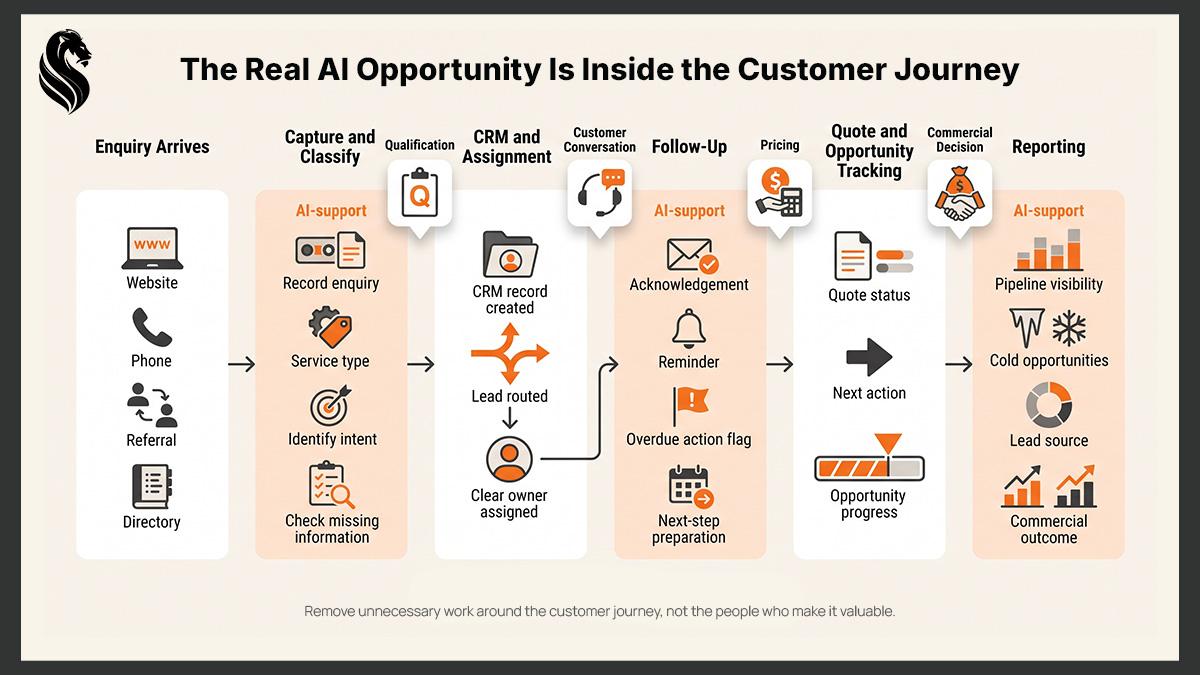
For small businesses, one of the clearest places to look for those opportunities is inside the customer journey.
Look at what happens when an enquiry arrives. Who reviews it? Where is the information recorded? How is the lead qualified and assigned? Who follows up? What happens after a quote is sent? How does the owner know which opportunities are progressing and which have gone cold?
These are often the points where manual administration builds up, and valuable opportunities are lost.
Standard automation can capture an enquiry, create a CRM record, assign it using predefined rules and trigger follow-up reminders. AI can add value where information needs interpreting—for example, identifying the intent of a free-text enquiry, summarising customer requirements or drafting a response for review. Together, these capabilities can reduce manual administration while the team retains responsibility for commercial decisions.
The opportunity is not to remove people from the customer journey. It is to remove unnecessary work around them.
For owner-led businesses, that matters because a better customer journey should do more than generate leads. It should reduce workload while helping more of the right enquiries move through to a commercial outcome.
What AI Integration Actually Looks Like in a Small Business
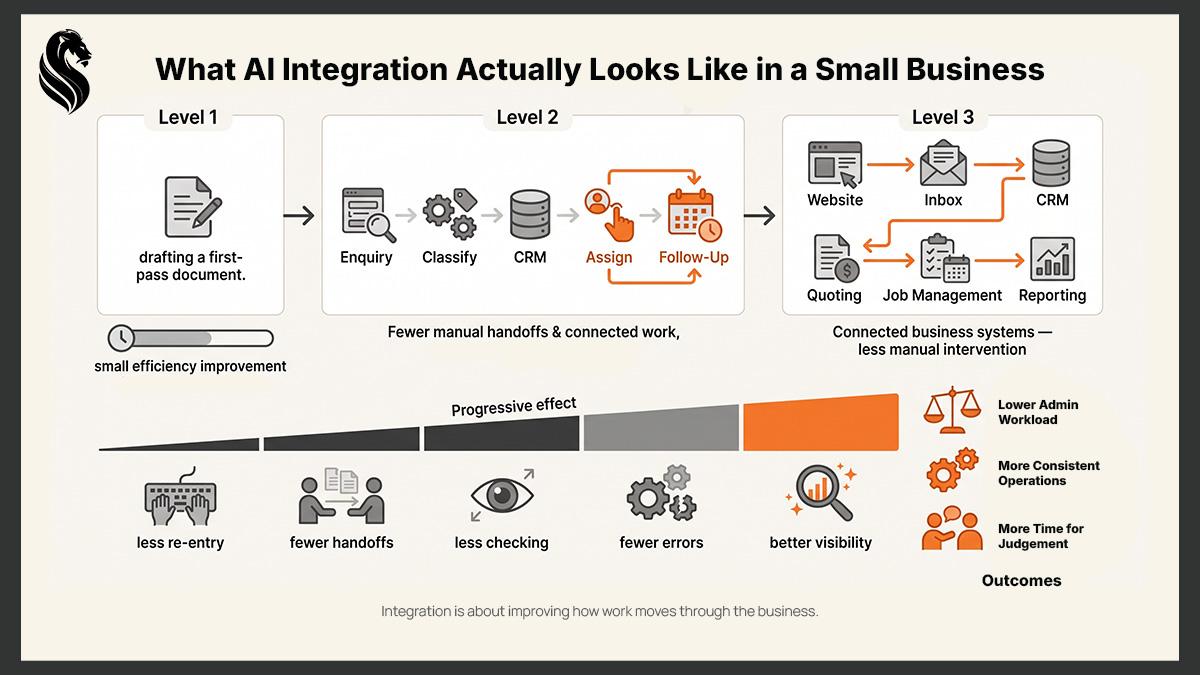
AI integration does not have to mean rebuilding the entire business around new technology.
In many small businesses, the opportunity is much simpler: improve the processes that already exist.
AI integration can happen at several levels, from improving a single task to supporting an entire workflow or connecting information across multiple business systems. The more disconnected those steps are, the more time the business spends transferring information, checking progress and correcting avoidable errors.
The goal of integration is to reduce the handoffs between people and systems, so information can move through the business with less manual intervention.
At the workflow level, automation can move an enquiry from a website form into the CRM and flag overdue actions, while AI can help interpret the request and prepare a useful summary or draft response. Across the business, connected systems provide the information AI needs to identify patterns and highlight issues for review. The right solution may combine standard automation and AI, depending on the task.
The goal is to remove repetitive administration around the customer journey so the team can spend more time on work that still requires judgement, relationships and commercial decision-making.
Small Businesses Don’t Need More AI Tools
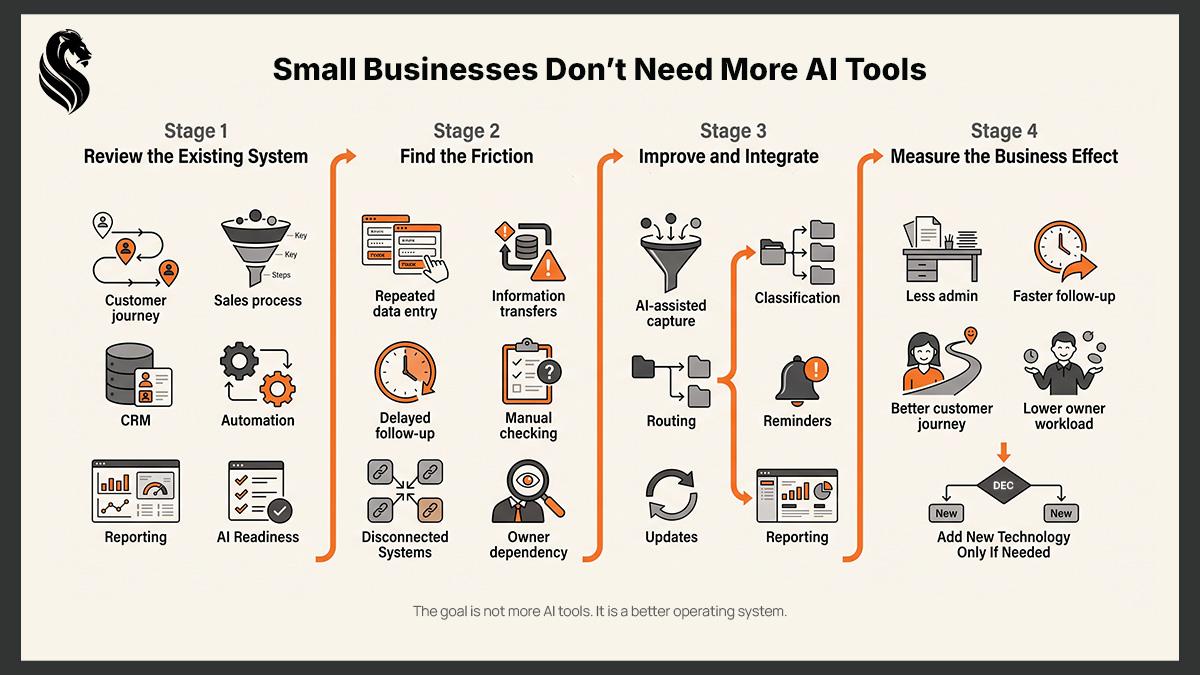
The next stage of AI adoption should be measured by what changes inside the business, not by how many AI tools an owner has started using.
For owners, the more useful questions are what work AI removes, which processes it improves and whether those changes reduce workload or support better commercial outcomes.
At Wandering Lion, we start by reviewing the customer journey, sales process, CRM, automation, reporting and AI readiness to identify where technology can genuinely reduce workload or improve commercial performance. The priority is to fix, connect and improve the existing system before deciding whether additional technology is needed.
If your business is exploring AI but you are not sure where it belongs, Wandering Lion can help identify the gaps, prioritise the highest-value opportunities and build a practical roadmap around the systems you already have.
FAQs
What is an AI strategy for a small business?
A small business AI strategy identifies where AI can improve real business processes, not just content creation. That could include reducing administration, improving workflows, supporting customer service and making better use of business data. The goal is to reduce workload, improve consistency and make the business operate more efficiently.
Where should a small business start with AI integration?
Start by reviewing the customer journey and identifying where information is being re-entered, delayed or checked manually. Assess whether each problem needs a clearer process, standard automation or AI. Use AI where interpreting, summarising or generating information adds value, and measure whether it saves time without compromising accuracy or customer experience.
Does a small business need more AI tools to improve productivity?
Not necessarily. Many businesses already have the core platforms they need. The bigger issue is often poor integration between existing systems. Before adding new tools, businesses should assess where processes break down and whether AI can improve the systems already in place.

AI Creates More Value When It Is Integrated Into the Business
The main AI gap for Australian small businesses is not access to tools. It is the lack of integration into customer journeys, workflows and operational systems where AI can reduce administration, improve consistency and support better commercial outcomes. The strategic response is to review how the business currently operates, identify the highest-value points of friction, and improve the existing system before adding more technology.

AI Strategy Should Improve How the Business Operates
Using AI for content and emails can save time, but the larger opportunity is integrating it into the processes that move information, enquiries and work through the business. Small businesses should focus on reducing operational friction and workload rather than simply accumulating more AI tools.
Using AI Is Not the Same as Integrating It
Experimenting with ChatGPT for social posts, emails, or content ideas can improve individual tasks, but it does not create an AI strategy. A useful strategy identifies where AI can remove repetitive work, improve consistency and strengthen day-to-day operations.
Start With the Customer Journey
Enquiry handling, lead qualification, CRM updates, follow-up, quoting and reporting are common points where manual work builds up, and opportunities are lost. AI can support these processes without removing the people, judgement and relationships that still matter.
Integration Means Improving Existing Workflows
Small businesses do not need to rebuild everything around AI. The opportunity is often to connect existing processes and systems more effectively, reduce unnecessary handoffs and keep information moving with less manual intervention.
Fix the System Before Adding More Tools
Productivity will not come from the number of AI platforms a business uses. It comes from identifying where work is being duplicated, delayed or manually managed, then improving the customer journey, CRM, automation, reporting and AI readiness around those problems.

Find Where AI Can Remove Real Workload
Before adding another AI tool, identify where administration, disconnected systems and manual follow-up are slowing the business down. A Wandering Lion Growth Audit can review your customer journey, sales process, CRM, automation, reporting and AI readiness to identify the highest-value opportunities and build a practical roadmap around the systems you already have.
KEEP READING
Explore more





FEEDBACK FROM THE FIELD
No polished scripts. Just the raw operational reality from owners who cleaned up their pipelines and got out of the daily administrative loop.
“When we set out to grow Discmania in the US market, Ryan was a key part of laying that foundation. He helped us cut through the noise & restructured how we told the story of each release, aligning our athlete partnerships with the brand, and building the kind of community touchpoints that turned buyers into fans. The results spoke for themselves. I’d work with him again without hesitation.”



“In 2019, Ryan from Wandering Lion helped transform the Kalamunda Eastern Suns’ presence in the community. He lifted our social profile, drove some of the strongest brand engagement in the league, and helped turn sparse crowds into sellouts. His work also strengthened sponsor interest and raised the overall profile of the club in a way that felt polished, professional, and genuine.”

“Young people who had switched off from school were not going to reconnect because of a campaign headline or a polished message. They needed a genuine reason to turn up again. Wandering Lion brought a strong sense of care to how the story was told. That gave the foundation a clearer public identity.”





“Working with Wandering Lion on the Discmania project was a standout experience. The team’s position work, blended creative vision with strategic execution, was a major asset as we built the Discmania brand globally. The work he produced didn’t just look great. It elevated our brand presence and supported measurable growth across multiple markets.”




“Wandering Lion understood from the outset that the Pacific Hockey League could not simply be another competition with a new name. Their work helped shape a player-first league with the right balance of ambition, fairness, and professionalism. What they brought was not just branding or communication, but real strategic thinking that gave the PHL a stronger and more credible foundation.”

“Authenticity is the centrepiece of all Lajosi Putter customisation works. The brand is reflected in each of our hand-made custom putters. Ryan’s team solidified that identity in our online presence. It led to higher social media engagement from a golfing community who value hand-crafted putters over overly polished ones.”

‹
›
READY TO FIX YOUR GROWTH?
Stop guessing. Get clarity on what's actually slowing your business down.
