

GEO Has Moved Faster Than Business Structures
Generative engine optimisation has moved from a technical discussion to a practical business concern. A company’s visibility is no longer determined only by where its website ranks. It is also shaped by what AI assistants can find, understand and verify about the business across its website, media coverage and independent sources.
New research shows that organisations recognise the change but have not yet established clear ownership. Muck Rack’s 2026 State of PR report surveyed 1,115 PR professionals and found that 73% consider GEO at least somewhat important to their communications strategy. Yet 29% said nobody in their organisation is responsible for it.
That gap matters because GEO crosses several business functions. One person or team should own the strategy and reporting, while SEO, PR, brand, content, website, sales and analytics contribute to the same system. Effective generative engine optimisation handling requires clear positioning, structured information, expert content, earned authority, credible third-party proof and commercial measurement.
Muck Rack Report Reveals a Growing GEO Responsibility Gap

Muck Rack surveyed 1,115 PR professionals between 14 May and 12 June 2026 to examine how the industry is responding to artificial intelligence, GEO, earned media and changing audience behaviour.
The results reveal a sharp contrast. While 73% of respondents said GEO was at least somewhat important to their communications strategy, 29% reported that nobody in their organisation was responsible for it. Only 24% placed responsibility with PR or communications, while 11% said it sat with marketing leadership.
The problem is not awareness. It is ownership and coordination. Many organisations still lack an operating model that turns awareness of AI-powered discovery into coordinated action.
Responsibility Is Divided Across Departments
GEO spans several established functions, which makes sole departmental ownership impractical.
SEO teams can improve website structure, technical accessibility and the clarity of online information. Communications teams can secure authoritative media coverage and strengthen public credibility. Marketing teams can shape demand, manage campaigns and measure what happens after a prospective customer discovers the business.
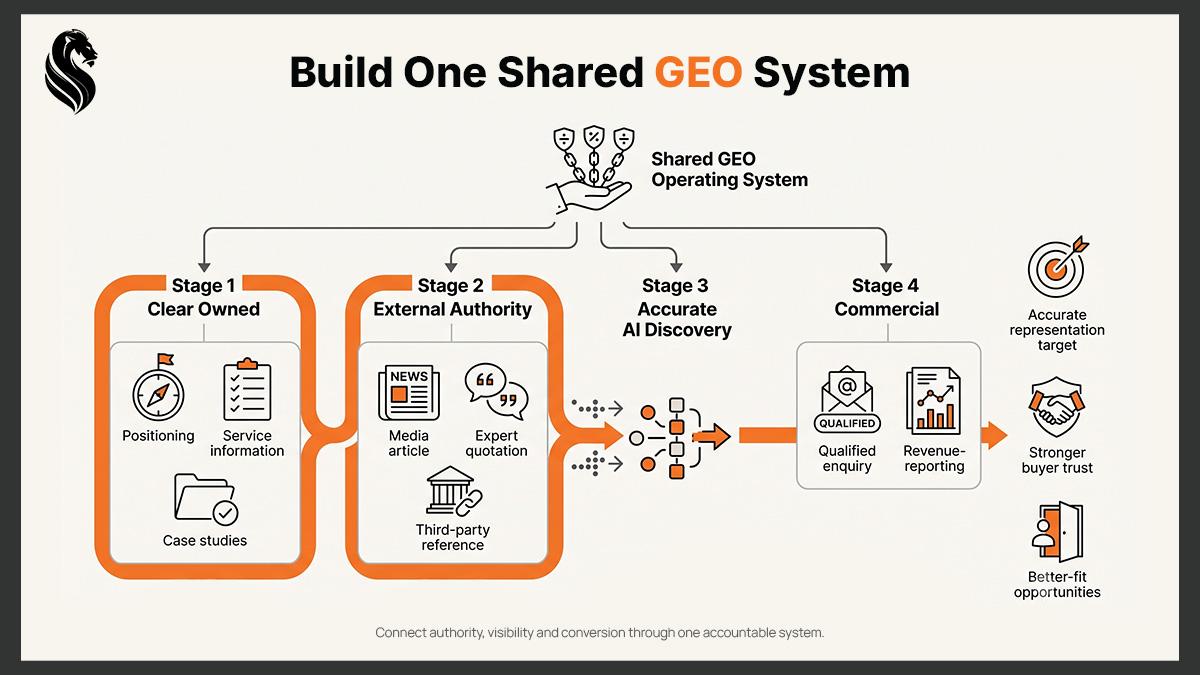
Each function controls part of the result, so GEO needs one accountable lead and a shared operating model rather than isolated departmental activity.
Axios reported that GEO revolves around the sources AI platforms use to answer questions. These include authoritative earned media, clear and well-structured information on official websites and credible third-party references.
Muck Rack also found that 55% of communications professionals were actively seeking coverage from high-authority publications to improve their visibility in AI-generated responses.
This creates a practical coordination problem. A company may publish technically strong website content while presenting inconsistent positioning in the media. It may secure valuable coverage without connecting that authority to a relevant landing page, lead-capture process or sales follow-up system. It may also increase AI visibility without tracking whether the attention produces qualified enquiries, opportunities or revenue.
GEO Exposes Disconnected Business Systems
The responsibility gap is a symptom of a larger weakness. Many organisations still manage positioning, website content, public relations, expert commentary, third-party proof and conversion reporting as separate activities. GEO exposes the cost of that fragmentation because AI platforms can draw information from all of them.
Publishing more articles or adding another reporting dashboard will not solve the problem. Information must be clear, claims must be supported, external sources must reinforce the intended position, and the customer journey must be capable of turning discovery into action.
The strongest response is not a departmental contest. It is a shared system led by one accountable owner, with agreed responsibilities, connected inputs and commercial measures. ContentGrip argues that GEO should be treated as a shared capability, with PR shaping credible inputs and marketing assessing downstream commercial impact.
Why GEO Now Matters to Organisations and Commercial Growth
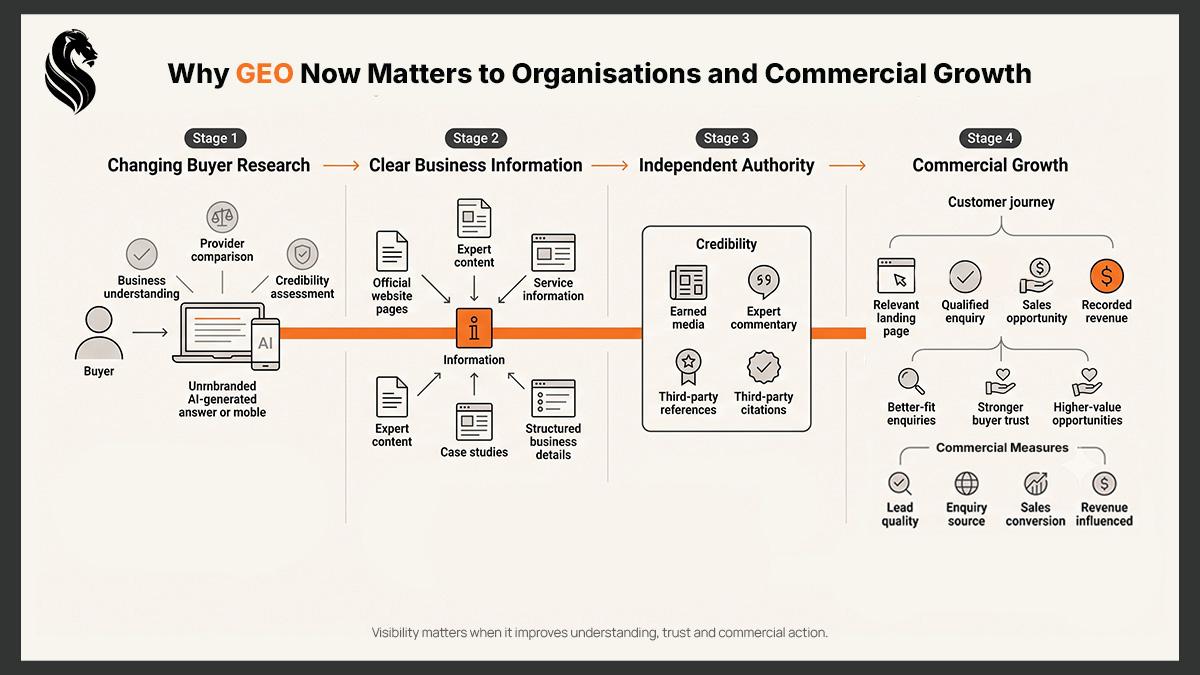
Generative engine optimisation matters because AI is changing how people research businesses, compare providers and decide who to trust. Visibility is now influenced by the information AI platforms can find and verify across websites, media coverage, expert commentary, reviews, case studies and other credible sources.
GEO therefore affects how accurately a business is understood, how credible it appears and whether discovery leads to a commercial opportunity.
Buyer Behaviour Is Changing
For some buyers, an AI-generated answer may shape their first impression of a business before they visit its website.
AI tools can summarise what a company does, compare it with competitors and surface external evidence that influences how credible it appears. If the information available is vague, inconsistent or poorly supported, the business may be misrepresented or left out altogether.
GEO is therefore not just about appearing in an answer. It is about giving AI platforms enough clear and credible information to describe the business accurately.
Proof Carries More Weight
A website can explain an offer, but it cannot provide every form of proof on its own.
Owned proof, such as expert content and case studies, should demonstrate expertise and results. Independent proof, such as media coverage, reviews and reputable directories, should reinforce the same position. AI-powered search draws information from a wider range of sources.
When these sources align, AI platforms and prospective customers get a clearer, more credible picture of the business.
Visibility Must Support Growth
Mentions and citations may indicate improved visibility, but they do not prove commercial value. Organisations should measure the full path from AI visibility to relevant website visits, qualified enquiries, sales opportunities and revenue.
Visibility alone is not enough. A business may appear in AI-generated answers and still lose the opportunity through weak landing pages, poor lead capture, slow follow-up or unclear sales ownership.
That is why GEO should connect positioning, website structure, content, proof, conversion, sales follow-up and reporting.
The organisations that make those connections will be in a stronger position to turn AI visibility into trust, enquiries and revenue.
How Wandering Lion Helps Businesses Strengthen GEO
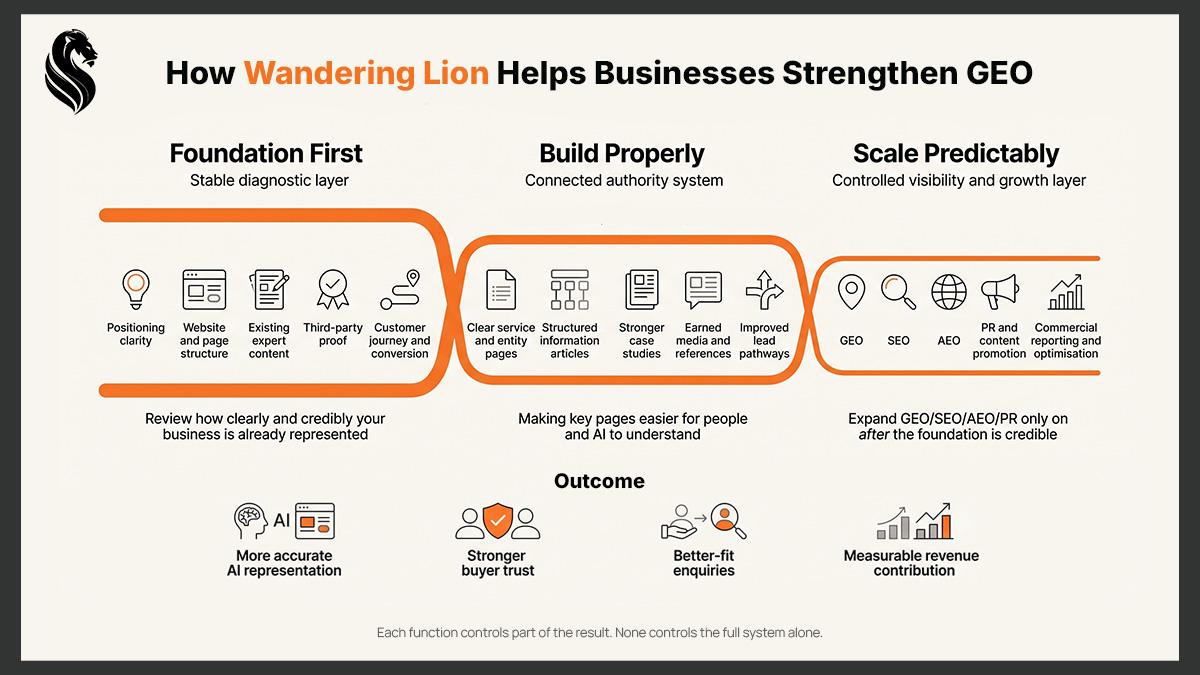
Wandering Lion follows a clear growth sequence: Foundation First → Build Properly → Scale Predictably.
It reviews positioning, website structure, proof, customer journey, sales follow-up and reporting before recommending broader SEO, AEO, PR or content activity.
That starts with a clear position. The website needs to explain what the business does, who it helps and why it is credible. Expert content, case studies, media coverage and third-party references should all support the same message.
Wandering Lion reviews these areas together rather than treating GEO as a separate marketing task. This helps uncover weak messaging, missing proof, unclear website pages and gaps between visibility, enquiry and sales follow-up.
Once those issues are clear, the next step is to strengthen the content, structure and proof around the business. That may mean improving key pages, developing stronger expert content, sharpening case studies or making it easier for potential customers to take action.
Only after the foundations, customer journey, follow-up systems and reporting mechanisms are ready should the business invest more heavily in SEO, AEO, PR or content promotion.
The aim is to help AI platforms understand the business, help customers trust it and create a measurable route from discovery to qualified enquiry and sale.
Want to see where your GEO gaps are? Book a growth audit with Wandering Lion and get a practical plan for improving visibility, trust and conversion.
FAQs
What is generative engine optimisation?
Generative engine optimisation improves how clearly AI tools can find, understand and describe a business. It strengthens and aligns website content, expert insight, media coverage, reviews, case studies and other trusted sources so AI-generated answers are more likely to represent the company accurately and credibly.
Why is GEO important for businesses?
GEO matters because buyers are increasingly using AI tools to research services, compare providers and assess credibility. Strong GEO can improve accurate visibility and build trust earlier, but its commercial value depends on a customer journey that turns discovery into qualified enquiries and revenue.
Who should manage GEO in an organisation?
GEO should have one accountable owner, but it should not sit with SEO, PR or marketing alone. Brand, content, communications, website, sales and reporting teams should contribute to one shared strategy, message and measurement framework.

GEO Needs One Accountable Owner and One Connected Growth System
Generative engine optimisation becomes ineffective when SEO, PR, brand, content, website, sales and reporting operate as separate activities. The commercial opportunity is to give GEO one accountable owner, align every contributing function around the same positioning and proof, and connect AI visibility to a customer journey that can turn discovery into qualified enquiries and revenue.

GEO Is a Business System, Not a Departmental Marketing Task
AI-powered discovery is changing how businesses are found, understood and trusted, but visibility alone does not create commercial value. Effective GEO connects clear positioning, credible proof, website structure, customer journey, sales follow-up and reporting under one coordinated operating model.
Ownership Must Be Clear
GEO crosses SEO, PR, marketing, brand, content, sales and analytics, so assigning it entirely to one specialist department creates gaps. One accountable lead should own the strategy and reporting while each function contributes to the same system.
Disconnected Systems Weaken GEO
AI platforms draw information from websites, media coverage, expert commentary and third-party sources, exposing inconsistencies that businesses could previously manage separately. Strong GEO requires those inputs to reinforce the same position and connect into a functioning customer journey.
Visibility Must Lead Somewhere Commercially
AI mentions and citations matter only when they contribute to relevant visits, qualified enquiries, sales opportunities and revenue. Weak landing pages, poor lead capture or slow follow-up can waste the value created by stronger AI visibility.
Foundation First Before GEO Scale
Businesses should strengthen positioning, website structure, proof, customer journey, follow-up and reporting before increasing investment in SEO, AEO, PR or content promotion. The aim is to help AI platforms understand the business, help buyers trust it and build a measurable path from discovery to sale.

Find the GEO Gaps Before You Scale Visibility
A Growth Audit can show where unclear positioning, weak proof, disconnected website journeys or poor follow-up are limiting the value of your current visibility. Wandering Lion reviews the system first, then builds a practical sequence for strengthening authority, conversion and measurement before recommending broader SEO, AEO, PR or content investment.
KEEP READING
Explore more









FEEDBACK FROM THE FIELD
No polished scripts. Just the raw operational reality from owners who cleaned up their pipelines and got out of the daily administrative loop.
“When we set out to grow Discmania in the US market, Ryan was a key part of laying that foundation. He helped us cut through the noise & restructured how we told the story of each release, aligning our athlete partnerships with the brand, and building the kind of community touchpoints that turned buyers into fans. The results spoke for themselves. I’d work with him again without hesitation.”



“In 2019, Ryan from Wandering Lion helped transform the Kalamunda Eastern Suns’ presence in the community. He lifted our social profile, drove some of the strongest brand engagement in the league, and helped turn sparse crowds into sellouts. His work also strengthened sponsor interest and raised the overall profile of the club in a way that felt polished, professional, and genuine.”

“Young people who had switched off from school were not going to reconnect because of a campaign headline or a polished message. They needed a genuine reason to turn up again. Wandering Lion brought a strong sense of care to how the story was told. That gave the foundation a clearer public identity.”





“Working with Wandering Lion on the Discmania project was a standout experience. The team’s position work, blended creative vision with strategic execution, was a major asset as we built the Discmania brand globally. The work he produced didn’t just look great. It elevated our brand presence and supported measurable growth across multiple markets.”




“Wandering Lion understood from the outset that the Pacific Hockey League could not simply be another competition with a new name. Their work helped shape a player-first league with the right balance of ambition, fairness, and professionalism. What they brought was not just branding or communication, but real strategic thinking that gave the PHL a stronger and more credible foundation.”

“Authenticity is the centrepiece of all Lajosi Putter customisation works. The brand is reflected in each of our hand-made custom putters. Ryan’s team solidified that identity in our online presence. It led to higher social media engagement from a golfing community who value hand-crafted putters over overly polished ones.”

‹
›
READY TO FIX YOUR GROWTH?
Stop guessing. Get clarity on what's actually slowing your business down.
